 Add to Chrome
 Add to Firefox
 Add to Edge
A general framework for adaptive nonparametric dimensionality reduction
Nov 12, 2025
Dimensionality reduction is a fundamental task in modern data science. Several projection methods specifically tailored to take into account the non-linearity of the data via local embeddings have been proposed. Such methods are often based on local neighbourhood structures and require tuning the number of neighbours that define this local structure, and the dimensionality of the lower-dimensional space onto which the data are projected. Such choices critically influence the quality of the resulting embedding. In this paper, we exploit a recently proposed intrinsic dimension estimator which also returns the optimal locally adaptive neighbourhood sizes according to some desirable criteria. In principle, this adaptive framework can be employed to perform an optimal hyper-parameter tuning of any dimensionality reduction algorithm that relies on local neighbourhood structures. Numerical experiments on both real-world and simulated datasets show that the proposed method can be used to significantly improve well-known projection methods when employed for various learning tasks, with improvements measurable through both quantitative metrics and the quality of low-dimensional visualizations.

Are LLMs effective psychological assessors? Leveraging adaptive RAG for interpretable mental health screening through psychometric practice
Jan 02, 2025
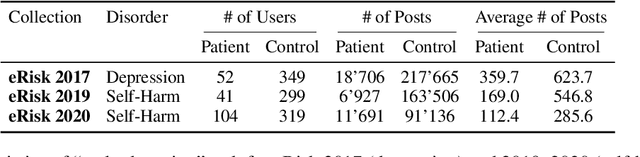


In psychological practice, standardized questionnaires serve as essential tools for assessing mental constructs (e.g., attitudes, traits, and emotions) through structured questions (aka items). With the increasing prevalence of social media platforms where users share personal experiences and emotions, researchers are exploring computational methods to leverage this data for rapid mental health screening. In this study, we propose a novel adaptive Retrieval-Augmented Generation (RAG) approach that completes psychological questionnaires by analyzing social media posts. Our method retrieves the most relevant user posts for each question in a psychological survey and uses Large Language Models (LLMs) to predict questionnaire scores in a zero-shot setting. Our findings are twofold. First we demonstrate that this approach can effectively predict users' responses to psychological questionnaires, such as the Beck Depression Inventory II (BDI-II), achieving performance comparable to or surpassing state-of-the-art models on Reddit-based benchmark datasets without relying on training data. Second, we show how this methodology can be generalized as a scalable screening tool, as the final assessment is systematically derived by completing standardized questionnaires and tracking how individual item responses contribute to the diagnosis, aligning with established psychometric practices.
The Emotional Spectrum of LLMs: Leveraging Empathy and Emotion-Based Markers for Mental Health Support
Dec 28, 2024The increasing demand for mental health services has highlighted the need for innovative solutions, particularly in the realm of psychological conversational AI, where the availability of sensitive data is scarce. In this work, we explored the development of a system tailored for mental health support with a novel approach to psychological assessment based on explainable emotional profiles in combination with empathetic conversational models, offering a promising tool for augmenting traditional care, particularly where immediate expertise is unavailable. Our work can be divided into two main parts, intrinsecaly connected to each other. First, we present RACLETTE, a conversational system that demonstrates superior emotional accuracy compared to state-of-the-art benchmarks in both understanding users' emotional states and generating empathetic responses during conversations, while progressively building an emotional profile of the user through their interactions. Second, we show how the emotional profiles of a user can be used as interpretable markers for mental health assessment. These profiles can be compared with characteristic emotional patterns associated with different mental disorders, providing a novel approach to preliminary screening and support.