 Add to Chrome
 Add to Firefox
 Add to Edge
Enhancing Human-Likeness in Reinforcement Learning Agents via Hierarchical Macro Action Quantization
May 29, 2026
Human-like agents are a long-standing goal of artificial intelligence. Despite strong performance, most reinforcement learning (RL) agents remain reward-driven and often exhibit behaviors that differ from humans, limiting interpretability and reliability. In this work, we introduce a novel human-like RL framework that predicts action sequences closely aligned with human behaviors while maximizing rewards. Specifically, we encode human demonstrations into macro actions using a hierarchical macro action quantization approach (termed HiMAQ) consisting of two successive levels of vector quantization. The lower quantization level maps input actions to fine-grained subaction clusters, while the higher quantization level aggregates these subaction clusters into action clusters. Extensive evaluations on the D4RL benchmarks show that our hierarchical approach outperforms the non-hierarchical baseline (MAQ), achieving better human-likeness scores while maintaining comparable or better success rates than previous RL agents. The improvements generalize across integrations with various RL algorithms, namely IQL, SAC, and RLPD.

A Hierarchical Spatiotemporal Action Tokenizer for In-Context Imitation Learning in Robotics
Apr 16, 2026We present a novel hierarchical spatiotemporal action tokenizer for in-context imitation learning. We first propose a hierarchical approach, which consists of two successive levels of vector quantization. In particular, the lower level assigns input actions to fine-grained subclusters, while the higher level further maps fine-grained subclusters to clusters. Our hierarchical approach outperforms the non-hierarchical counterpart, while mainly exploiting spatial information by reconstructing input actions. Furthermore, we extend our approach by utilizing both spatial and temporal cues, forming a hierarchical spatiotemporal action tokenizer, namely HiST-AT. Specifically, our hierarchical spatiotemporal approach conducts multi-level clustering, while simultaneously recovering input actions and their associated timestamps. Finally, extensive evaluations on multiple simulation and real robotic manipulation benchmarks show that our approach establishes a new state-of-the-art performance in in-context imitation learning.
Unsupervised Skeleton-Based Action Segmentation via Hierarchical Spatiotemporal Vector Quantization
Apr 16, 2026We propose a novel hierarchical spatiotemporal vector quantization framework for unsupervised skeleton-based temporal action segmentation. We first introduce a hierarchical approach, which includes two consecutive levels of vector quantization. Specifically, the lower level associates skeletons with fine-grained subactions, while the higher level further aggregates subactions into action-level representations. Our hierarchical approach outperforms the non-hierarchical baseline, while primarily exploiting spatial cues by reconstructing input skeletons. Next, we extend our approach by leveraging both spatial and temporal information, yielding a hierarchical spatiotemporal vector quantization scheme. In particular, our hierarchical spatiotemporal approach performs multi-level clustering, while simultaneously recovering input skeletons and their corresponding timestamps. Lastly, extensive experiments on multiple benchmarks, including HuGaDB, LARa, and BABEL, demonstrate that our approach establishes a new state-of-the-art performance and reduces segment length bias in unsupervised skeleton-based temporal action segmentation.
Video LLMs for Temporal Reasoning in Long Videos
Dec 04, 2024



This paper introduces TemporalVLM, a video large language model capable of effective temporal reasoning and fine-grained understanding in long videos. At the core, our approach includes a visual encoder for mapping a long-term input video into features which are time-aware and contain both local and global cues. In particular, it first divides the input video into short-term clips, which are jointly encoded with their timestamps into time-sensitive local features. Next, the local features are passed through a bidirectional long short-term memory module for global feature aggregation. The extracted time-aware and multi-level features are important for accurate temporal reasoning and fine-grained understanding in long videos. Moreover, to facilitate the evaluation of TemporalVLM, we present a large-scale long video dataset of industry assembly processes, namely IndustryASM, which consists of videos recorded on factory floors with actions and timestamps annotated by industrial engineers for time and motion studies and temporal action segmentation evaluation. Finally, extensive experiments on datasets of long videos, including TimeIT and IndustryASM, show that TemporalVLM achieves superior performance than previous methods across temporal reasoning and fine-grained understanding tasks, namely dense video captioning, temporal video grounding, video highlight detection, and temporal action segmentation.
Action Segmentation Using 2D Skeleton Heatmaps
Sep 19, 2023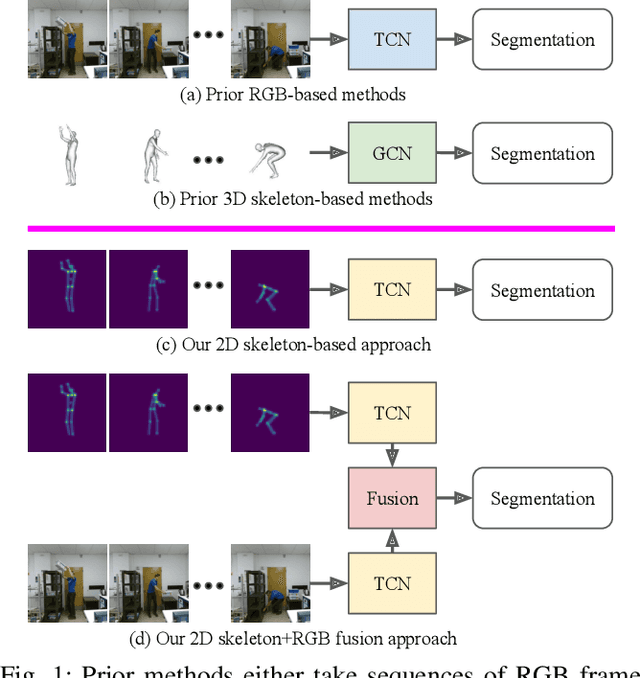
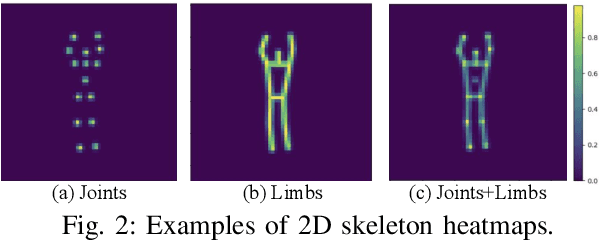
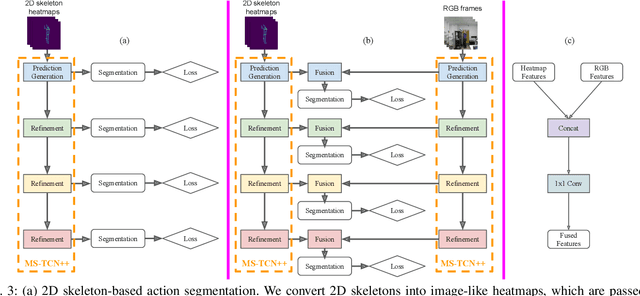
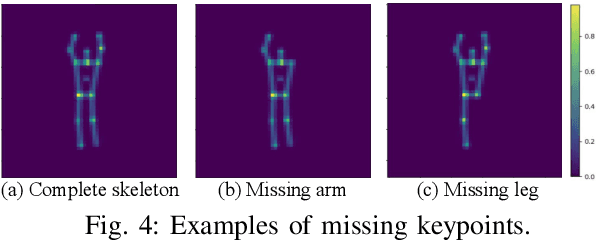
This paper presents a 2D skeleton-based action segmentation method with applications in fine-grained human activity recognition. In contrast with state-of-the-art methods which directly take sequences of 3D skeleton coordinates as inputs and apply Graph Convolutional Networks (GCNs) for spatiotemporal feature learning, our main idea is to use sequences of 2D skeleton heatmaps as inputs and employ Temporal Convolutional Networks (TCNs) to extract spatiotemporal features. Despite lacking 3D information, our approach yields comparable/superior performances and better robustness against missing keypoints than previous methods on action segmentation datasets. Moreover, we improve the performances further by using both 2D skeleton heatmaps and RGB videos as inputs. To our best knowledge, this is the first work to utilize 2D skeleton heatmap inputs and the first work to explore 2D skeleton+RGB fusion for action segmentation.