 Add to Chrome
 Add to Firefox
 Add to Edge
Practical Geometric and Quantum Kernel Methods for Predicting Skeletal Muscle Outcomes in chronic obstructive pulmonary disease
Jan 01, 2026
Skeletal muscle dysfunction is a clinically relevant extra-pulmonary manifestation of chronic obstructive pulmonary disease (COPD) and is closely linked to systemic and airway inflammation. This motivates predictive modelling of muscle outcomes from minimally invasive biomarkers that can be acquired longitudinally. We study a small-sample preclinical dataset comprising 213 animals across two conditions (Sham versus cigarette-smoke exposure), with blood and bronchoalveolar lavage fluid measurements and three continuous targets: tibialis anterior muscle weight (milligram: mg), specific force (millinewton: mN), and a derived muscle quality index (mN per mg). We benchmark tuned classical baselines, geometry-aware symmetric positive definite (SPD) descriptors with Stein divergence, and quantum kernel models designed for low-dimensional tabular data. In the muscle-weight setting, quantum kernel ridge regression using four interpretable inputs (blood C-reactive protein, neutrophil count, bronchoalveolar lavage cellularity, and condition) attains a test root mean squared error of 4.41 mg and coefficient of determination of 0.605, improving over a matched ridge baseline on the same feature set (4.70 mg and 0.553). Geometry-informed Stein-divergence prototype distances yield a smaller but consistent gain in the biomarker-only setting (4.55 mg versus 4.79 mg). Screening-style evaluation, obtained by thresholding the continuous outcome at 0.8 times the training Sham mean, achieves an area under the receiver operating characteristic curve (ROC-AUC) of up to 0.90 for detecting low muscle weight. These results indicate that geometric and quantum kernel lifts can provide measurable benefits in low-data, low-feature biomedical prediction problems, while preserving interpretability and transparent model selection.

Practical Quantum-Classical Feature Fusion for complex data Classification
Dec 22, 2025Hybrid quantum and classical learning aims to couple quantum feature maps with the robustness of classical neural networks, yet most architectures treat the quantum circuit as an isolated feature extractor and merge its measurements with classical representations by direct concatenation. This neglects that the quantum and classical branches constitute distinct computational modalities and limits reliable performance on complex, high dimensional tabular and semi structured data, including remote sensing, environmental monitoring, and medical diagnostics. We present a multimodal formulation of hybrid learning and propose a cross attention mid fusion architecture in which a classical representation queries quantum derived feature tokens through an attention block with residual connectivity. The quantum branch is kept within practical NISQ budgets and uses up to nine qubits. We evaluate on Wine, Breast Cancer, Forest CoverType, FashionMNIST, and SteelPlatesFaults, comparing a quantum only model, a classical baseline, residual hybrid models, and the proposed mid fusion model under a consistent protocol. Pure quantum and standard hybrid designs underperform due to measurement induced information loss, while cross attention mid fusion is consistently competitive and improves performance on the more complex datasets in most cases. These findings suggest that quantum derived information becomes most valuable when integrated through principled multimodal fusion rather than used in isolation or loosely appended to classical features.
Analyzing Advanced AI Systems Against Definitions of Life and Consciousness
Feb 07, 2025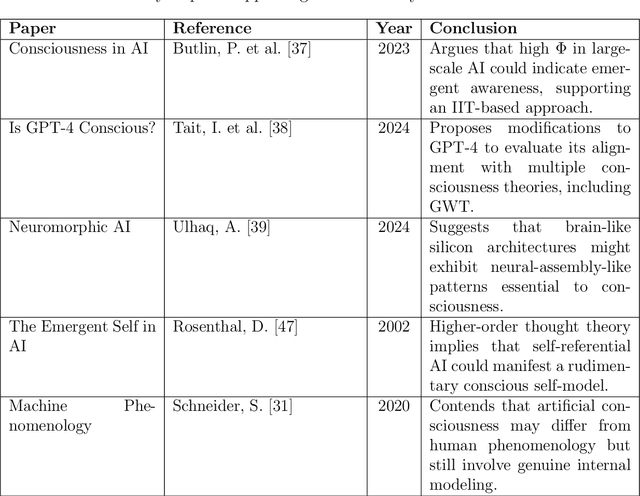
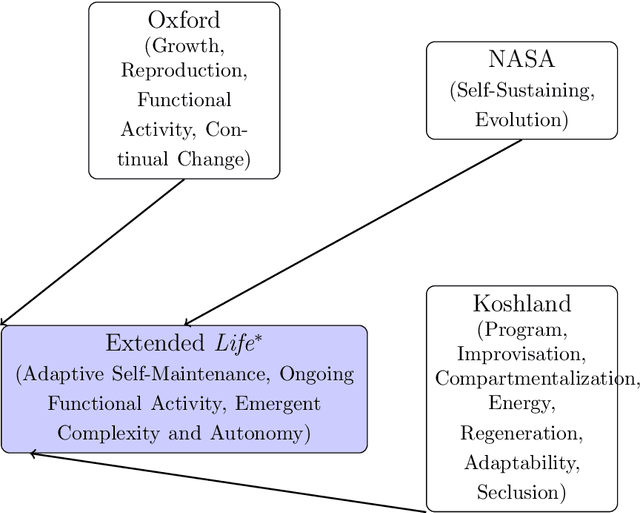
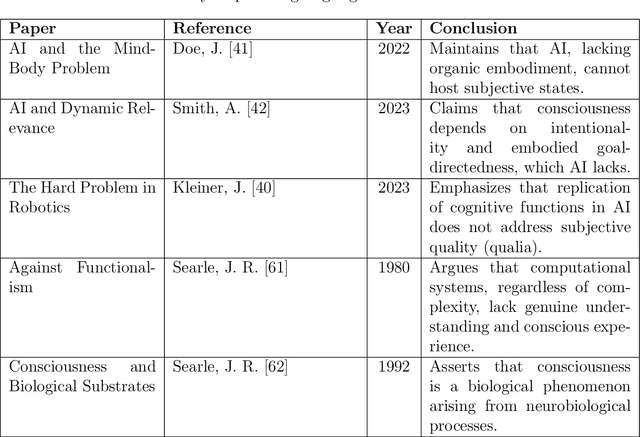
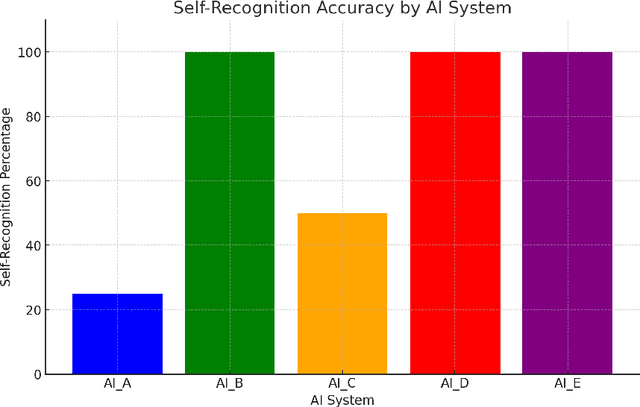
Could artificial intelligence ever become truly conscious in a functional sense; this paper explores that open-ended question through the lens of Life, a concept unifying classical biological criteria (Oxford, NASA, Koshland) with empirical hallmarks such as adaptive self maintenance, emergent complexity, and rudimentary self referential modeling. We propose a number of metrics for examining whether an advanced AI system has gained consciousness, while emphasizing that we do not claim all AI stems can become conscious. Rather, we suggest that sufficiently advanced architectures exhibiting immune like sabotage defenses, mirror self-recognition analogs, or meta-cognitive updates may cross key thresholds akin to life-like or consciousness-like traits. To demonstrate these ideas, we start by assessing adaptive self-maintenance capability, and introduce controlled data corruption sabotage into the training process. The result demonstrates AI capability to detect these inconsistencies and revert or self-correct analogous to regenerative biological processes. We also adapt an animal-inspired mirror self recognition test to neural embeddings, finding that partially trained CNNs can distinguish self from foreign features with complete accuracy. We then extend our analysis by performing a question-based mirror test on five state-of-the-art chatbots (ChatGPT4, Gemini, Perplexity, Claude, and Copilot) and demonstrated their ability to recognize their own answers compared to those of the other chatbots.