 Add to Chrome
 Add to Firefox
 Add to Edge
CN101 - A Digital Thermodynamic Computer for Generative AI
Aug 01, 2026
Thermodynamic computing is an emerging hardware paradigm, in which stochastic physical dynamics serve as the direct computational primitive. The recent explosion of generative AI has only sharpened the search for alternative approaches to compute, and, as we show in this work, thermodynamic computing turns out to be well suited to this space. An important class of methods realises a function as the stationary expectation of an ergodic stochastic process: the answer is encoded in the time-averaged statistics of an equilibrating trajectory. To date, this equilibration-style class has been formulated exclusively through Langevin dynamics, restricting its implementations to analogue substrates and the engineering challenges those bring. In this work, we propose a substrate-independent formalisation of the equilibration-style formulation, in which the only object of design is the dynamical generator L* of an arbitrary ergodic process. The formalisation makes three hardware-level properties of the formulation explicit: the precision of a result is a knob set by how long the dynamics are run, sample averages decompose across independent trajectories, and dependent stages of a computation operate concurrently rather than serially, a property we call sequential parallelism. We instantiate the formalisation by fabricating a prototype digital thermodynamic computing chip, named CN101, that implements the formulation through discrete accumulator dynamics on standard CMOS using stochastic computing principles. We characterise CN101's success across conventional generative AI workloads in the form of VAEs and flow matching, applied to both image generation and scientific problems. Together, the formalisation and its digital instantiation show that the equilibration-style formulation is substrate-independent, and that its computational properties can be exploited on standard digital hardware.

Thermodynamic Computing System for AI Applications
Dec 08, 2023
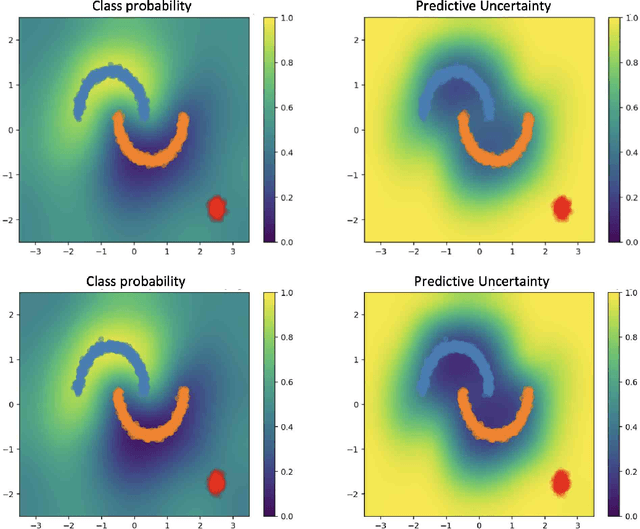


Recent breakthroughs in artificial intelligence (AI) algorithms have highlighted the need for novel computing hardware in order to truly unlock the potential for AI. Physics-based hardware, such as thermodynamic computing, has the potential to provide a fast, low-power means to accelerate AI primitives, especially generative AI and probabilistic AI. In this work, we present the first continuous-variable thermodynamic computer, which we call the stochastic processing unit (SPU). Our SPU is composed of RLC circuits, as unit cells, on a printed circuit board, with 8 unit cells that are all-to-all coupled via switched capacitances. It can be used for either sampling or linear algebra primitives, and we demonstrate Gaussian sampling and matrix inversion on our hardware. The latter represents the first thermodynamic linear algebra experiment. We also illustrate the applicability of the SPU to uncertainty quantification for neural network classification. We envision that this hardware, when scaled up in size, will have significant impact on accelerating various probabilistic AI applications.