 Add to Chrome
 Add to Firefox
 Add to Edge
Manipulation Planning for Construction Activities with Repetitive Tasks
May 13, 2026
In this paper, we study the problem of manipulation skill acquisition for performing construction activities consisting of repetitive tasks (e.g., building a wall or installing ceiling tiles). Our approach involves setting up a simulated construction activity in a Virtual Reality (VR) environment, where the user can provide demonstrations of the object manipulation skills needed to perform the construction activity. We then exploit the screw geometry of motion to approximate the demonstrated motion as a sequence of constant screw motions. For performing the construction activity, we generate the sequence of manipulation task instances and then compute the joint space motion plan corresponding to each instance using Screw Linear Interpolation (ScLERP) and Resolved Motion Rate Control (RMRC). We evaluate our framework by executing two representative construction tasks: constructing brick walls and installing multiple ceiling tiles. Each task is performed using only a single demonstration, a pick-and-place action for the bricks, and a single ceiling tile installation. Our experiments with a 7-DoF robot in both simulation and hardware demonstrate that the approach generalizes robustly to arbitrarily long construction activities that involve repetitive motions and demand precision, even when provided with just one demonstration. For instance, we can construct walls of arbitrary layout and length by leveraging a single demonstration of placing one brick on top of another.

Research on Flight Accidents Prediction based Back Propagation Neural Network
Jun 20, 2024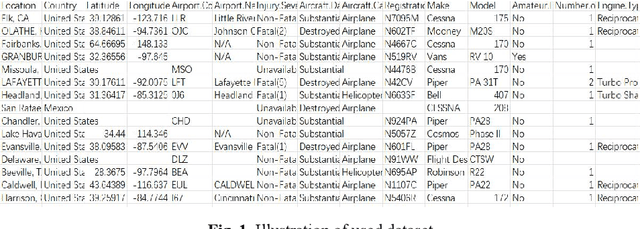
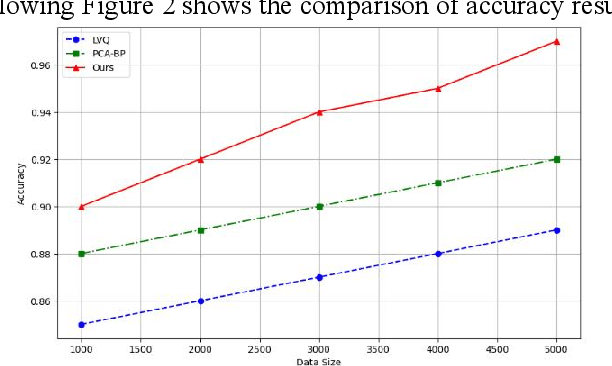
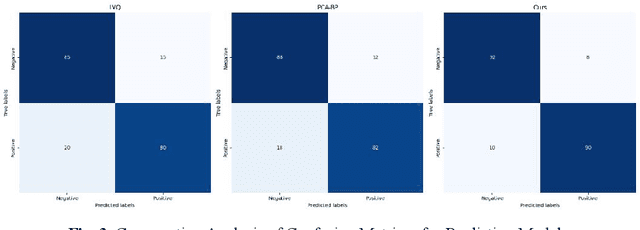
With the rapid development of civil aviation and the significant improvement of people's living standards, taking an air plane has become a common and efficient way of travel. However, due to the flight characteris-tics of the aircraft and the sophistication of the fuselage structure, flight de-lays and flight accidents occur from time to time. In addition, the life risk factor brought by aircraft after an accident is also the highest among all means of transportation. In this work, a model based on back-propagation neural network was used to predict flight accidents. By collecting historical flight data, including a variety of factors such as meteorological conditions, aircraft technical condition, and pilot experience, we trained a backpropaga-tion neural network model to identify potential accident risks. In the model design, a multi-layer perceptron structure is used to optimize the network performance by adjusting the number of hidden layer nodes and the learning rate. Experimental analysis shows that the model can effectively predict flight accidents with high accuracy and reliability.