 Add to Chrome
 Add to Firefox
 Add to Edge
Physics-Informed Modeling and Control of Emergent Behaviors in Robot Swarms
Jun 01, 2026
Robot swarms can exhibit coherent collective behaviors through local perception, limited communication and decentralized decision-making, yet modeling and controlling such emergence remains challenging when behaviors unfold over multiple phases. Here we introduce PhySwarm, a physics-informed micro--macro framework that represents multi-stage swarm emergence as physically constrained density-field evolution coupled to executable robot motion. At the macroscopic level, a multi-phase advection--diffusion--reaction model (Macro-ADR) describes phase-dependent swarm-density evolution through directed transport, diffusion-based spatial regulation and behavioral phase transitions. At the microscopic level, an equivalent deterministic motion model (Micro-EDM) realizes these mechanisms through potential-field advection, density-gradient compensation and rate- or event-gated phase switching. A neural-physics controller (NPC) maps local observations and temporal memory to bounded physical parameters, and is trained with a reinforcement learning--PINN objective that combines task rewards with macro-scale density residuals and micro-scale motion-consistency constraints. In several proof-of-concept swarm missions -- including trail-guided foraging, formation-reconfigurable navigation and role-adaptive search and rescue -- we demonstrate that PhySwarm can generate distinct multi-stage emergent behaviors within a unified physics-informed modeling framework. The learned density fields and physical parameters provide interpretable evidence of how advection, diffusion and reaction jointly regulate multi-stage swarm organization. These results establish a physics-informed route for learning, interpreting and controlling emergent behaviors in robot swarms.

Dynamic Deep Factor Graph for Multi-Agent Reinforcement Learning
May 09, 2024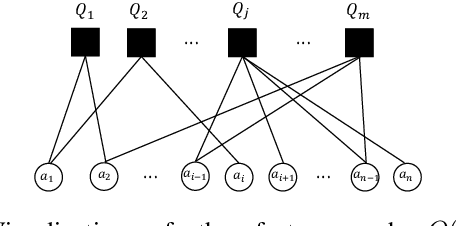
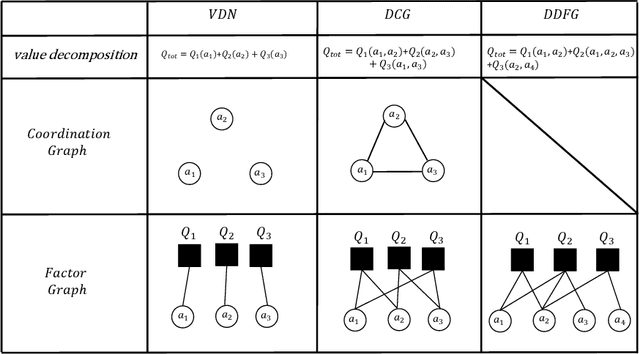
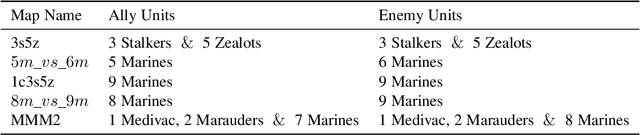
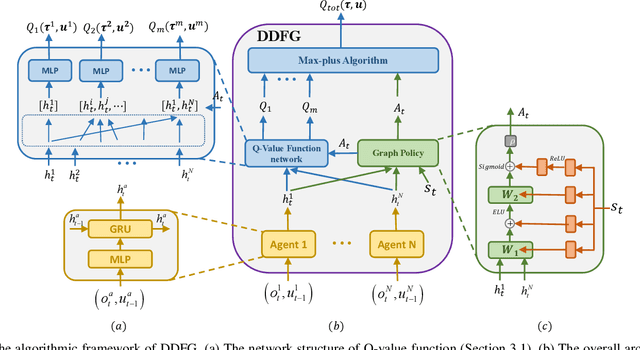
This work introduces a novel value decomposition algorithm, termed \textit{Dynamic Deep Factor Graphs} (DDFG). Unlike traditional coordination graphs, DDFG leverages factor graphs to articulate the decomposition of value functions, offering enhanced flexibility and adaptability to complex value function structures. Central to DDFG is a graph structure generation policy that innovatively generates factor graph structures on-the-fly, effectively addressing the dynamic collaboration requirements among agents. DDFG strikes an optimal balance between the computational overhead associated with aggregating value functions and the performance degradation inherent in their complete decomposition. Through the application of the max-sum algorithm, DDFG efficiently identifies optimal policies. We empirically validate DDFG's efficacy in complex scenarios, including higher-order predator-prey tasks and the StarCraft II Multi-agent Challenge (SMAC), thus underscoring its capability to surmount the limitations faced by existing value decomposition algorithms. DDFG emerges as a robust solution for MARL challenges that demand nuanced understanding and facilitation of dynamic agent collaboration. The implementation of DDFG is made publicly accessible, with the source code available at \url{https://github.com/SICC-Group/DDFG}.