 Add to Chrome
 Add to Firefox
 Add to Edge
RASR: Range-Aware Scale Recovery for Metric UAV Navigation
Jul 10, 2026
Under Global Navigation Satellite System (GNSS) denial, a UAV controller still needs a distance and heading command it can execute, making accurate metric last-meter navigation essential. Dense pair-geometry foundation models transfer relative structure well, yet the distance scale of their raw metric outputs remains poorly calibrated. Under the relative error metric of PairUAV, correcting only the average scale can still leave costly, distance-dependent residuals near the goal. To address this scale mismatch, Range-Aware Scale Recovery (RASR) separates a transferable scale-recovery core from a protocol-specific calibration module in a per-pair system fixed at inference. The core compresses frozen Matching And Stereo 3D Reconstruction (MASt3R)-style geometry into a compact descriptor and uses global calibration to recover the dominant metric signal. Range-bucket residual correction and command-grid alignment stay inside the calibration module, so they match the command format and evaluation protocol of PairUAV. On the UAVs in Multimedia 2026 PairUAV online evaluation, RASR reaches a total score of 0.003189. Under the PairUAV protocol, frozen pair geometry thus yields stable per-pair distance and heading estimates, while every protocol-specific adjustment stays confined to a calibration module fixed before inference. Code and materials are available at https://github.com/lht-research/rasr-pairuav.

Compression before Fusion: Broadcast Semantic Communication System for Heterogeneous Tasks
Jan 31, 2024Semantic communication has emerged as new paradigm shifts in 6G from the conventional syntax-oriented communications. Recently, the wireless broadcast technology has been introduced to support semantic communication system toward higher communication efficiency. Nevertheless, existing broadcast semantic communication systems target on general representation within one stage and fail to balance the inference accuracy among users. In this paper, the broadcast encoding process is decomposed into compression and fusion to improves communication efficiency with adaptation to tasks and channels.Particularly, we propose multiple task-channel-aware sub-encoders (TCE) and a channel-aware feature fusion sub-encoder (CFE) towards compression and fusion, respectively. In TCEs, multiple local-channel-aware attention blocks are employed to extract and compress task-relevant information for each user. In GFE, we introduce a global-channel-aware fine-tuning block to merge these compressed task-relevant signals into a compact broadcast signal. Notably, we retrieve the bottleneck in DeepBroadcast and leverage information bottleneck theory to further optimize the parameter tuning of TCEs and CFE.We substantiate our approach through experiments on a range of heterogeneous tasks across various channels with additive white Gaussian noise (AWGN) channel, Rayleigh fading channel, and Rician fading channel. Simulation results evidence that the proposed DeepBroadcast outperforms the state-of-the-art methods.
Mechanisms for Hiding Sensitive Genotypes with Information-Theoretic Privacy
Jul 10, 2020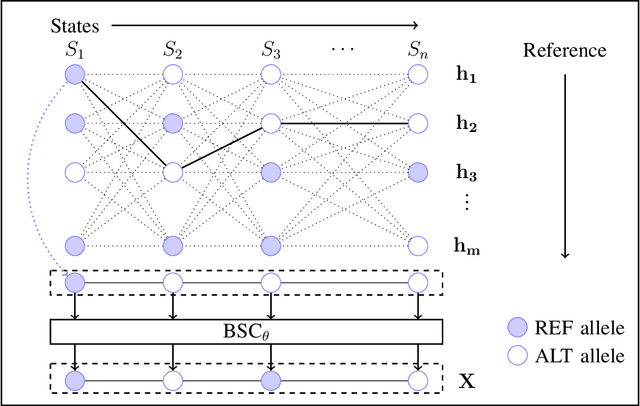
The growing availability of personal genomics services comes with increasing concerns for genomic privacy. Individuals may wish to withhold sensitive genotypes that contain critical health-related information when sharing their data with such services. A straightforward solution that masks only the sensitive genotypes does not ensure privacy due to the correlation structure within the genome. Here, we develop an information-theoretic mechanism for masking sensitive genotypes, which ensures no information about the sensitive genotypes is leaked. We also propose an efficient algorithmic implementation of our mechanism for genomic data governed by hidden Markov models. Our work is a step towards more rigorous control of privacy in genomic data sharing.