 Add to Chrome
 Add to Firefox
 Add to Edge
Zing: Social Mind for LLMs
Jul 26, 2026
As large language models move from isolated task solving toward long-term service in human environments, they require social intelligence: the ability to infer mental states, track social relations, reason over norms, and adapt behavior under context. This report presents Zhijing, an integrated framework for measuring, internalizing, and grounding social intelligence. For measurement, we introduce SoMBench, a psychology-grounded benchmark spanning 3 primary dimensions, 17 secondary dimensions, and 71 task paradigms. It controls question format, narrative perspective, and context length across 284 shared scenarios and 3,481 expert-verified instances. Evaluation of 20 representative LLMs reveals substantial headroom: the best model achieves only 72.08% overall accuracy, and none of the 17 secondary dimensions reaches the 90% near-ceiling band. For internalization, we develop Zing, a diagnosis-driven training recipe combining supervised fine-tuning, on-policy distillation, and rubric-based reinforcement learning. Across five social-cognition benchmarks, Zing consistently outperforms its base models, with Zing-27B-Stage2 achieving the best average score and Zing-32B-Stage2 remaining competitive with DeepSeek-V4-Pro. For deployment-time grounding, we build Actio, a harness-controlled inference architecture that routes four typed supports into reasoning: PRISM for procedural guidance, Starling for runtime mental-state representation, SAGE for reusable experience, and gated RAG for external social and normative knowledge. Across five base models and three benchmarks, the full harness improves 14 of 15 model-benchmark pairs and is best or tied for best in 8, demonstrating the effectiveness of typed runtime support. Together, these results show that socially intelligent LLMs require coordinated advances in evaluation, parametric internalization, and deployment-time grounding.

Pre-training with Aspect-Content Text Mutual Prediction for Multi-Aspect Dense Retrieval
Aug 22, 2023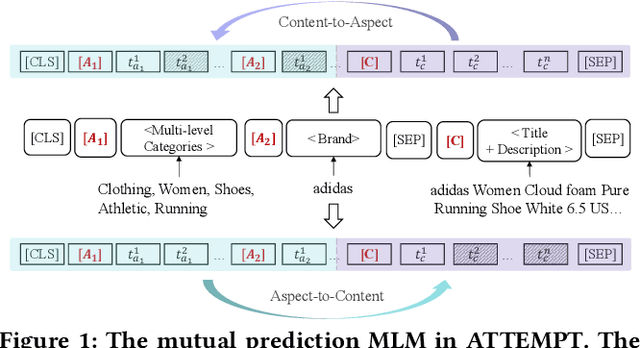
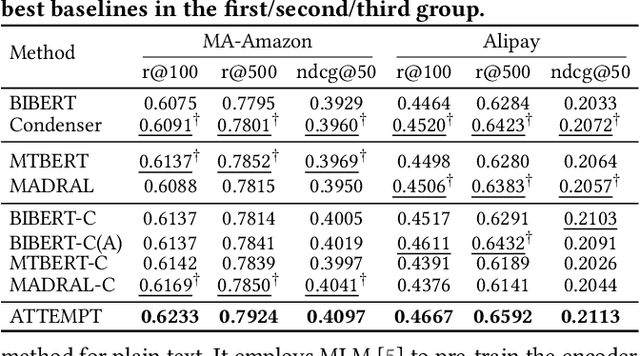
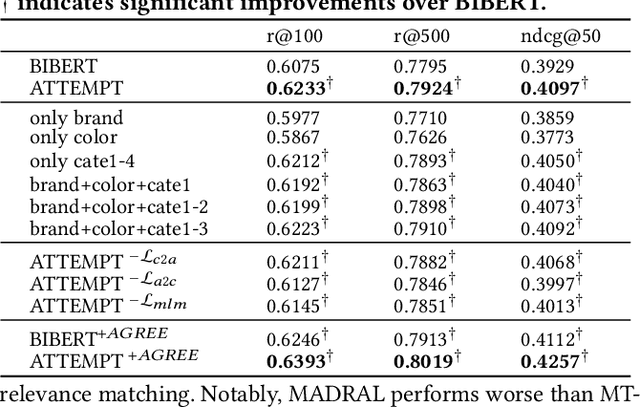
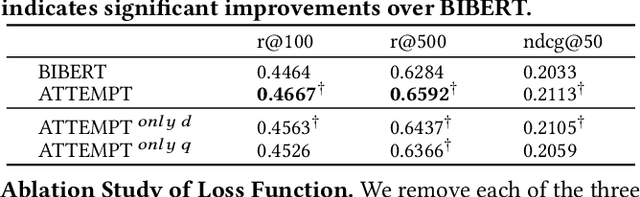
Grounded on pre-trained language models (PLMs), dense retrieval has been studied extensively on plain text. In contrast, there has been little research on retrieving data with multiple aspects using dense models. In the scenarios such as product search, the aspect information plays an essential role in relevance matching, e.g., category: Electronics, Computers, and Pet Supplies. A common way of leveraging aspect information for multi-aspect retrieval is to introduce an auxiliary classification objective, i.e., using item contents to predict the annotated value IDs of item aspects. However, by learning the value embeddings from scratch, this approach may not capture the various semantic similarities between the values sufficiently. To address this limitation, we leverage the aspect information as text strings rather than class IDs during pre-training so that their semantic similarities can be naturally captured in the PLMs. To facilitate effective retrieval with the aspect strings, we propose mutual prediction objectives between the text of the item aspect and content. In this way, our model makes more sufficient use of aspect information than conducting undifferentiated masked language modeling (MLM) on the concatenated text of aspects and content. Extensive experiments on two real-world datasets (product and mini-program search) show that our approach can outperform competitive baselines both treating aspect values as classes and conducting the same MLM for aspect and content strings. Code and related dataset will be available at the URL \footnote{https://github.com/sunxiaojie99/ATTEMPT}.