 Add to Chrome
 Add to Firefox
 Add to Edge
SDVDiag: Multimodal Causal Discovery for Online Diagnosis in Software-defined Vehicles
Jun 14, 2026
The transition toward software-defined vehicles concentrates an increasing share of vehicle functionality into distributed software services, where failures propagate through service dependencies and the surface symptom is often several causal hops away from the underlying defect. Existing approaches to causal root-cause analysis in such systems address this only partially: they typically reason over a single observability modality and operate in an offline, operator-driven mode that does not match the demands of continuous vehicle operation. This paper presents SDVDiag, a multimodal causal-discovery pipeline that fuses log-based and metric-based service representations into a shared embedding space before graph construction, coupled with an anomaly-driven trigger that converts the diagnostic platform from a manually operated batch tool into a continuously running online system. Evaluation on an Autonomous Valet Parking testbed shows that the multimodal pipeline produces sparser causal graphs than a metrics-only baseline (134 vs. 182 edges on average) and consistently outperforms it in edge-weighted reward against an expert knowledge graph at every stage of human-feedback refinement, showing a 2.4-fold improvement over the baseline after 60 feedback queries. An end-to-end fault-injection scenario further demonstrates that the integrated trigger correctly recovers a true root cause located two causal hops upstream of the observable symptom.

SDVDiag: Using Context-Aware Causality Mining for the Diagnosis of Connected Vehicle Functions
Apr 03, 2026Real-world implementations of connected vehicle functions are spreading steadily, yet operating these functions reliably remains challenging due to their distributed nature and the complexity of the underlying cloud, edge, and networking infrastructure. Quick diagnosis of problems and understanding the error chains that lead to failures is essential for reducing downtime. However, diagnosing these systems is still largely performed manually, as automated analysis techniques are predominantly data-driven and struggle with hidden relationships and the integration of context information. This paper addresses this gap by introducing a multimodal approach that integrates human feedback and system-specific information into the causal analysis process. Reinforcement Learning from Human Feedback is employed to continuously train a causality mining model while incorporating expert knowledge. Additional modules leverage distributed tracing data to prune false-positive causal links and enable the injection of domain-specific relationships to further refine the causal graph.Evaluation is performed using an automated valet parking application operated in a connected vehicle test field. Results demonstrate a significant increase in precision from 14\% to 100\% for the detection of causal edges and improved system interpretability compared to purely data-driven approaches, highlighting the potential for system operators in the connected vehicle domain.
A Survey on Performance, Current and Future Usage of Vehicle-To-Everything Communication Standards
Oct 14, 2024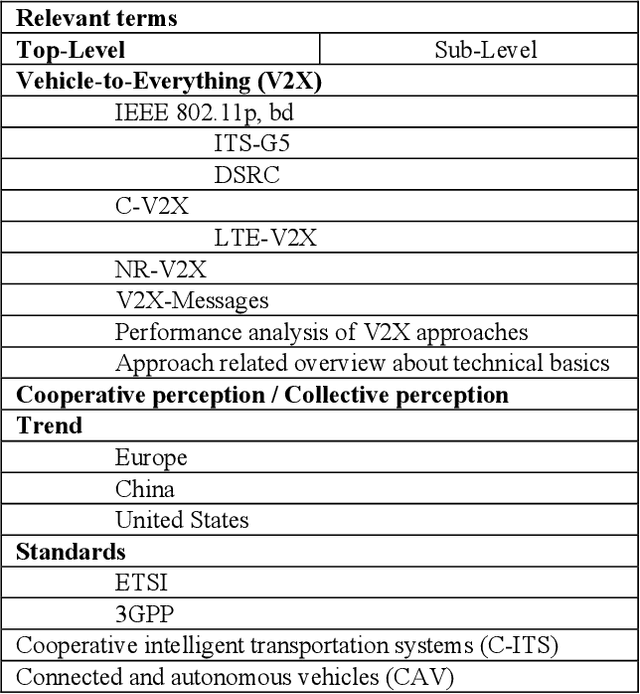
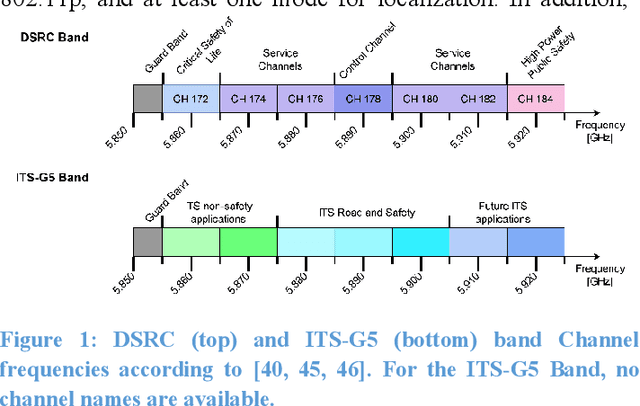
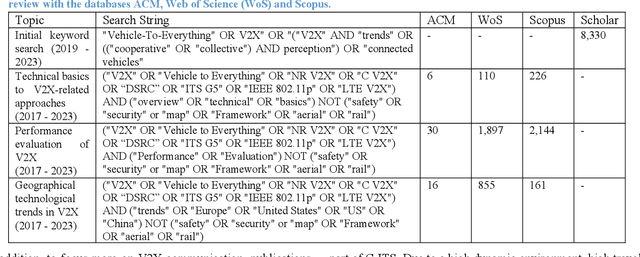
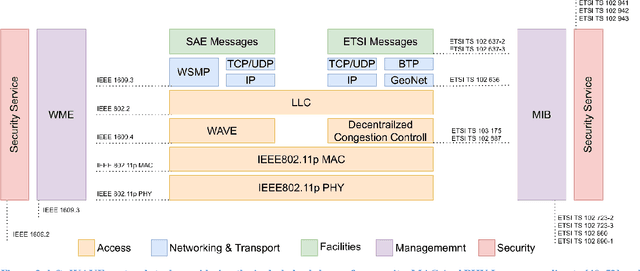
Wireless communication between road users is essential for environmental perception, reasoning, and mission planning to enable fully autonomous vehicles, and thus improve road safety and transport efficiency. To enable collaborative driving, the concept of vehicle-to-Everything (V2X) has long been introduced to the industry. Within the last two decades, several communication standards have been developed based on IEEE 802.11p and cellular standards, namely Dedicated Short-Range Communication (DSRC), Intelligent Transportation System G5 (ITS-G5), and Cellular- and New Radio- Vehicle-to-Everything (C-V2X and NR-V2X). However, while there exists a high quantity of available publications concerning V2X and the analysis of the different standards, only few surveys exist that summarize these results. Furthermore, to our knowledge, no survey that provides an analysis about possible future trends and challenges for the global implementation of V2Xexists. Thus, this contribution provides a detailed survey on Vehicle-to-Everything communication standards, their performance, current and future applications, and associated challenges. Based on our research, we have identified several research gaps and provide a picture about the possible future of the Vehicle-to-Everything communication domain.