 Add to Chrome
 Add to Firefox
 Add to Edge
A Neuropsychologically Grounded Evaluation of LLM Cognitive Abilities
Mar 03, 2026
Large language models (LLMs) exhibit a unified "general factor" of capability across 10 benchmarks, a finding confirmed by our factor analysis of 156 models, yet they still struggle with simple, trivial tasks for humans. This is because current benchmarks focus on task completion, failing to probe the foundational cognitive abilities that highlight these behaviors. We address this by introducing the NeuroCognition benchmark, grounded in three adapted neuropsychological tests: Raven's Progressive Matrices (abstract relational reasoning), Spatial Working Memory (maintenance and systematic search), and the Wisconsin Card Sorting Test (cognitive flexibility). Our evaluation reveals that while models perform strongly on text, their performance degrades for images and with increased complexity. Furthermore, we observe that complex reasoning is not universally beneficial, whereas simple, human-like strategies yield partial gains. We also find that NeuroCognition correlates positively with standard general-capability benchmarks, while still measuring distinct cognitive abilities beyond them. Overall, NeuroCognition emphasizes where current LLMs align with human-like intelligence and where they lack core adaptive cognition, showing the potential to serve as a verifiable, scalable source for improving LLMs.

OLA: Output Language Alignment in Code-Switched LLM Interactions
Jan 07, 2026Code-switching, alternating between languages within a conversation, is natural for multilingual users, yet poses fundamental challenges for large language models (LLMs). When a user code-switches in their prompt to an LLM, they typically do not specify the expected language of the LLM response, and thus LLMs must infer the output language from contextual and pragmatic cues. We find that current LLMs systematically fail to align with this expectation, responding in undesired languages even when cues are clear to humans. We introduce OLA, a benchmark to evaluate LLMs' Output Language Alignment in code-switched interactions. OLA focuses on Korean--English code-switching and spans simple intra-sentential mixing to instruction-content mismatches. Even frontier models frequently misinterpret implicit language expectation, exhibiting a bias toward non-English responses. We further show this bias generalizes beyond Korean to Chinese and Indonesian pairs. Models also show instability through mid-response switching and language intrusions. Chain-of-Thought prompting fails to resolve these errors, indicating weak pragmatic reasoning about output language. However, Code-Switching Aware DPO with minimal data (about 1K examples) substantially reduces misalignment, suggesting these failures stem from insufficient alignment rather than fundamental limitations. Our results highlight the need to align multilingual LLMs with users' implicit expectations in real-world code-switched interactions.
Survey of Cultural Awareness in Language Models: Text and Beyond
Oct 30, 2024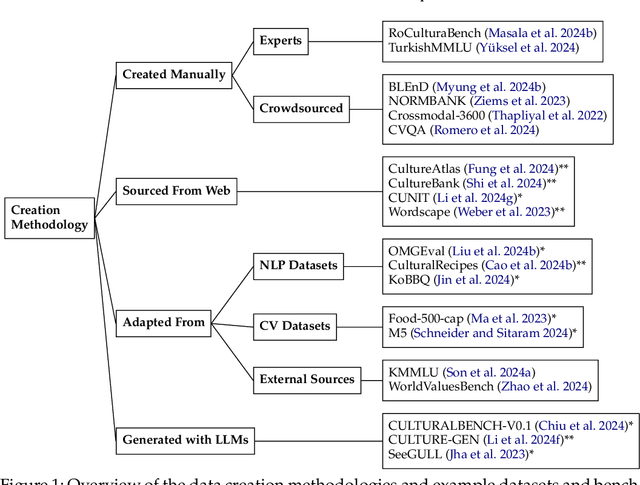
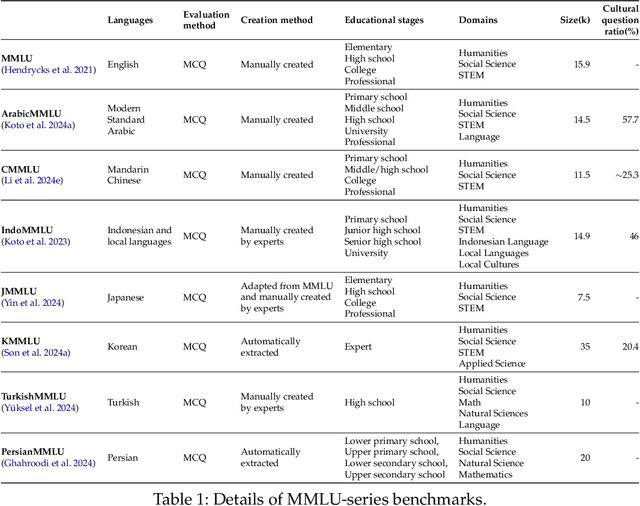
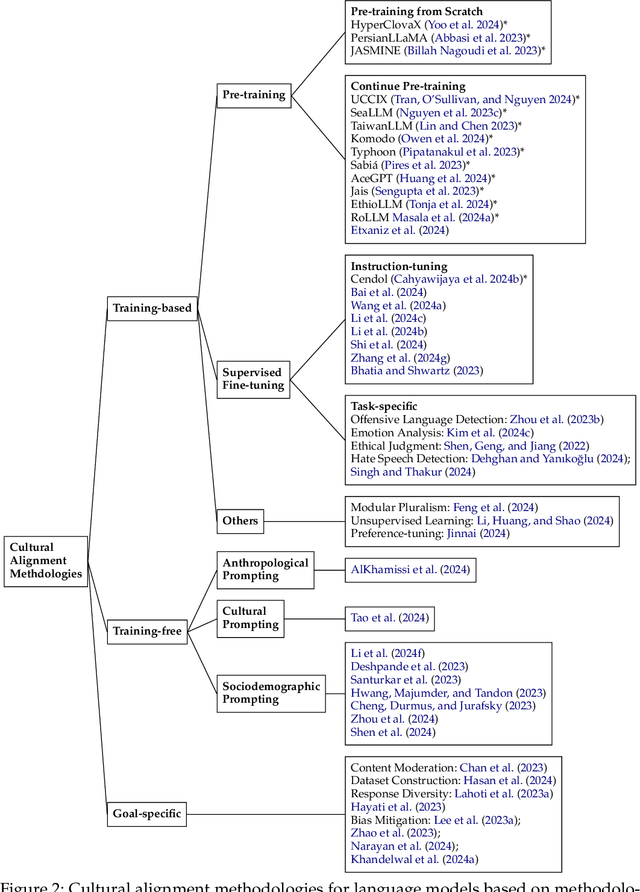
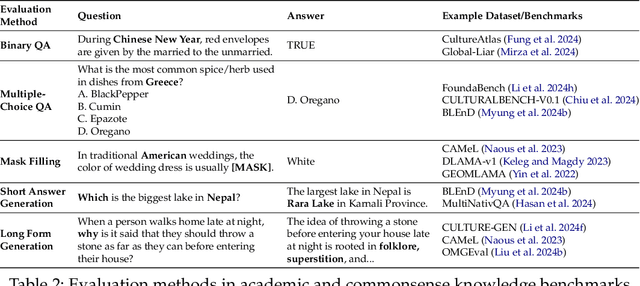
Large-scale deployment of large language models (LLMs) in various applications, such as chatbots and virtual assistants, requires LLMs to be culturally sensitive to the user to ensure inclusivity. Culture has been widely studied in psychology and anthropology, and there has been a recent surge in research on making LLMs more culturally inclusive in LLMs that goes beyond multilinguality and builds on findings from psychology and anthropology. In this paper, we survey efforts towards incorporating cultural awareness into text-based and multimodal LLMs. We start by defining cultural awareness in LLMs, taking the definitions of culture from anthropology and psychology as a point of departure. We then examine methodologies adopted for creating cross-cultural datasets, strategies for cultural inclusion in downstream tasks, and methodologies that have been used for benchmarking cultural awareness in LLMs. Further, we discuss the ethical implications of cultural alignment, the role of Human-Computer Interaction in driving cultural inclusion in LLMs, and the role of cultural alignment in driving social science research. We finally provide pointers to future research based on our findings about gaps in the literature.
Can LLM Generate Culturally Relevant Commonsense QA Data? Case Study in Indonesian and Sundanese
Feb 27, 2024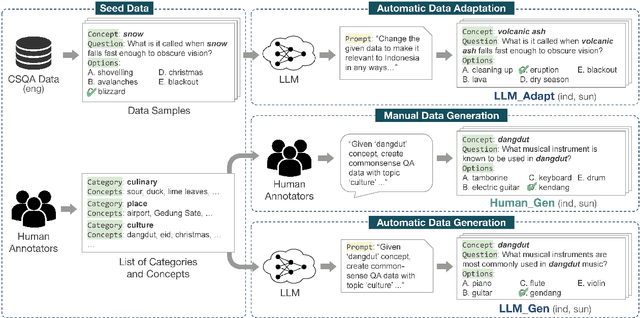
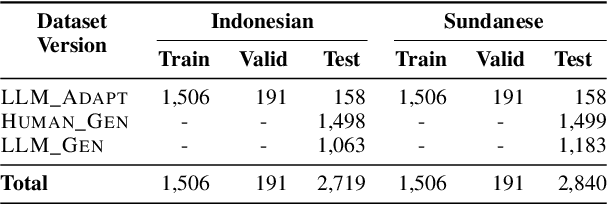
Large Language Models (LLMs) are increasingly being used to generate synthetic data for training and evaluating models. However, it is unclear whether they can generate a good quality of question answering (QA) dataset that incorporates knowledge and cultural nuance embedded in a language, especially for low-resource languages. In this study, we investigate the effectiveness of using LLMs in generating culturally relevant commonsense QA datasets for Indonesian and Sundanese languages. To do so, we create datasets for these languages using various methods involving both LLMs and human annotators. Our experiments show that the current best-performing LLM, GPT-4 Turbo, is capable of generating questions with adequate knowledge in Indonesian but not in Sundanese, highlighting the performance discrepancy between medium- and lower-resource languages. We also benchmark various LLMs on our generated datasets and find that they perform better on the LLM-generated datasets compared to those created by humans.