 Add to Chrome
 Add to Firefox
 Add to Edge
Agentic Control Center for Data Product Optimization
Mar 10, 2026
Data products enable end users to gain greater insights about their data by providing supporting assets, such as example question-SQL pairs which can be answered using the data or views over the database tables. However, producing useful data products is challenging, and typically requires domain experts to hand-craft supporting assets. We propose a system that automates data product improvement through specialized AI agents operating in a continuous optimization loop. By surfacing questions, monitoring multi-dimensional quality metrics, and supporting human-in-the-loop controls, it transforms data into observable and refinable assets that balance automation with trust and oversight.

Automatic Prompt Engineering with No Task Cues and No Tuning
Jan 06, 2026This paper presents a system for automatic prompt engineering that is much simpler in both design and application and yet as effective as the existing approaches. It requires no tuning and no explicit clues about the task. We evaluated our approach on cryptic column name expansion (CNE) in database tables, a task which is critical for tabular data search, access, and understanding and yet there has been very little existing work. We evaluated on datasets in two languages, English and German. This is the first work to report on the application of automatic prompt engineering for the CNE task. To the best of our knowledge, this is also the first work on the application of automatic prompt engineering for a language other than English.
DP-Bench: A Benchmark for Evaluating Data Product Creation Systems
Dec 16, 2025A data product is created with the intention of solving a specific problem, addressing a specific business usecase or meeting a particular need, going beyond just serving data as a raw asset. Data products enable end users to gain greater insights about their data. Since it was first introduced over a decade ago, there has been considerable work, especially in industry, to create data products manually or semi-automatically. However, there exists hardly any benchmark to evaluate automatic data product creation. In this work, we present a benchmark, first of its kind, for this task. We call it DP-Bench. We describe how this benchmark was created by taking advantage of existing work in ELT (Extract-Load-Transform) and Text-to-SQL benchmarks. We also propose a number of LLM based approaches that can be considered as baselines for generating data products automatically. We make the DP-Bench and supplementary materials available in https://huggingface.co/datasets/ibm-research/dp-bench .
Automatic Prompt Optimization for Knowledge Graph Construction: Insights from an Empirical Study
Jun 24, 2025A KG represents a network of entities and illustrates relationships between them. KGs are used for various applications, including semantic search and discovery, reasoning, decision-making, natural language processing, machine learning, and recommendation systems. Triple (subject-relation-object) extraction from text is the fundamental building block of KG construction and has been widely studied, for example, in early benchmarks such as ACE 2002 to more recent ones, such as WebNLG 2020, REBEL and SynthIE. While the use of LLMs is explored for KG construction, handcrafting reasonable task-specific prompts for LLMs is a labour-intensive exercise and can be brittle due to subtle changes in the LLM models employed. Recent work in NLP tasks (e.g. autonomy generation) uses automatic prompt optimization/engineering to address this challenge by generating optimal or near-optimal task-specific prompts given input-output examples. This empirical study explores the application of automatic prompt optimization for the triple extraction task using experimental benchmarking. We evaluate different settings by changing (a) the prompting strategy, (b) the LLM being used for prompt optimization and task execution, (c) the number of canonical relations in the schema (schema complexity), (d) the length and diversity of input text, (e) the metric used to drive the prompt optimization, and (f) the dataset being used for training and testing. We evaluate three different automatic prompt optimizers, namely, DSPy, APE, and TextGrad and use two different triple extraction datasets, SynthIE and REBEL. Through rigorous empirical evaluation, our main contribution highlights that automatic prompt optimization techniques can generate reasonable prompts similar to humans for triple extraction. In turn, these optimized prompts achieve improved results, particularly with increasing schema complexity and text size.
KnowGL: Knowledge Generation and Linking from Text
Oct 25, 2022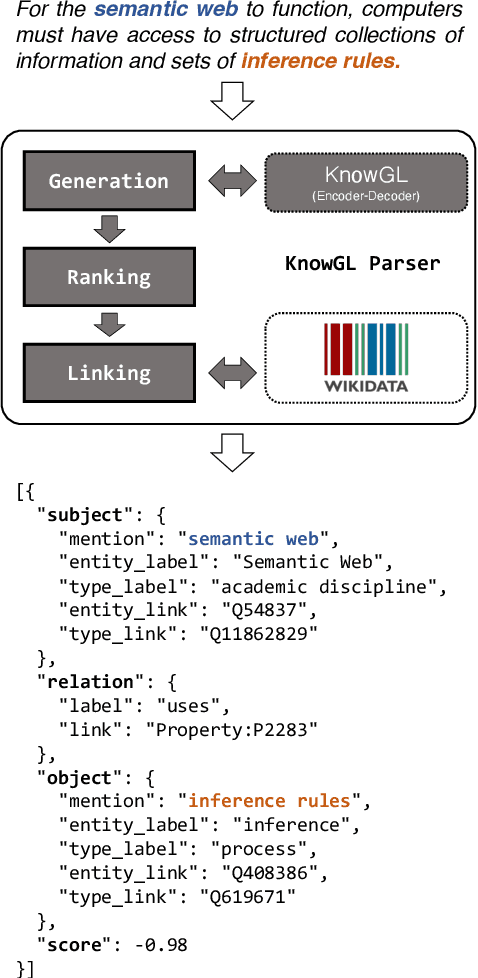
We propose KnowGL, a tool that allows converting text into structured relational data represented as a set of ABox assertions compliant with the TBox of a given Knowledge Graph (KG), such as Wikidata. We address this problem as a sequence generation task by leveraging pre-trained sequence-to-sequence language models, e.g. BART. Given a sentence, we fine-tune such models to detect pairs of entity mentions and jointly generate a set of facts consisting of the full set of semantic annotations for a KG, such as entity labels, entity types, and their relationships. To showcase the capabilities of our tool, we build a web application consisting of a set of UI widgets that help users to navigate through the semantic data extracted from a given input text. We make the KnowGL model available at https://huggingface.co/ibm/knowgl-large.