 Add to Chrome
 Add to Firefox
 Add to Edge
Towards foundation-style models for energy-frontier heterogeneous neutrino detectors via self-supervised pre-training
Apr 08, 2026
Accelerator-based neutrino physics is entering an energy-frontier regime in which interactions reach the TeV scale and produce exceptionally dense, overlapping detector signatures. In this regime, event interpretation becomes impractical for conventional reconstruction approaches, particularly when labelled data are scarce and the analysis spans diverse downstream objectives. We present a sparse ViT framework for learning reusable representations from heterogeneous detector data. Self-supervised pre-training combines masked autoencoder reconstruction with relational voxel-level objectives for hierarchy, ghost and particle identification, and the resulting shared encoder is then jointly fine-tuned across classification and regression tasks. Evaluated on simulated events from the proposed FASERCal concept at the LHC, we find that pre-training consistently improves neutrino flavour and charm-quark identification, momentum regression, and vertex reconstruction over training from scratch, with the addition of relational objectives yielding further gains in the most topologically complex channels. Interpretability analyses further show that pre-training yields a more structured latent space, while detector-subsystem ablations recover physically plausible channel-dependent roles for the heterogeneous inputs. A data-efficiency study shows that, with roughly $10^3$ labelled events, the pre-trained encoder already matches the flavour-classification performance of a randomly initialised model trained on an order of magnitude more data. The learned representations also transfer effectively to publicly available benchmarks spanning different detector technologies and energy scales, matching or exceeding published baselines. These results support self-supervised pre-training on multimodal detector data as a scalable route towards reusable representations for neutrino and particle-detector analysis.

Unsupervised Particle Tracking with Neuromorphic Computing
Feb 10, 2025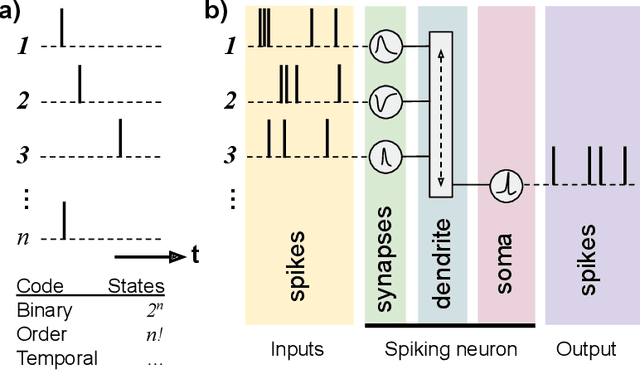
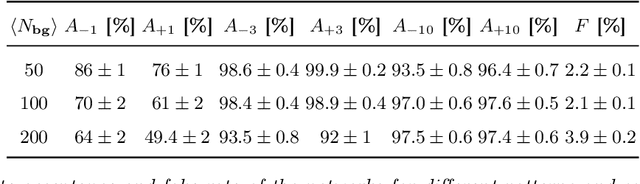
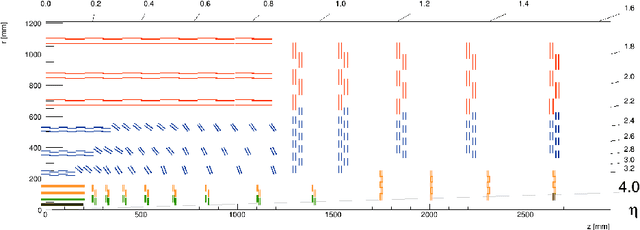
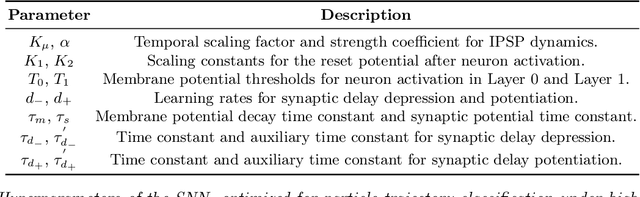
We study the application of a neural network architecture for identifying charged particle trajectories via unsupervised learning of delays and synaptic weights using a spike-time-dependent plasticity rule. In the considered model, the neurons receive time-encoded information on the position of particle hits in a tracking detector for a particle collider, modeled according to the geometry of the Compact Muon Solenoid Phase II detector. We show how a spiking neural network is capable of successfully identifying in a completely unsupervised way the signal left by charged particles in the presence of conspicuous noise from accidental or combinatorial hits. These results open the way to applications of neuromorphic computing to particle tracking, motivating further studies into its potential for real-time, low-power particle tracking in future high-energy physics experiments.