 Add to Chrome
 Add to Firefox
 Add to Edge
Towards foundation-style models for energy-frontier heterogeneous neutrino detectors via self-supervised pre-training
Apr 08, 2026
Accelerator-based neutrino physics is entering an energy-frontier regime in which interactions reach the TeV scale and produce exceptionally dense, overlapping detector signatures. In this regime, event interpretation becomes impractical for conventional reconstruction approaches, particularly when labelled data are scarce and the analysis spans diverse downstream objectives. We present a sparse ViT framework for learning reusable representations from heterogeneous detector data. Self-supervised pre-training combines masked autoencoder reconstruction with relational voxel-level objectives for hierarchy, ghost and particle identification, and the resulting shared encoder is then jointly fine-tuned across classification and regression tasks. Evaluated on simulated events from the proposed FASERCal concept at the LHC, we find that pre-training consistently improves neutrino flavour and charm-quark identification, momentum regression, and vertex reconstruction over training from scratch, with the addition of relational objectives yielding further gains in the most topologically complex channels. Interpretability analyses further show that pre-training yields a more structured latent space, while detector-subsystem ablations recover physically plausible channel-dependent roles for the heterogeneous inputs. A data-efficiency study shows that, with roughly $10^3$ labelled events, the pre-trained encoder already matches the flavour-classification performance of a randomly initialised model trained on an order of magnitude more data. The learned representations also transfer effectively to publicly available benchmarks spanning different detector technologies and energy scales, matching or exceeding published baselines. These results support self-supervised pre-training on multimodal detector data as a scalable route towards reusable representations for neutrino and particle-detector analysis.

Deep-learning-based decomposition of overlapping-sparse images: application at the vertex of neutrino interactions
Nov 06, 2023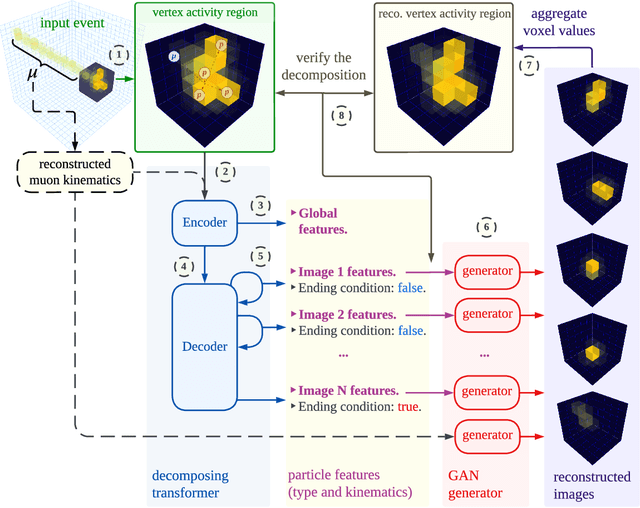
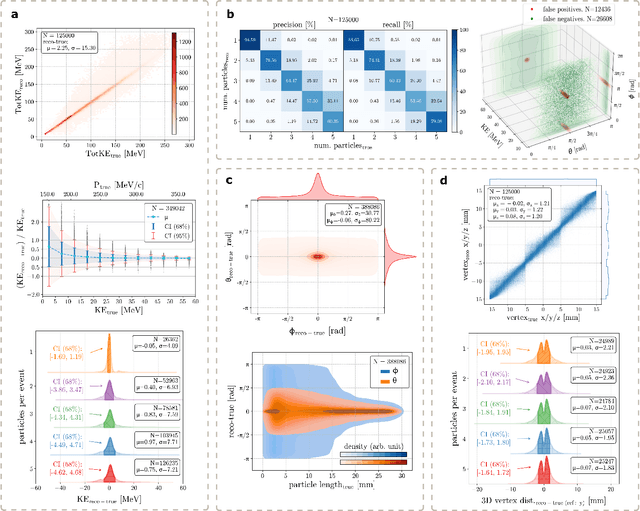
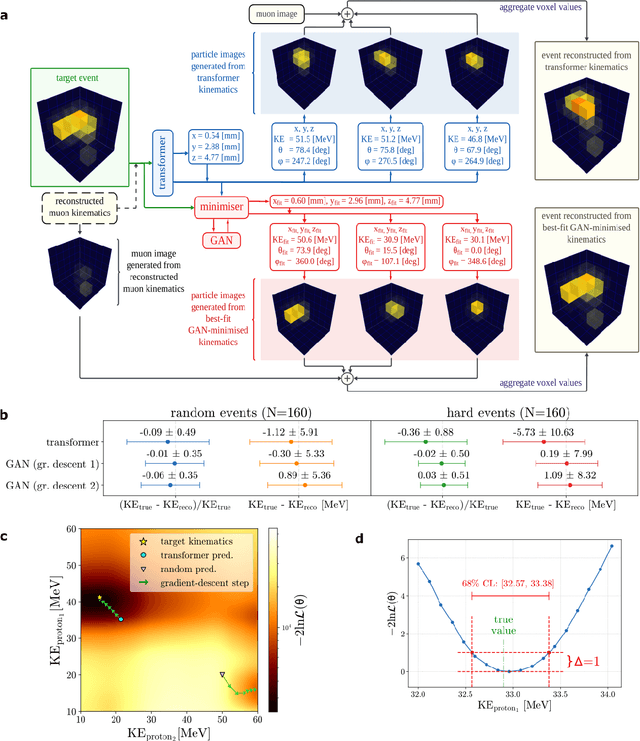
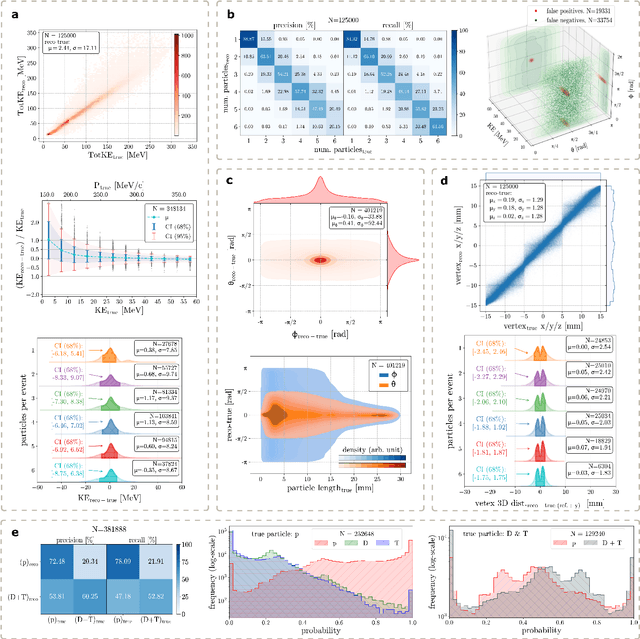
Image decomposition plays a crucial role in various computer vision tasks, enabling the analysis and manipulation of visual content at a fundamental level. Overlapping images, which occur when multiple objects or scenes partially occlude each other, pose unique challenges for decomposition algorithms. The task intensifies when working with sparse images, where the scarcity of meaningful information complicates the precise extraction of components. This paper presents a solution that leverages the power of deep learning to accurately extract individual objects within multi-dimensional overlapping-sparse images, with a direct application in high-energy physics with decomposition of overlaid elementary particles obtained from imaging detectors. In particular, the proposed approach tackles a highly complex yet unsolved problem: identifying and measuring independent particles at the vertex of neutrino interactions, where one expects to observe detector images with multiple indiscernible overlapping charged particles. By decomposing the image of the detector activity at the vertex through deep learning, it is possible to infer the kinematic parameters of the identified low-momentum particles - which otherwise would remain neglected - and enhance the reconstructed energy resolution of the neutrino event. We also present an additional step - that can be tuned directly on detector data - combining the above method with a fully-differentiable generative model to improve the image decomposition further and, consequently, the resolution of the measured parameters, achieving unprecedented results. This improvement is crucial for precisely measuring the parameters that govern neutrino flavour oscillations and searching for asymmetries between matter and antimatter.
Artificial intelligence for improved fitting of trajectories of elementary particles in inhomogeneous dense materials immersed in a magnetic field
Nov 09, 2022In this article, we use artificial intelligence algorithms to show how to enhance the resolution of the elementary particle track fitting in inhomogeneous dense detectors, such as plastic scintillators. We use deep learning to replace more traditional Bayesian filtering methods, drastically improving the reconstruction of the interacting particle kinematics. We show that a specific form of neural network, inherited from the field of natural language processing, is very close to the concept of a Bayesian filter that adopts a hyper-informative prior. Such a paradigm change can influence the design of future particle physics experiments and their data exploitation.