 Add to Chrome
 Add to Firefox
 Add to Edge
SEISMO: Increasing Sample Efficiency in Molecular Optimization with a Trajectory-Aware LLM Agent
Jan 31, 2026
Optimizing the structure of molecules to achieve desired properties is a central bottleneck across the chemical sciences, particularly in the pharmaceutical industry where it underlies the discovery of new drugs. Since molecular property evaluation often relies on costly and rate-limited oracles, such as experimental assays, molecular optimization must be highly sample-efficient. To address this, we introduce SEISMO, an LLM agent that performs strictly online, inference-time molecular optimization, updating after every oracle call without the need for population-based or batched learning. SEISMO conditions each proposal on the full optimization trajectory, combining natural-language task descriptions with scalar scores and, when available, structured explanatory feedback. Across the Practical Molecular Optimization benchmark of 23 tasks, SEISMO achieves a 2-3 times higher area under the optimisation curve than prior methods, often reaching near-maximal task scores within 50 oracle calls. Our additional medicinal-chemistry tasks show that providing explanatory feedback further improves efficiency, demonstrating that leveraging domain knowledge and structured information is key to sample-efficient molecular optimization.

Publishing Neural Networks in Drug Discovery Might Compromise Training Data Privacy
Oct 22, 2024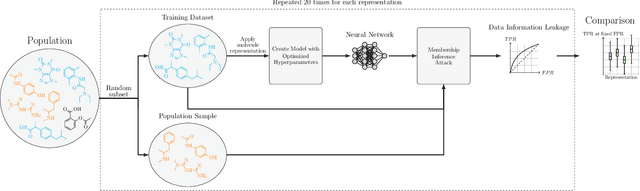
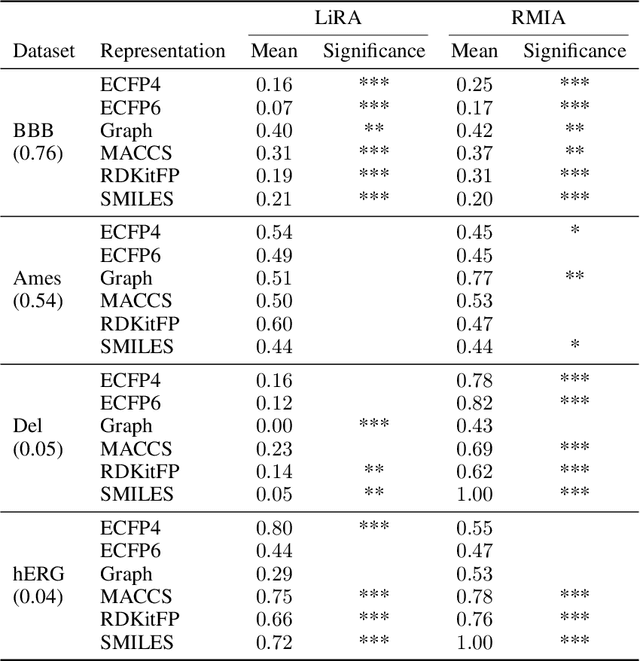
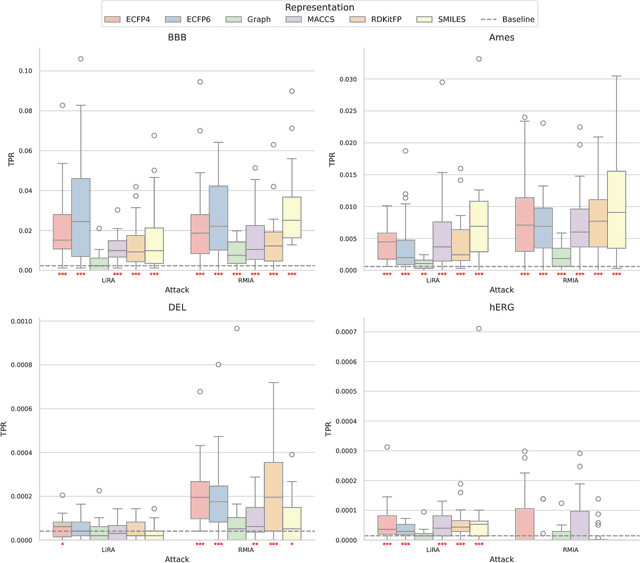
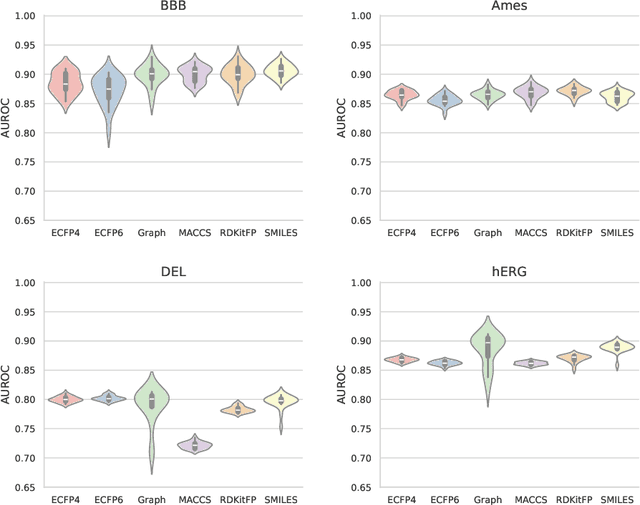
This study investigates the risks of exposing confidential chemical structures when machine learning models trained on these structures are made publicly available. We use membership inference attacks, a common method to assess privacy that is largely unexplored in the context of drug discovery, to examine neural networks for molecular property prediction in a black-box setting. Our results reveal significant privacy risks across all evaluated datasets and neural network architectures. Combining multiple attacks increases these risks. Molecules from minority classes, often the most valuable in drug discovery, are particularly vulnerable. We also found that representing molecules as graphs and using message-passing neural networks may mitigate these risks. We provide a framework to assess privacy risks of classification models and molecular representations. Our findings highlight the need for careful consideration when sharing neural networks trained on proprietary chemical structures, informing organisations and researchers about the trade-offs between data confidentiality and model openness.