 Add to Chrome
 Add to Firefox
 Add to Edge
Agent-Centric Animal Pose Forecasting
Jul 21, 2026
Understanding animal behavior at an algorithmic level -- what animals attend to, how they form internal models and plans, and how this maps to action -- remains a central challenge in neuroscience and ethology. Data-driven generative models offer a path toward this understanding. We introduce a framework for training agent-centric autoregressive models of animal behavior from tracked pose, applicable to single animals and to groups in which each agent senses and responds to its conspecifics. Our models input egocentric sensory observations and output egocentric movements, mirroring the biological constraint that animals observe and act on the world from their own reference frame. Social behavior emerges from agents independently sensing and responding to one another. This agent-centric formulation requires managing many parallel representations of the same data, along with ML-specific transformations like discretization. We release a general-purpose library focused on the composable sequences of operations that translate between these representations. We show that trained models capture the distribution of social behavior in groups of courting Drosophila, and our library includes quantitative tools for measuring fit. We demonstrate how the library supports systematic comparison across input and output representations and that it adapts straightforwardly to a new domain.

Learning recurrent representations for hierarchical behavior modeling
Nov 15, 2016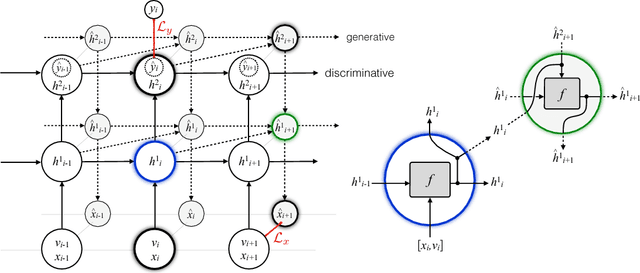
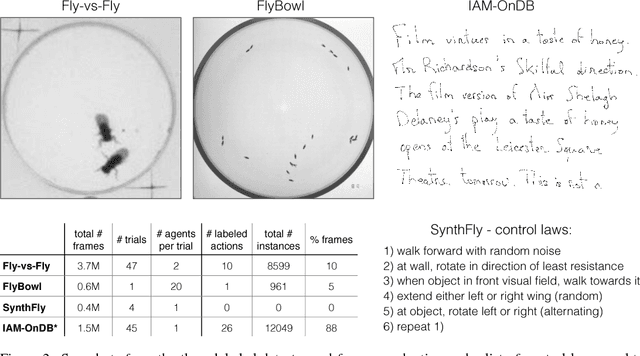
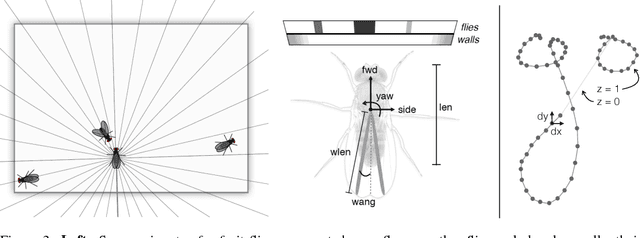
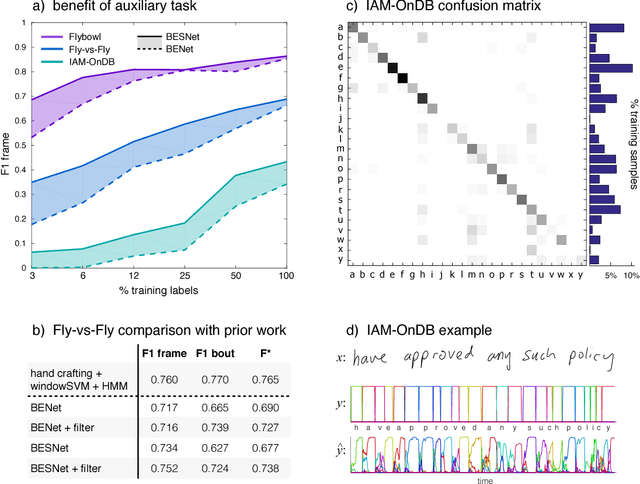
We propose a framework for detecting action patterns from motion sequences and modeling the sensory-motor relationship of animals, using a generative recurrent neural network. The network has a discriminative part (classifying actions) and a generative part (predicting motion), whose recurrent cells are laterally connected, allowing higher levels of the network to represent high level phenomena. We test our framework on two types of data, fruit fly behavior and online handwriting. Our results show that 1) taking advantage of unlabeled sequences, by predicting future motion, significantly improves action detection performance when training labels are scarce, 2) the network learns to represent high level phenomena such as writer identity and fly gender, without supervision, and 3) simulated motion trajectories, generated by treating motion prediction as input to the network, look realistic and may be used to qualitatively evaluate whether the model has learnt generative control rules.