 Add to Chrome
 Add to Firefox
 Add to Edge
'The Order in the Horse's Heart': A Case Study in LLM-Assisted Stylometry for the Discovery of Biblical Allusion in Modern Literary Fiction
Apr 21, 2026
We present a dual-track pipeline for detecting biblical allusions in literary fiction and apply it to the novels of Cormac McCarthy. A bottom-up embedding track uses inverse document frequency to identify rare vocabulary shared with the King James Bible, embeds occurrences in their local context for sense disambiguation, and passes candidate passage pairs through cascaded LLM review. A top-down register track asks an LLM to read McCarthy's prose undirected to any specific biblical passage for comparison, catching allusions not distinguished by word or phrase rarity. Both tracks are cross-validated by a long-context model that holds entire novels alongside the KJV in a single pass, and every finding is checked against published scholarship. Restricting attention to allusions that carry a textual echo--shared phrasing, reworked vocabulary, or transplanted cadence--and distinguishing literary allusions proper from signposted biblical references (similes naming biblical figures, characters overtly citing scripture), the pipeline surfaces 349 allusions across the corpus. Among a target set of 115 previously documented allusions retrieved through human review of the academic literature, the pipeline independently recovers 62 (54% recall), with recall varying by connection type from 30% (transformed imagery) to 80% (register collisions). We contextualise these results with respect to the value-add from LLMs as assistants to mechanical stylometric analyses, and their potential to facilitate the statistical study of intertextuality in massive literary corpora.

Variational Learning on Aggregate Outputs with Gaussian Processes
May 22, 2018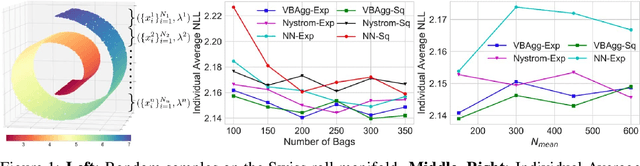
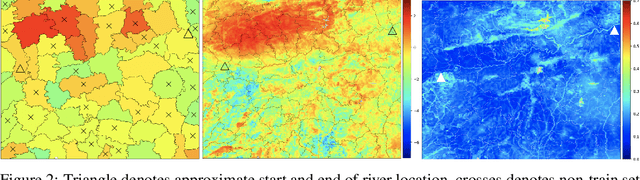
While a typical supervised learning framework assumes that the inputs and the outputs are measured at the same levels of granularity, many applications, including global mapping of disease, only have access to outputs at a much coarser level than that of the inputs. Aggregation of outputs makes generalization to new inputs much more difficult. We consider an approach to this problem based on variational learning with a model of output aggregation and Gaussian processes, where aggregation leads to intractability of the standard evidence lower bounds. We propose new bounds and tractable approximations, leading to improved prediction accuracy and scalability to large datasets, while explicitly taking uncertainty into account. We develop a framework which extends to several types of likelihoods, including the Poisson model for aggregated count data. We apply our framework to a challenging and important problem, the fine-scale spatial modelling of malaria incidence, with over 1 million observations.
Improved prediction accuracy for disease risk mapping using Gaussian Process stacked generalisation
Dec 10, 2016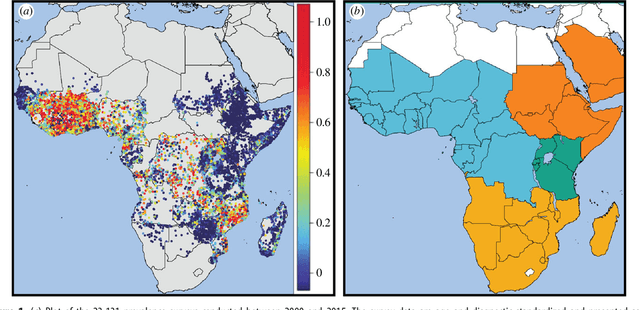
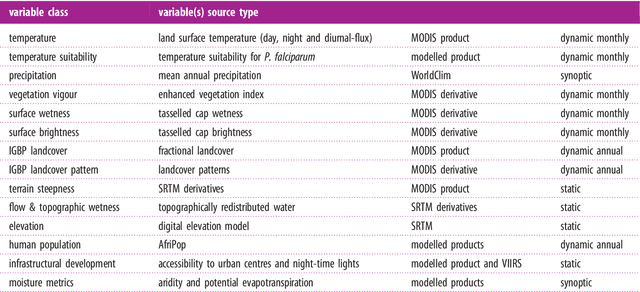
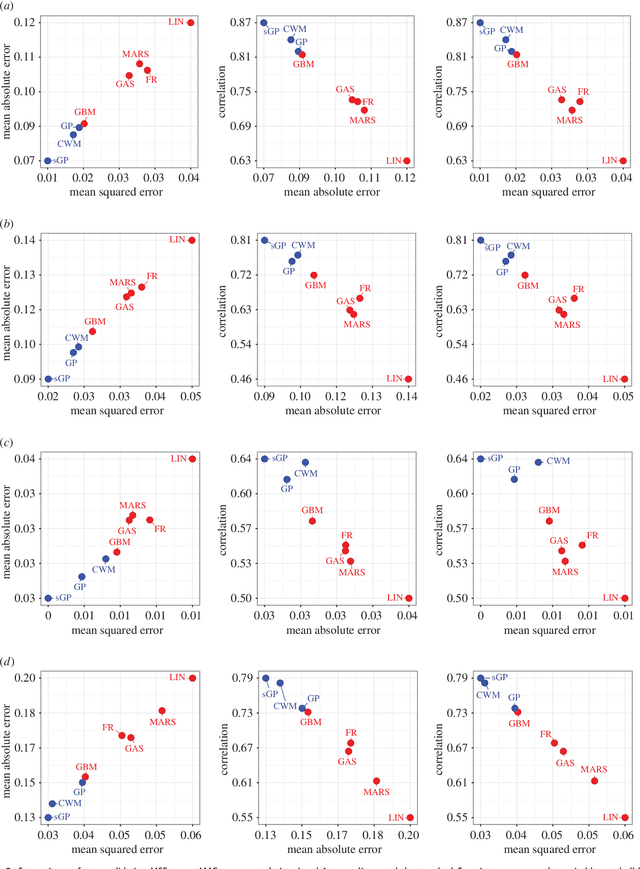
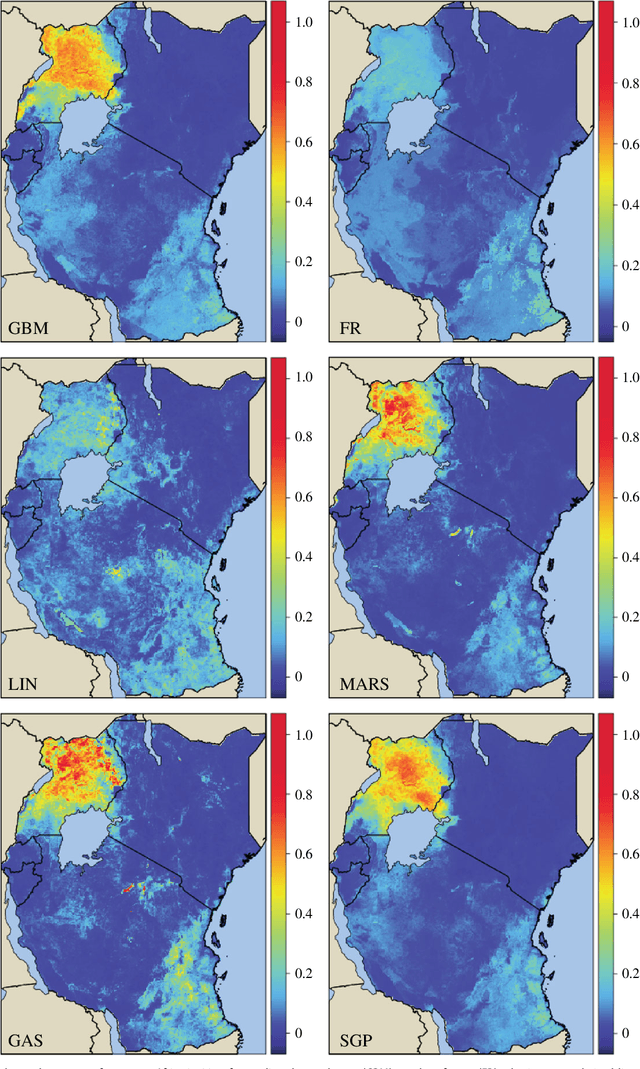
Maps of infectious disease---charting spatial variations in the force of infection, degree of endemicity, and the burden on human health---provide an essential evidence base to support planning towards global health targets. Contemporary disease mapping efforts have embraced statistical modelling approaches to properly acknowledge uncertainties in both the available measurements and their spatial interpolation. The most common such approach is that of Gaussian process regression, a mathematical framework comprised of two components: a mean function harnessing the predictive power of multiple independent variables, and a covariance function yielding spatio-temporal shrinkage against residual variation from the mean. Though many techniques have been developed to improve the flexibility and fitting of the covariance function, models for the mean function have typically been restricted to simple linear terms. For infectious diseases, known to be driven by complex interactions between environmental and socio-economic factors, improved modelling of the mean function can greatly boost predictive power. Here we present an ensemble approach based on stacked generalisation that allows for multiple, non-linear algorithmic mean functions to be jointly embedded within the Gaussian process framework. We apply this method to mapping Plasmodium falciparum prevalence data in Sub-Saharan Africa and show that the generalised ensemble approach markedly out-performs any individual method.