 Add to Chrome
 Add to Firefox
 Add to Edge
Model Agnostic Combination for Ensemble Learning
Jun 16, 2020


Ensemble of models is well known to improve single model performance. We present a novel ensembling technique coined MAC that is designed to find the optimal function for combining models while remaining invariant to the number of sub-models involved in the combination. Being agnostic to the number of sub-models enables addition and replacement of sub-models to the combination even after deployment, unlike many of the current methods for ensembling such as stacking, boosting, mixture of experts and super learners that lock the models used for combination during training and therefore need retraining whenever a new model is introduced into the ensemble. We show that on the Kaggle RSNA Intracranial Hemorrhage Detection challenge, MAC outperforms classical average methods, demonstrates competitive results to boosting via XGBoost for a fixed number of sub-models, and outperforms it when adding sub-models to the combination without retraining.

Lung Nodules Detection and Segmentation Using 3D Mask-RCNN
Jul 17, 2019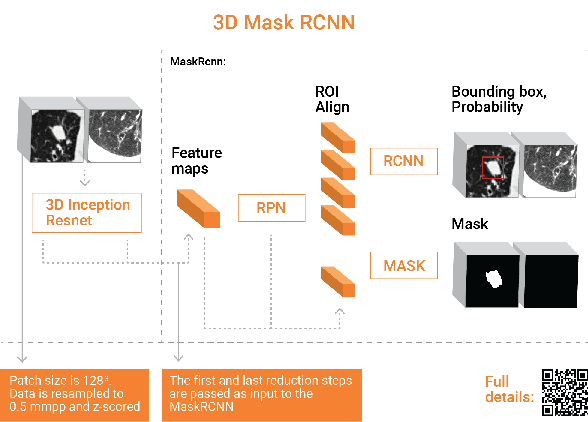
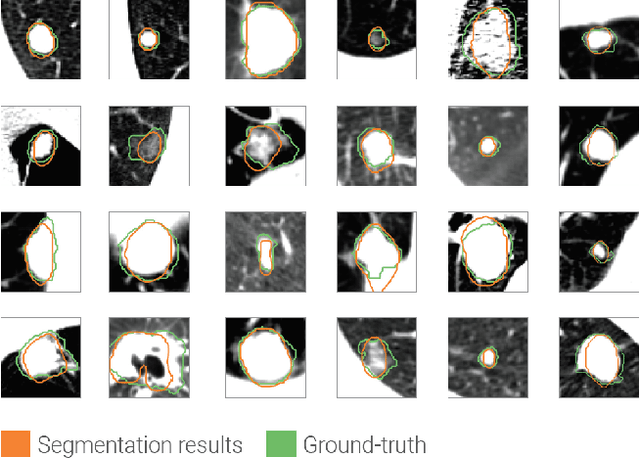
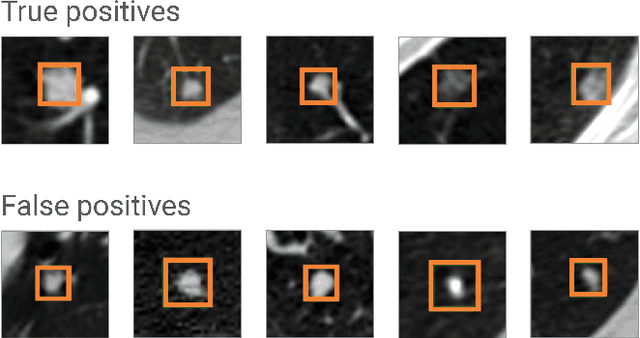
Accurate assessment of Lung nodules is a time consuming and error prone ingredient of the radiologist interpretation work. Automating 3D volume detection and segmentation can improve workflow as well as patient care. Previous works have focused either on detecting lung nodules from a full CT scan or on segmenting them from a small ROI. We adapt the state of the art architecture for 2D object detection and segmentation, MaskRCNN, to handle 3D images and employ it to detect and segment lung nodules from CT scans. We report on competitive results for the lung nodule detection on LUNA16 data set. The added value of our method is that in addition to lung nodule detection, our framework produces 3D segmentations of the detected nodules.