 Add to Chrome
 Add to Firefox
 Add to Edge
Automated Classification of Source Code Changes Based on Metrics Clustering in the Software Development Process
Feb 16, 2026
This paper presents an automated method for classifying source code changes during the software development process based on clustering of change metrics. The method consists of two steps: clustering of metric vectors computed for each code change, followed by expert mapping of the resulting clusters to predefined change classes. The distribution of changes into clusters is performed automatically, while the mapping of clusters to classes is carried out by an expert. Automation of the distribution step substantially reduces the time required for code change review. The k-means algorithm with a cosine similarity measure between metric vectors is used for clustering. Eleven source code metrics are employed, covering lines of code, cyclomatic complexity, file counts, interface changes, and structural changes. The method was validated on five software systems, including two open-source projects (Subversion and NHibernate), and demonstrated classification purity of P_C = 0.75 +/- 0.05 and entropy of E_C = 0.37 +/- 0.06 at a significance level of 0.05.

app.build: A Production Framework for Scaling Agentic Prompt-to-App Generation with Environment Scaffolding
Sep 03, 2025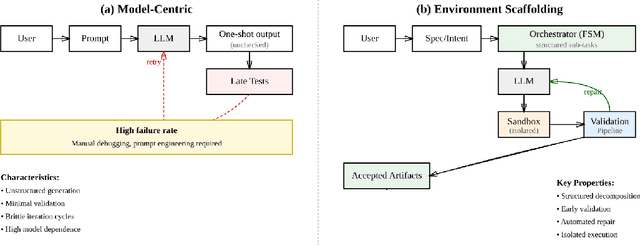
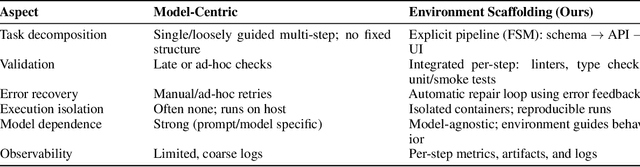
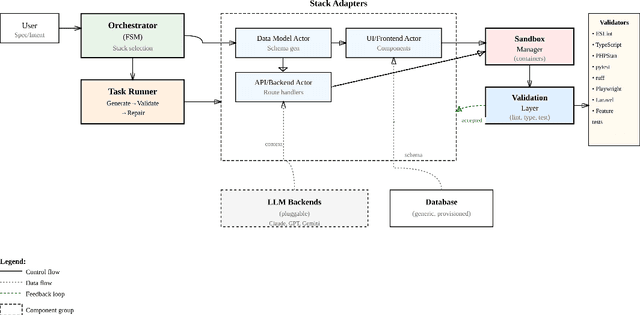
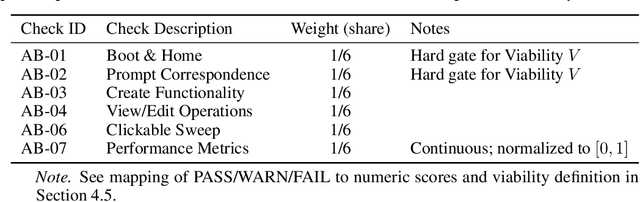
We present app.build (https://github.com/appdotbuild/agent/), an open-source framework that improves LLM-based application generation through systematic validation and structured environments. Our approach combines multi-layered validation pipelines, stack-specific orchestration, and model-agnostic architecture, implemented across three reference stacks. Through evaluation on 30 generation tasks, we demonstrate that comprehensive validation achieves 73.3% viability rate with 30% reaching perfect quality scores, while open-weights models achieve 80.8% of closed-model performance when provided structured environments. The open-source framework has been adopted by the community, with over 3,000 applications generated to date. This work demonstrates that scaling reliable AI agents requires scaling environments, not just models -- providing empirical insights and complete reference implementations for production-oriented agent systems.