 Add to Chrome
 Add to Firefox
 Add to Edge
Goal Force: Teaching Video Models To Accomplish Physics-Conditioned Goals
Jan 09, 2026
Recent advancements in video generation have enabled the development of ``world models'' capable of simulating potential futures for robotics and planning. However, specifying precise goals for these models remains a challenge; text instructions are often too abstract to capture physical nuances, while target images are frequently infeasible to specify for dynamic tasks. To address this, we introduce Goal Force, a novel framework that allows users to define goals via explicit force vectors and intermediate dynamics, mirroring how humans conceptualize physical tasks. We train a video generation model on a curated dataset of synthetic causal primitives-such as elastic collisions and falling dominos-teaching it to propagate forces through time and space. Despite being trained on simple physics data, our model exhibits remarkable zero-shot generalization to complex, real-world scenarios, including tool manipulation and multi-object causal chains. Our results suggest that by grounding video generation in fundamental physical interactions, models can emerge as implicit neural physics simulators, enabling precise, physics-aware planning without reliance on external engines. We release all datasets, code, model weights, and interactive video demos at our project page.

Force Prompting: Video Generation Models Can Learn and Generalize Physics-based Control Signals
May 26, 2025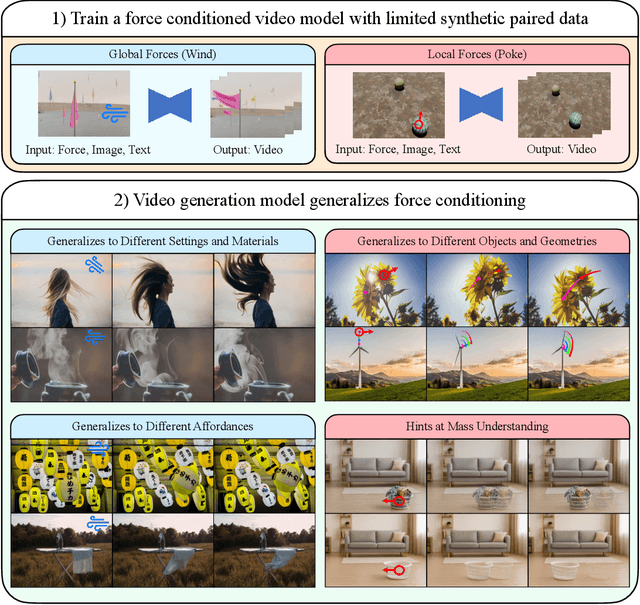
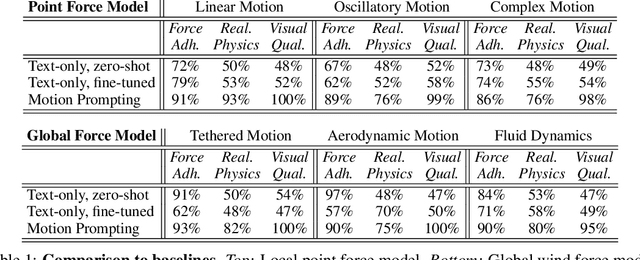
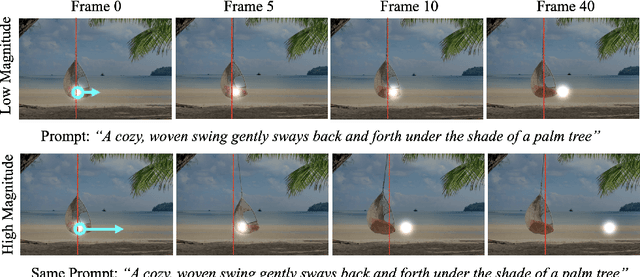

Recent advances in video generation models have sparked interest in world models capable of simulating realistic environments. While navigation has been well-explored, physically meaningful interactions that mimic real-world forces remain largely understudied. In this work, we investigate using physical forces as a control signal for video generation and propose force prompts which enable users to interact with images through both localized point forces, such as poking a plant, and global wind force fields, such as wind blowing on fabric. We demonstrate that these force prompts can enable videos to respond realistically to physical control signals by leveraging the visual and motion prior in the original pretrained model, without using any 3D asset or physics simulator at inference. The primary challenge of force prompting is the difficulty in obtaining high quality paired force-video training data, both in the real world due to the difficulty of obtaining force signals, and in synthetic data due to limitations in the visual quality and domain diversity of physics simulators. Our key finding is that video generation models can generalize remarkably well when adapted to follow physical force conditioning from videos synthesized by Blender, even with limited demonstrations of few objects. Our method can generate videos which simulate forces across diverse geometries, settings, and materials. We also try to understand the source of this generalization and perform ablations that reveal two key elements: visual diversity and the use of specific text keywords during training. Our approach is trained on only around 15k training examples for a single day on four A100 GPUs, and outperforms existing methods on force adherence and physics realism, bringing world models closer to real-world physics interactions. We release all datasets, code, weights, and interactive video demos at our project page.