 Add to Chrome
 Add to Firefox
 Add to Edge
The Geometric Wall: Manifold Structure Predicts Layerwise Sparse Autoencoder Scaling Laws
May 11, 2026
Sparse autoencoders (SAEs) operationalise the linear representation hypothesis: they reconstruct model activations as sparse linear combinations of interpretable dictionary atoms, on the implicit assumption that activation space is well approximated by a globally linear structure. Their reconstruction error varies sharply across layers in ways that existing scaling laws, fitted at single layers, do not explain. We argue that this variation is the empirical trace of a geometric mismatch: where the activation manifold is curved and its intrinsic dimension varies across layers, no sparse linear dictionary can match it uniformly, and the SAE's width-sparsity scaling becomes a layer-dependent function of manifold structure rather than a single universal law. We conduct the first cross-layer SAE scaling study, fitting and regressing on 844 residual-stream Gemma Scope SAE checkpoints across 68 layers of Gemma 2 2B and 9B. Stage 1 fits a per-layer scaling-law surface; Stage 2 regresses the fitted parameters and the derived per-layer width exponents on four layerwise geometric summaries. We find that manifold geometry predicts the per-layer width exponent in both models, and that the same regression coefficients learnt on one model predict the other model's per-layer exponents under cross-model transfer, indicating a transferable geometric law. At the showcase layers where richer width grids permit identification of the asymptotic floor, we find that the fitted floor tracks the layerwise geometric ordering: higher curvature and intrinsic dimension correspond to higher floor, consistent with the irreducible second-order residual that any sparse linear approximation of a curved manifold must leave behind. SAEs thus encounter not a finite-resource ceiling but a geometry-dependent wall, set by the manifold they are trying to reconstruct.

Counterfactual Explanations on Robust Perceptual Geodesics
Jan 26, 2026Latent-space optimization methods for counterfactual explanations - framed as minimal semantic perturbations that change model predictions - inherit the ambiguity of Wachter et al.'s objective: the choice of distance metric dictates whether perturbations are meaningful or adversarial. Existing approaches adopt flat or misaligned geometries, leading to off-manifold artifacts, semantic drift, or adversarial collapse. We introduce Perceptual Counterfactual Geodesics (PCG), a method that constructs counterfactuals by tracing geodesics under a perceptually Riemannian metric induced from robust vision features. This geometry aligns with human perception and penalizes brittle directions, enabling smooth, on-manifold, semantically valid transitions. Experiments on three vision datasets show that PCG outperforms baselines and reveals failure modes hidden under standard metrics.
Manifold Integrated Gradients: Riemannian Geometry for Feature Attribution
May 16, 2024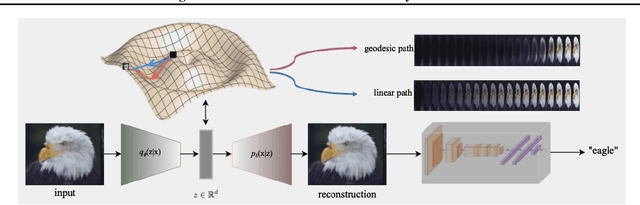
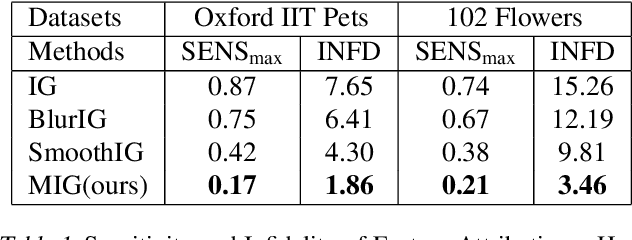
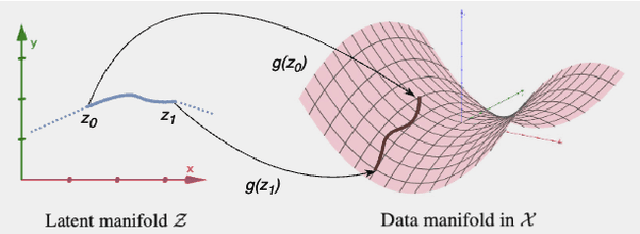
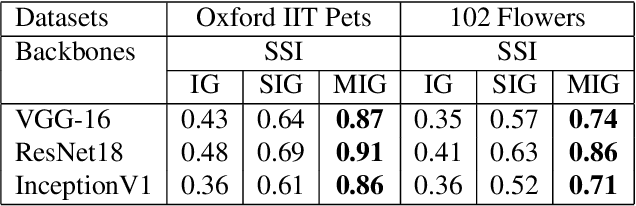
In this paper, we dive into the reliability concerns of Integrated Gradients (IG), a prevalent feature attribution method for black-box deep learning models. We particularly address two predominant challenges associated with IG: the generation of noisy feature visualizations for vision models and the vulnerability to adversarial attributional attacks. Our approach involves an adaptation of path-based feature attribution, aligning the path of attribution more closely to the intrinsic geometry of the data manifold. Our experiments utilise deep generative models applied to several real-world image datasets. They demonstrate that IG along the geodesics conforms to the curved geometry of the Riemannian data manifold, generating more perceptually intuitive explanations and, subsequently, substantially increasing robustness to targeted attributional attacks.