 Add to Chrome
 Add to Firefox
 Add to Edge
Towards Generalizable Representations of Mathematical Strategies
Apr 09, 2026
Pretrained encoders for mathematical texts have achieved significant improvements on various tasks such as formula classification and information retrieval. Yet they remain limited in representing and capturing student strategies for entire solution pathways. Previously, this has been accomplished either through labor-intensive manual labeling, which does not scale, or by learning representations tied to platform-specific actions, which limits generalizability. In this work, we present a novel approach for learning problem-invariant representations of entire algebraic solution pathways. We first construct transition embeddings by computing vector differences between consecutive algebraic states encoded by high-capacity pretrained models, emphasizing transformations rather than problem-specific features. Sequence-level embeddings are then learned via SimCSE, using contrastive objectives to position semantically similar solution pathways close in embedding space while separating dissimilar strategies. We evaluate these embeddings through multiple tasks, including multi-label action classification, solution efficiency prediction, and sequence reconstruction, and demonstrate their capacity to encode meaningful strategy information. Furthermore, we derive embedding-based measures of strategy uniqueness, diversity, and conformity that correlate with both short-term and distal learning outcomes, providing scalable proxies for mathematical creativity and divergent thinking. This approach facilitates platform-agnostic and cross-problem analyses of student problem-solving behaviors, demonstrating the effectiveness of transition-based sequence embeddings for educational data mining and automated assessment.

Toward Automated Classroom Observation: Multimodal Machine Learning to Estimate CLASS Positive Climate and Negative Climate
May 19, 2020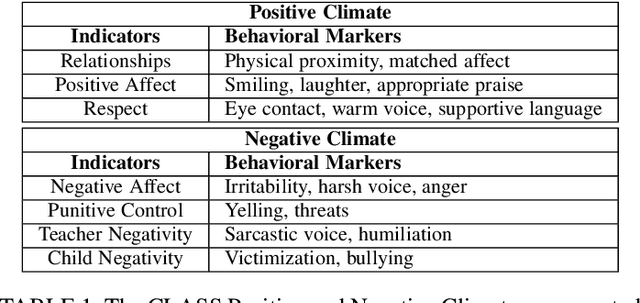
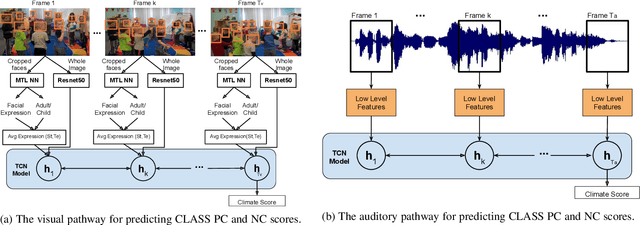
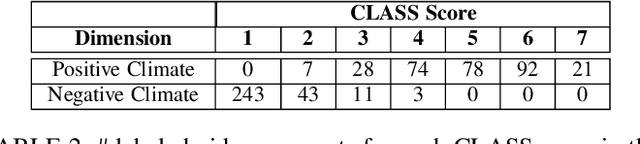
In this work we present a multi-modal machine learning-based system, which we call ACORN, to analyze videos of school classrooms for the Positive Climate (PC) and Negative Climate (NC) dimensions of the CLASS observation protocol that is widely used in educational research. ACORN uses convolutional neural networks to analyze spectral audio features, the faces of teachers and students, and the pixels of each image frame, and then integrates this information over time using Temporal Convolutional Networks. The audiovisual ACORN's PC and NC predictions have Pearson correlations of $0.55$ and $0.63$ with ground-truth scores provided by expert CLASS coders on the UVA Toddler dataset (cross-validation on $n=300$ 15-min video segments), and a purely auditory ACORN predicts PC and NC with correlations of $0.36$ and $0.41$ on the MET dataset (test set of $n=2000$ videos segments). These numbers are similar to inter-coder reliability of human coders. Finally, using Graph Convolutional Networks we make early strides (AUC=$0.70$) toward predicting the specific moments (45-90sec clips) when the PC is particularly weak/strong. Our findings inform the design of automatic classroom observation and also more general video activity recognition and summary recognition systems.