 Add to Chrome
 Add to Firefox
 Add to Edge
SurvCF(t): Counterfactual Explanations for Survival Analysis in Predictive Maintenance Multivariate Time Series Data
Jul 18, 2026
Predictive maintenance relies on accurate Remaining Useful Life estimation, often formulated using survival analysis over multivariate time-series data. While modern deep survival models achieve strong predictive performance, their black-box nature limits their use in safety-critical settings where actionable insight is required. In this work, we introduce \textit{SurvCF(t)}, the first framework for generating counterfactual explanations for survival models operating on time-series data. \textit{SurvCF(t)} identifies minimal, plausible, and temporally consistent changes to an asset's operational history that increase its predicted life time, framing explanation as a constrained optimization problem combining validity, proximity, sparsity, and plausibility. We evaluate the method on multiple benchmarks, including C-MAPSS, N-CMAPSS, and a real-world case study of the Scania Component\_X dataset, demonstrating its ability to produce actionable and interpretable interventions. Our results show that \textit{SurvCF(t)} bridges the gap between survival prediction and prescriptive maintenance, enabling explainable and decision-oriented AI for maintenance strategies.

Vessel Trajectory Prediction using COLREGs-aware Optimal Planning
Jul 17, 2026This paper presents a trajectory prediction method for marine vessels based on optimal planning. Crude initial trajectories respecting static obstacles are first generated using A*-search to provide a feasible warm start. In the second step, a numerical optimizer is used to ensure COLREG compliance. The prediction problem is posed as sequential trajectory planning from the perspective of each surrounding vessel, requiring only their current positions, velocities, and intended destinations as input. As the latter is included in AIS messages, this enables faster predictions than learning-based methods that typically require longer data histories. The proposed method is validated using real-world scenarios constructed from AIS data.
Unveiling Transferability in Trajectory Prediction via Latent Scene Embeddings
Jun 29, 2026The growing availability of trajectory datasets has fueled major advances in data-driven motion prediction. Yet, models trained on one dataset often fail to generalize beyond their training domain as a result of differences in scene layouts, agent behaviors, and sensing conditions. A framework that learns latent representations of datasets and quantifies their similarity using distributional metrics is presented. This large-scale study covers 24 major datasets, including the most widely used motion-prediction benchmarks, and shows that the resulting transferability scores strongly correlate with cross-dataset model performance. The results provide practical guidance for dataset selection, pretraining, and large-scale foundation models for motion prediction, paving the way toward more generalizable and robust predictive systems.
Lateral tracking control of all-wheel steering vehicles with intelligent tires
Feb 11, 2026The accurate characterization of tire dynamics is critical for advancing control strategies in autonomous road vehicles, as tire behavior significantly influences handling and stability through the generation of forces and moments at the tire-road interface. Smart tire technologies have emerged as a promising tool for sensing key variables such as road friction, tire pressure, and wear states, and for estimating kinematic and dynamic states like vehicle speed and tire forces. However, most existing estimation and control algorithms rely on empirical correlations or machine learning approaches, which require extensive calibration and can be sensitive to variations in operating conditions. In contrast, model-based techniques, which leverage infinite-dimensional representations of tire dynamics using partial differential equations (PDEs), offer a more robust approach. This paper proposes a novel model-based, output-feedback lateral tracking control strategy for all-wheel steering vehicles that integrates distributed tire dynamics with smart tire technologies. The primary contributions include the suppression of micro-shimmy phenomena at low speeds and path-following via force control, achieved through the estimation of tire slip angles, vehicle kinematics, and lateral tire forces. The proposed controller and observer are based on formulations using ODE-PDE systems, representing rigid body dynamics and distributed tire behavior. This work marks the first rigorous control strategy for vehicular systems equipped with distributed tire representations in conjunction with smart tire technologies.
First-order friction models with bristle dynamics: lumped and distributed formulations
Feb 11, 2026Dynamic models, particularly rate-dependent models, have proven effective in capturing the key phenomenological features of frictional processes, whilst also possessing important mathematical properties that facilitate the design of control and estimation algorithms. However, many rate-dependent formulations are built on empirical considerations, whereas physical derivations may offer greater interpretability. In this context, starting from fundamental physical principles, this paper introduces a novel class of first-order dynamic friction models that approximate the dynamics of a bristle element by inverting the friction characteristic. Amongst the developed models, a specific formulation closely resembling the LuGre model is derived using a simple rheological equation for the bristle element. This model is rigorously analyzed in terms of stability and passivity -- important properties that support the synthesis of observers and controllers. Furthermore, a distributed version, formulated as a hyperbolic partial differential equation (PDE), is presented, which enables the modeling of frictional processes commonly encountered in rolling contact phenomena. The tribological behavior of the proposed description is evaluated through classical experiments and validated against the response predicted by the LuGre model, revealing both notable similarities and key differences.
Semilinear single-track vehicle models with distributed tyre friction dynamics
Jan 11, 2026This paper introduces a novel family of single-track vehicle models that incorporate a distributed representation of transient tyre dynamics, whilst simultaneously accounting for nonlinear effects induced by friction. The core of the proposed framework is represented by the distributed Friction with Bristle Dynamics (FrBD) model, which unifies and extends classical formulations such as Dahl and LuGre by describing the rolling contact process as a spatially distributed system governed by semilinear partial differential equations (PDEs). This model is systematically integrated into a single-track vehicle framework, where the resulting semilinear ODE-PDE interconnection captures the interaction between lateral vehicle motion and tyre deformation. Two main variants are considered: one with rigid tyre carcass and another with flexible carcass, each admitting a compact state-space representation. Local and global well-posedness properties for the coupled system are established rigorously, highlighting the dissipative and physically consistent properties of the distributed FrBD model. A linearisation procedure is also presented, enabling spectral analysis and transfer function derivation, and potentially facilitating the synthesis of controllers and observers. Numerical simulations demonstrate the model's capability to capture micro-shimmy oscillations and transient lateral responses to advanced steering manoeuvres. The proposed formulation advances the state-of-the-art in vehicle dynamics modelling by providing a physically grounded, mathematically rigorous, and computationally tractable approach to incorporating transient tyre behaviour in lateral vehicle dynamics, when accounting for the effect of limited friction.
Behavior-Aware Online Prediction of Obstacle Occupancy using Zonotopes
Oct 23, 2025Predicting the motion of surrounding vehicles is key to safe autonomous driving, especially in unstructured environments without prior information. This paper proposes a novel online method to accurately predict the occupancy sets of surrounding vehicles based solely on motion observations. The approach is divided into two stages: first, an Extended Kalman Filter and a Linear Programming (LP) problem are used to estimate a compact zonotopic set of control actions; then, a reachability analysis propagates this set to predict future occupancy. The effectiveness of the method has been validated through simulations in an urban environment, showing accurate and compact predictions without relying on prior assumptions or prior training data.
Uncertainty-Aware Decision-Making and Planning for Autonomous Forced Merging
Oct 27, 2024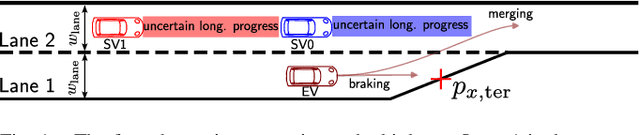
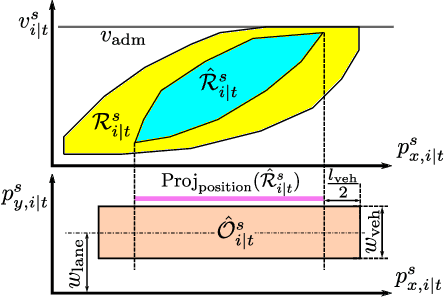
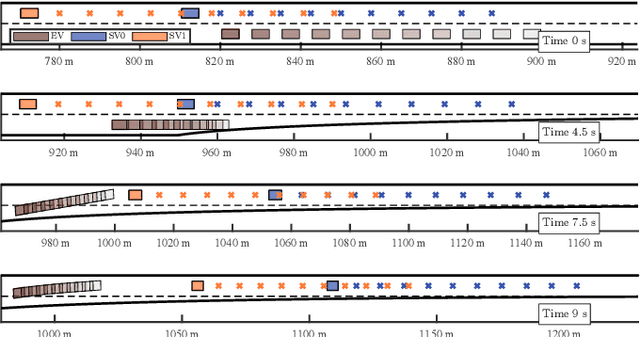
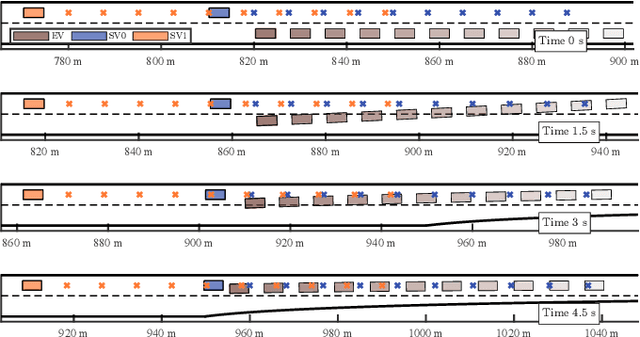
In this paper, we develop an uncertainty-aware decision-making and motion-planning method for an autonomous ego vehicle in forced merging scenarios, considering the motion uncertainty of surrounding vehicles. The method dynamically captures the uncertainty of surrounding vehicles by online estimation of their acceleration bounds, enabling a reactive but rapid understanding of the uncertainty characteristics of the surrounding vehicles. By leveraging these estimated bounds, a non-conservative forward occupancy of surrounding vehicles is predicted over a horizon, which is incorporated in both the decision-making process and the motion-planning strategy, to enhance the resilience and safety of the planned reference trajectory. The method successfully fulfills the tasks in challenging forced merging scenarios, and the properties are illustrated by comparison with several alternative approaches.
A Preprocessing and Evaluation Toolbox for Trajectory Prediction Research on the Drone Datasets
May 01, 2024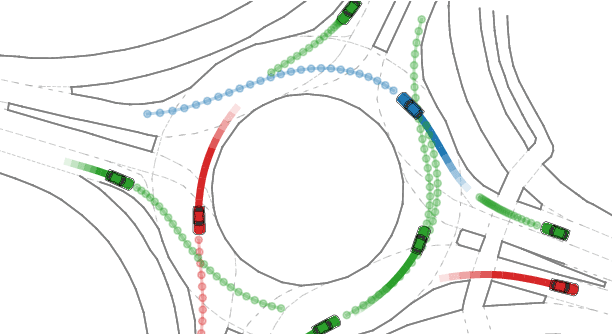
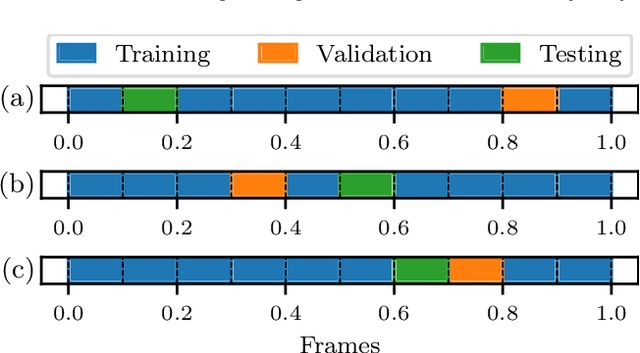

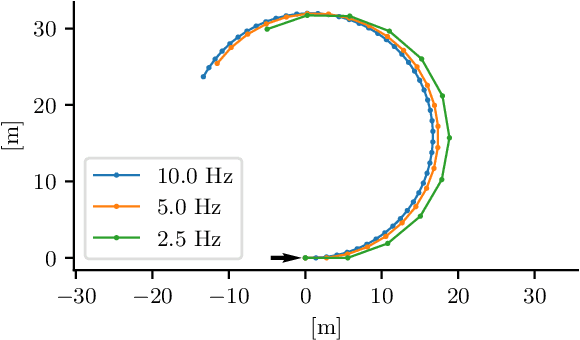
The availability of high-quality datasets is crucial for the development of behavior prediction algorithms in autonomous vehicles. This paper highlights the need for standardizing the use of certain datasets for motion forecasting research to simplify comparative analysis and proposes a set of tools and practices to achieve this. Drawing on extensive experience and a comprehensive review of current literature, we summarize our proposals for preprocessing, visualizing, and evaluation in the form of an open-sourced toolbox designed for researchers working on trajectory prediction problems. The clear specification of necessary preprocessing steps and evaluation metrics is intended to alleviate development efforts and facilitate the comparison of results across different studies. The toolbox is available at: https://github.com/westny/dronalize.
Usage-Specific Survival Modeling Based on Operational Data and Neural Networks
Mar 27, 2024
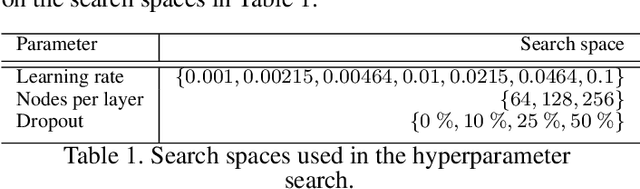


Accurate predictions of when a component will fail are crucial when planning maintenance, and by modeling the distribution of these failure times, survival models have shown to be particularly useful in this context. The presented methodology is based on conventional neural network-based survival models that are trained using data that is continuously gathered and stored at specific times, called snapshots. An important property of this type of training data is that it can contain more than one snapshot from a specific individual which results in that standard maximum likelihood training can not be directly applied since the data is not independent. However, the papers show that if the data is in a specific format where all snapshot times are the same for all individuals, called homogeneously sampled, maximum likelihood training can be applied and produce desirable results. In many cases, the data is not homogeneously sampled and in this case, it is proposed to resample the data to make it homogeneously sampled. How densely the dataset is sampled turns out to be an important parameter; it should be chosen large enough to produce good results, but this also increases the size of the dataset which makes training slow. To reduce the number of samples needed during training, the paper also proposes a technique to, instead of resampling the dataset once before the training starts, randomly resample the dataset at the start of each epoch during the training. The proposed methodology is evaluated on both a simulated dataset and an experimental dataset of starter battery failures. The results show that if the data is homogeneously sampled the methodology works as intended and produces accurate survival models. The results also show that randomly resampling the dataset on each epoch is an effective way to reduce the size of the training data.