 Add to Chrome
 Add to Firefox
 Add to Edge
Side-Channel Attacks Bypass Protection in 3D Printers
Jun 11, 2026
Active Motor Noise Cancellation (AMNC) ships in commercial fused deposition modeling (FDM) 3D printers as a hardware countermeasure against acoustic side-channel attacks that target intellectual property (IP). We present the first empirical evaluation of a deployed AMNC countermeasure, using a public dataset of synchronized acoustic and vibration recordings from two AMNC-equipped Bambu Lab printers across 12 object classes. AMNC fully neutralizes the acoustic channel: classification accuracy is indistinguishable from the 8.33% random baseline. The vibration channel, which AMNC does not target, still leaks. With summary statistics the leak is coarse and amplitude-driven (vibration accuracy approximately 31% pooled, 36-47% within-printer), while the waveform shape carries essentially nothing (frequency-only features at chance). A full-sequence temporal model that ingests the ordered evolution of the print raises accuracy to approximately 61%, and an order-shuffling control (approximately 33%) shows that a substantial component is genuinely sequential and tied to print progression. The leak is device-specific: a classifier trained on one printer transfers near chance to the other. We conclude that AMNC is an acoustic-only defense: vibration remains a partial, geometry-correlated side channel it does not address, but one that does not, on this dataset, support full geometric reconstruction; reconstruction-grade attacks would require the magnetic or power channels AMNC also leaves untouched. We release all code.

TriSweep: A Four-Drone Swarm Framework for Electromagnetic Side-Channel Analysis
May 21, 2026Electromagnetic (EM) side-channel analysis traditionally assumes a stationary, close-proximity probe - a threat model that underestimates aerial adversaries. TriSweep is a simulation framework that designs and evaluates a four-drone swarm architecture for autonomous standoff EM-SCA of embedded microcontrollers at 0.25-1.5 m. Three spatially specialized collector drones - Anchor (full-spectrum), Mask Probe (mask-register loading leakage), and Cipher Probe (masked SubBytes output leakage) - feed a stationary Accumulator drone that performs coherent combining (+4.8 dB SNR gain) and second-order mask cancellation via a centered product of the two spatially separated leakage streams. Evaluated against three real ANSSI ASCAD datasets (ATmega8515 masked AES-128 and 50/100-sample desynchronized variants), the framework achieves a simulated key rank of 18 +/- 1.7 (five-seed) at 0.25 m on the primary masked dataset. Profiling-trace cross-correlation alignment reduces single-drone rank from 89 to 21 on the 100-sample-jitter variant, demonstrating compensation for drone hover vibration. A two-channel CNN in the Accumulator converges to a loss of 0.454 (vs. random baseline 5.545) and improves rank on desynchronized datasets. No physical hardware has been fabricated; prototype construction is the planned next step.
H-Node Attack and Defense in Large Language Models
Mar 27, 2026We present H-Node Adversarial Noise Cancellation (H-Node ANC), a mechanistic framework that identifies, exploits, and defends hallucination representations in transformer-based large language models (LLMs) at the level of individual hidden-state dimensions. A logistic regression probe trained on last-token hidden states localizes hallucination signal to a small set of high-variance dimensions -- termed Hallucination Nodes (H-Nodes) -- with probe AUC reaching 0.90 across four architectures. A white-box adversarial attack amplifies these dimensions at inference time via a real-time forward hook, achieving a selectivity of 3.02x with less than 10% visibility to the defender. Adaptive ANC defense suppresses H-Node excess in-pass using confidence-weighted cancellation, reducing grounded activation drift by 33-42% over static cancellation. A dynamic iterative extension that re-ranks cancellation targets across successive passes recovers up to 0.69 robustness from a single-pass baseline of 8%. All contributions are validated on OPT-125M, Phi-3-mini-4k-instruct, LLaMA-3-8B-Instruct, and Mistral-7B-Instruct-v0.3 (125M-8B parameters). Perplexity impact is surgical (<5%) and MMLU degradation is at most 3%, confirming that the defense does not impair general reasoning capability.
Adaptive Activation Cancellation for Hallucination Mitigation in Large Language Models
Mar 10, 2026Large Language Models frequently generate fluent but factually incorrect text. We propose Adaptive Activation Cancellation (AAC), a real-time inference-time framework that treats hallucination-associated neural activations as structured interference within the transformer residual stream, drawing an explicit analogy to classical adaptive noise cancellation from signal processing. The framework identifies Hallucination Nodes (H-Nodes) via layer-wise linear probing and suppresses them using a confidence-weighted forward hook during auto-regressive generation -- requiring no external knowledge, no fine-tuning, and no additional inference passes. Evaluated across OPT-125M, Phi-3-mini, and LLaMA 3-8B on TruthfulQA and HaluEval, the real-time hook is the only intervention that consistently improves downstream accuracy on all three scales. Critically, the method is strictly surgical: WikiText-103 perplexity and MMLU reasoning accuracy are preserved at exactly 0.0% degradation across all three model scales, a property that distinguishes AAC from interventions that trade fluency or general capability for factual improvement. On the LLaMA 3-8B scale, the hook additionally yields positive generation-level gains (MC1 +0.04; MC2 +0.003; Token-F1 +0.003) while achieving probe-space selectivity 5.94x - 3.5x higher than the ITI baseline -- demonstrating that targeted neuron-level suppression can simultaneously improve factual accuracy and preserve model capability.
Quantum Adversarial Machine Learning and Defense Strategies: Challenges and Opportunities
Dec 16, 2024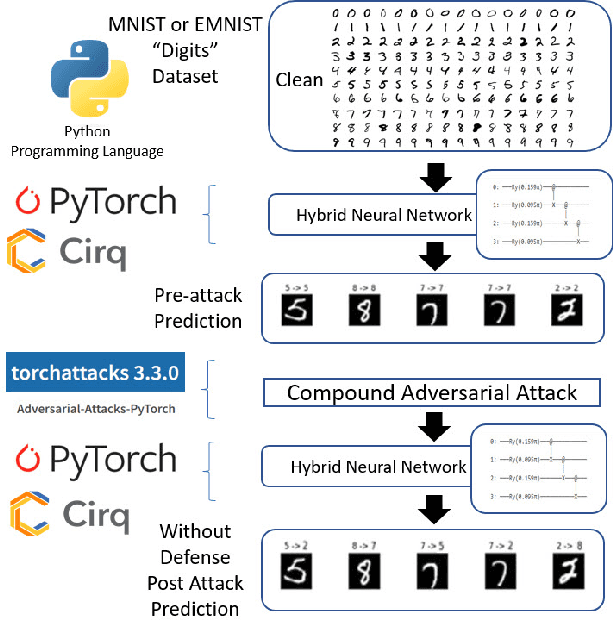
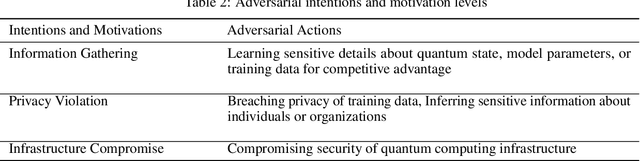
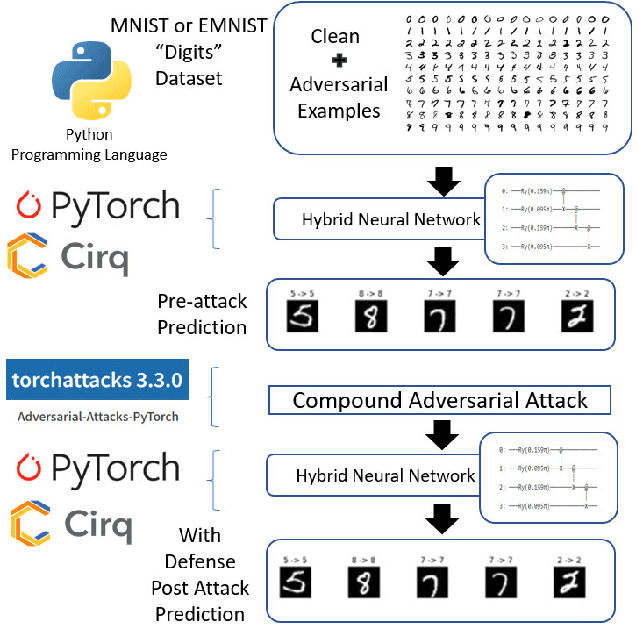
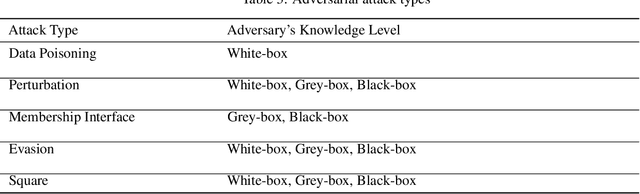
As quantum computing continues to advance, the development of quantum-secure neural networks is crucial to prevent adversarial attacks. This paper proposes three quantum-secure design principles: (1) using post-quantum cryptography, (2) employing quantum-resistant neural network architectures, and (3) ensuring transparent and accountable development and deployment. These principles are supported by various quantum strategies, including quantum data anonymization, quantum-resistant neural networks, and quantum encryption. The paper also identifies open issues in quantum security, privacy, and trust, and recommends exploring adaptive adversarial attacks and auto adversarial attacks as future directions. The proposed design principles and recommendations provide guidance for developing quantum-secure neural networks, ensuring the integrity and reliability of machine learning models in the quantum era.