 Add to Chrome
 Add to Firefox
 Add to Edge
Sliding Sensors: Configurable Confidence in State Estimation for Continuum Robots
Aug 05, 2026
Continuum robots often operate in uncertain environments, where accurate state estimation is essential for safe interactions. Estimate uncertainty is inherently spatially non-uniform: confidence varies depending on where measurements are available. Global estimation accuracy is not always the top priority, but rather achieving sufficient confidence at task-relevant locations along the robot. This extended abstract introduces mechanically reconfigurable sensing enabling uncertainty-shaping in state estimation for continuum robots. We present a concept hardware design demonstrating the feasibility of longitudinal translation of a sensor within a continuum robot. We demonstrate that state estimation confidence can be reconfigured by varying the sensor location, and show a reduction of full-body shape estimation errors when sliding the sensor back and forth over time, compared to a single fixed tip sensor.

Electromagnets Under the Table: an Unobtrusive Magnetic Navigation System for Microsurgery
Aug 23, 2023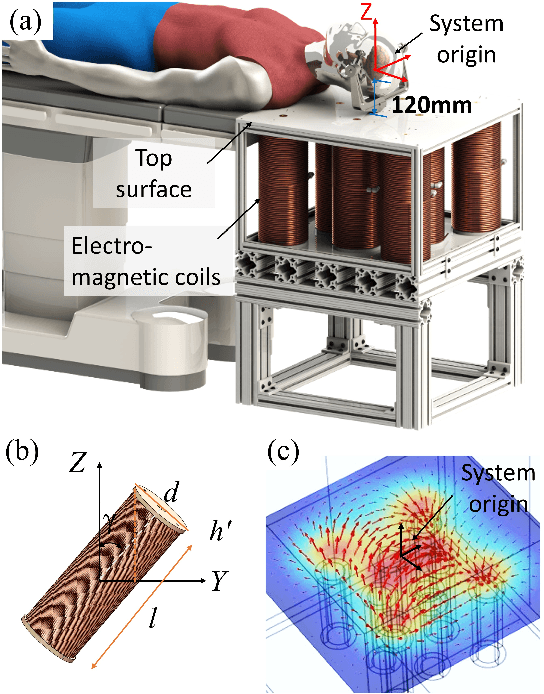
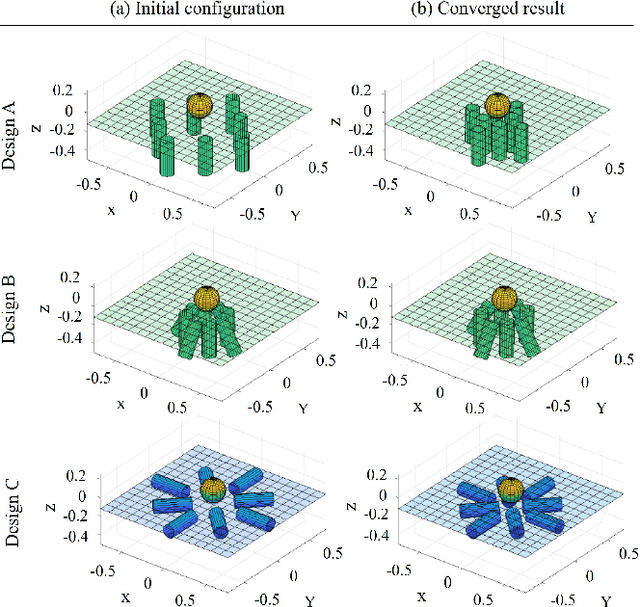
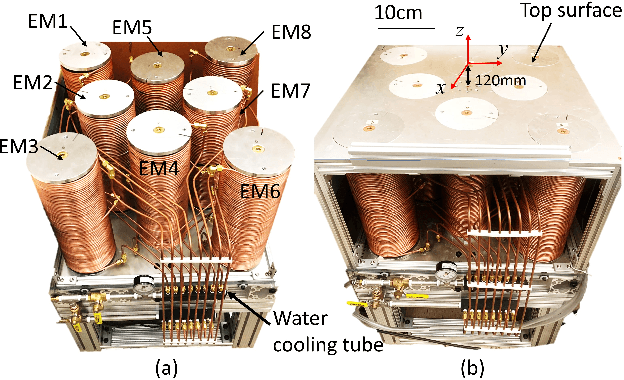
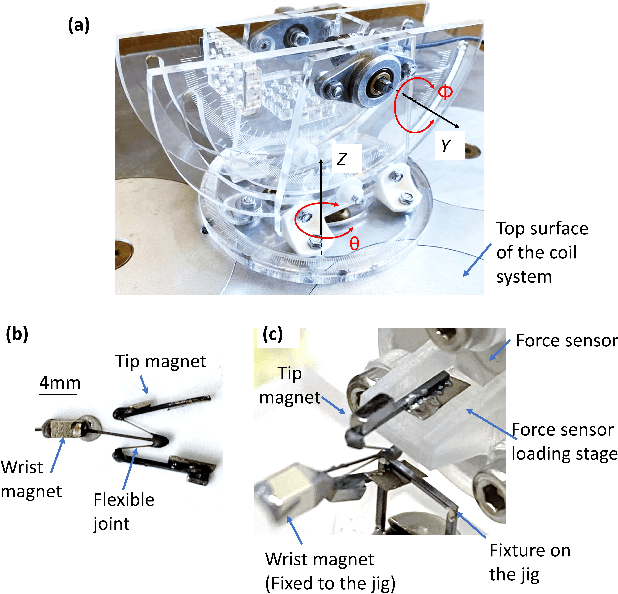
Miniature magnetic tools have the potential to enable minimally invasive surgical techniques to be applied to space-restricted surgical procedures in areas such as neurosurgery. However, typical magnetic navigation systems, which create the magnetic fields to drive such tools, either cannot generate large enough fields, or surround the patient in a way that obstructs surgeon access to the patient. This paper introduces the design of a magnetic navigation system with eight electromagnets arranged completely under the operating table, to endow the system with maximal workspace accessibility, which allows the patient to lie down on the top surface of the system without any constraints. The found optimal geometric layout of the electromagnets maximizes the field strength and uniformity over a reasonable neurosurgical operating volume. The system can generate non-uniform magnetic fields up to 38 mT along the x and y axes and 47 mT along the z axis at a working distance of 120 mm away from the actuation system workbench, deep enough to deploy magnetic microsurgical tools in the brain. The forces which can be exerted on millimeter-scale magnets used in prototype neurosurgical tools are validated experimentally. Due to its large workspace, this system could be used to control milli-robots in a variety of surgical applications.