 Add to Chrome
 Add to Firefox
 Add to Edge
Parametric Channel Estimation with Hardware Impaired Hybrid Beamformers: Sensing, Communications, and Power Efficiency Tradeoffs
Jun 10, 2026
Due to high power consumption and hardware costs of fully digital arrays, hybrid beamformers are often considered as a more economic alternative. Furthermore, using high resolution analog to digital converters (ADCs) can also have prohibitive power consumption, which leads to lower resolution converters being considered for radio frequency (RF) front end design. The finite quantization resolution as well as the nonlinearities caused by the power amplifiers (PAs) and low noise amplifiers (LNAs) can have a substantial impact on system performance. While widely studied for communications, the impact of hardware impairments on sensing performance is considerably less explored. In this work, we study the interplay between hybrid beamforming architectures, hardware impairments, and sensing and communications performance. Additionally, we define the concept of double-isotropy for pilot-combiner pairs, formalizing the notion of a perfectly energy-fair beam sweep. The multiple start (MS) space alternating generalized expectation maximization algorithm (SAGE) is also introduced, aimed at addressing the optimization issues arising from parametric channel estimation (PCE) in hybrid beamformed systems. We then provide a set of numerical results assessing the impacts of beamformer architecture and ADC resolution on PCE, sensing, and communications performance. The results show that medium resolution ADCs lead to the most power efficient configurations, with the best tradeoff between power consumption and performance for the majority of beamforming architectures. Additionally, fully digital beamforming architectures with high resolution converters can often be substituted for a hybrid beamformer setup with medium resolution converters without significant performance loss at a lower power consumption and overall hardware cost.

Time-Varying Parametric Channel Estimation With CP Decomposition Tensor Processing
May 25, 2026Integrated sensing and communications (ISAC) is a key use case for sixth-generation (6G) wireless systems, where parametric channel estimation (PCE) plays a central role in enabling sensing, localization, and channel equalization in high-mobility scenarios. However, PCE is typically more computationally demanding than conventional channel estimation, which motivates the development of lower-complexity solutions. In this letter, we propose a fast PCE algorithm for time-varying and frequency-selective (TVFS) channels based on canonical polyadic (CP) decomposition and tensor processing, combined with ESPRIT-based initialization, component refinement, and exact line-search alternating coordinate descent. Two variants are presented: one for fully digital and another for hybrid receiver architectures. Numerical results show that the proposed method clearly outperforms a related CP-based baseline while achieving estimation performance close to a multiple-start SAGE benchmark at a substantially lower computational cost, with about one order of magnitude shorter execution time.
Sequential MAP Parametric OFDM Channel Estimation for Joint Sensing and Communication
Jun 12, 2024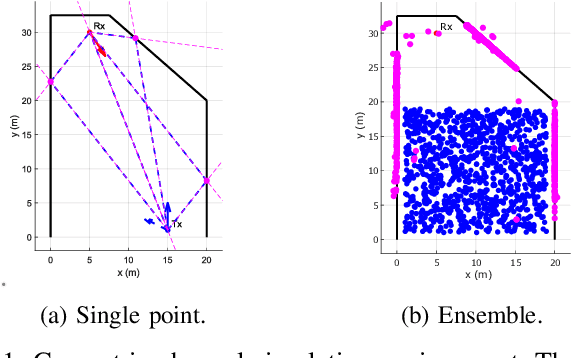
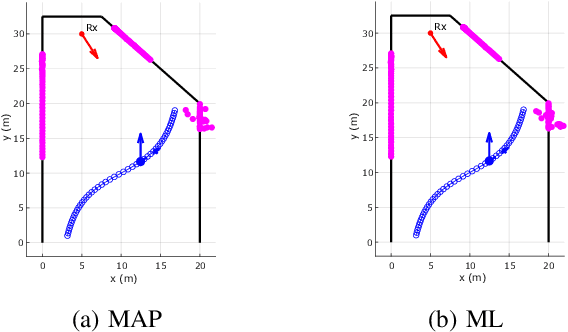


Uplink sensing is still a relatively unexplored scenario in integrated sensing and communication which can be used to improve positioning and sensing estimates. We introduce a pilot-based maximum likelihood, and a maximum a posteriori parametric channel estimation procedure using an orthogonal frequency division multiplexing (OFDM) waveform in uplink sensing. The algorithm is capable of estimating the multipath components of the channel, such as the angles of arrival, departure, path coefficient, and the delay and Doppler terms. As an advantage, when compared to other existing methods, the proposed procedure presents expressions for exact alternating coordinate updates, which can be further improved to achieve a competitive multipath channel estimation tool.
Doppler-Robust Maximum Likelihood Parametric Channel Estimation for Multiuser MIMO-OFDM
Jun 12, 2024The high directionality and intense Doppler effects of millimeter wave (mmWave) and sub-terahertz (subTHz) channels demand accurate localization of the users and a new paradigm of channel estimation. For orthogonal frequency division multiplexing (OFDM) waveforms, estimating the geometric parameters of the radio channel can make these systems more Doppler-resistant and also enhance sensing and positioning performance. In this paper, we derive a multiuser, multiple-input multiple-output (MIMO), maximum likelihood, parametric channel estimation algorithm for uplink sensing, which is capable of accurately estimating the parameters of each multipath that composes each user's channel under severe Doppler shift conditions. The presented method is one of the only Doppler-robust currently available algorithms that does not rely on line search.