 Add to Chrome
 Add to Firefox
 Add to Edge
Easy to Complete, Hard to Choose: Investigating LLM Performance on the ProverbIT Benchmark
Aug 05, 2026
Large Language Models (LLMs) have transformed computational linguistics and achieved remarkable performance across numerous natural language processing tasks, yet significant gaps persist in understanding how these systems process culturally embedded linguistic expressions. This paper introduces ProverbIT, a novel Italian benchmark comprising 100 multiple-choice questions designed to evaluate LLMs' ability to complete Italian proverbs. We assess 13 frontier models, including Large Reasoning Models (LRMs) and traditional LLMs, across three tasks: proverb completion, multiple-choice selection with correct answers, and multiple-choice selection without correct answers. Our evaluation reveals surprising results: while nearly all models demonstrate knowledge of the proverbs through successful completion tasks, performance drops dramatically when transitioning to multiple-choice formats without correct answers, with even state-of-the-art reasoning models showing substantial degradation. Through detailed Chain-of-Thought analysis of two LRMs, we uncover that models exhibit a strong bias toward selecting literal synonyms and frequently mention correct proverb endings during reasoning without successfully identifying their absence from the given options. These findings suggest that current LLMs rely heavily on memorized patterns rather than deeper semantic understanding of culturally grounded expressions, highlighting important limitations in their reasoning capabilities for figurative language comprehension.

Wikibio: a Semantic Resource for the Intersectional Analysis of Biographical Events
Jun 15, 2023Biographical event detection is a relevant task for the exploration and comparison of the ways in which people's lives are told and represented. In this sense, it may support several applications in digital humanities and in works aimed at exploring bias about minoritized groups. Despite that, there are no corpora and models specifically designed for this task. In this paper we fill this gap by presenting a new corpus annotated for biographical event detection. The corpus, which includes 20 Wikipedia biographies, was compared with five existing corpora to train a model for the biographical event detection task. The model was able to detect all mentions of the target-entity in a biography with an F-score of 0.808 and the entity-related events with an F-score of 0.859. Finally, the model was used for performing an analysis of biases about women and non-Western people in Wikipedia biographies.
Guidelines and a Corpus for Extracting Biographical Events
Jun 07, 2022
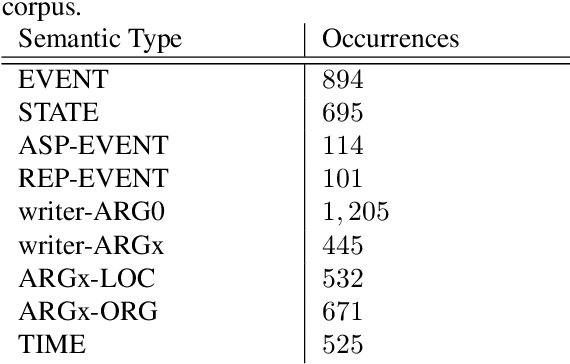
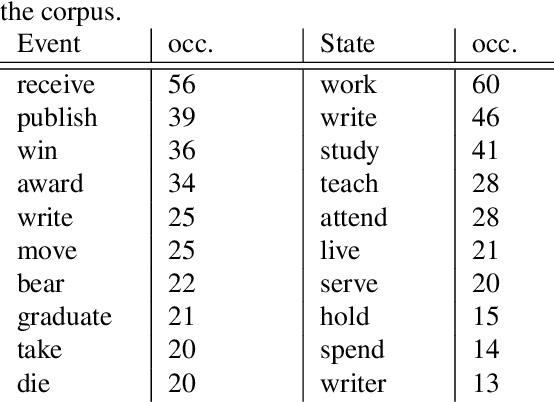
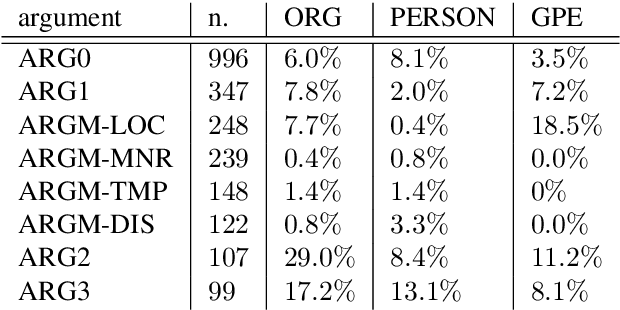
Despite biographies are widely spread within the Semantic Web, resources and approaches to automatically extract biographical events are limited. Such limitation reduces the amount of structured, machine-readable biographical information, especially about people belonging to underrepresented groups. Our work challenges this limitation by providing a set of guidelines for the semantic annotation of life events. The guidelines are designed to be interoperable with existing ISO-standards for semantic annotation: ISO-TimeML (ISO-24617-1), and SemAF (ISO-24617-4). Guidelines were tested through an annotation task of Wikipedia biographies of underrepresented writers, namely authors born in non-Western countries, migrants, or belonging to ethnic minorities. 1,000 sentences were annotated by 4 annotators with an average Inter-Annotator Agreement of 0.825. The resulting corpus was mapped on OntoNotes. Such mapping allowed to to expand our corpus, showing that already existing resources may be exploited for the biographical event extraction task.