 Add to Chrome
 Add to Firefox
 Add to Edge
A solver-in-the-loop framework for end-to-end differentiable coastal hydrodynamics
Apr 08, 2026
Numerical simulation of wave propagation and run-up is a cornerstone of coastal engineering and tsunami hazard assessment. However, applying these forward models to inverse problems, such as bathymetry estimation, source inversion, and structural optimization, remains notoriously difficult due to the rigidity and high computational cost of deriving discrete adjoints. In this paper, we introduce AegirJAX, a fully differentiable hydrodynamic solver based on the depth-integrated, non-hydrostatic shallow-water equations. By implementing the solver entirely within a reverse-mode automatic differentiation framework, AegirJAX treats the time-marching physics loop as a continuous computational graph. We demonstrate the framework's versatility across a suite of scientific machine learning tasks: (1) discovering regime-specific neural corrections for model misspecifications in highly dispersive wave propagation; (2) performing continuous topology optimization for breakwater design; (3) training recurrent neural networks in-the-loop for active wave cancellation; and (4) inverting hidden bathymetry and submarine landslide kinematics directly from downstream sensor data. The proposed differentiable paradigm fundamentally blurs the line between forward simulation and inverse optimization, offering a unified, end-to-end framework for coastal hydrodynamics.

Learning vertical coordinates via automatic differentiation of a dynamical core
Dec 19, 2025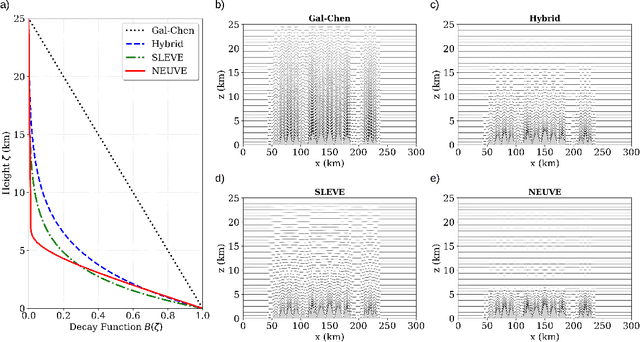

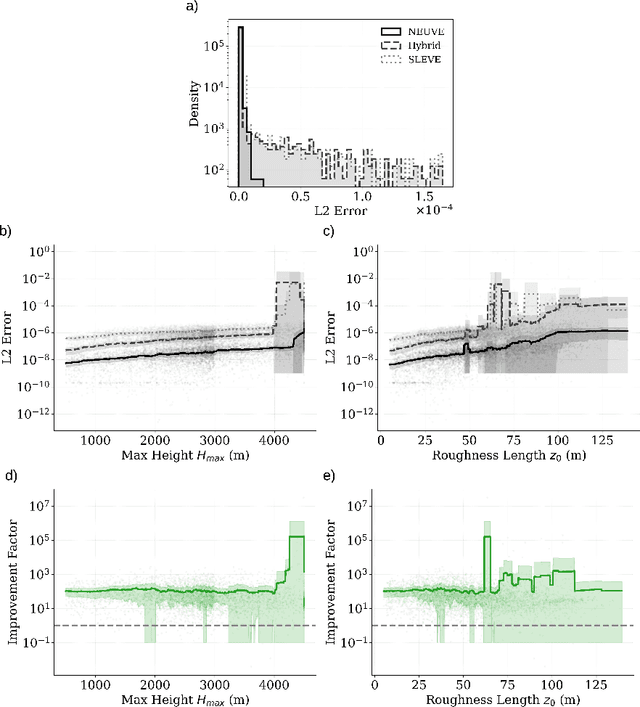
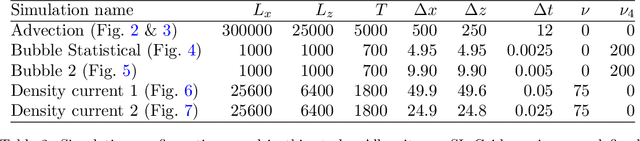
Terrain-following coordinates in atmospheric models often imprint their grid structure onto the solution, particularly over steep topography, where distorted coordinate layers can generate spurious horizontal and vertical motion. Standard formulations, such as hybrid or SLEVE coordinates, mitigate these errors by using analytic decay functions controlled by heuristic scale parameters that are typically tuned by hand and fixed a priori. In this work, we propose a framework to define a parametric vertical coordinate system as a learnable component within a differentiable dynamical core. We develop an end-to-end differentiable numerical solver for the two-dimensional non-hydrostatic Euler equations on an Arakawa C-grid, and introduce a NEUral Vertical Enhancement (NEUVE) terrain-following coordinate based on an integral transformed neural network that guarantees monotonicity. A key feature of our approach is the use of automatic differentiation to compute exact geometric metric terms, thereby eliminating truncation errors associated with finite-difference coordinate derivatives. By coupling simulation errors through the time integration to the parameterization, our formulation finds a grid structure optimized for both the underlying physics and numerics. Using several standard tests, we demonstrate that these learned coordinates reduce the mean squared error by a factor of 1.4 to 2 in non-linear statistical benchmarks, and eliminate spurious vertical velocity striations over steep topography.
Exactly conservative physics-informed neural networks and deep operator networks for dynamical systems
Nov 23, 2023We introduce a method for training exactly conservative physics-informed neural networks and physics-informed deep operator networks for dynamical systems. The method employs a projection-based technique that maps a candidate solution learned by the neural network solver for any given dynamical system possessing at least one first integral onto an invariant manifold. We illustrate that exactly conservative physics-informed neural network solvers and physics-informed deep operator networks for dynamical systems vastly outperform their non-conservative counterparts for several real-world problems from the mathematical sciences.