 Add to Chrome
 Add to Firefox
 Add to Edge
Domain-informed explainable boosting machines for trustworthy lateral spread predictions
Mar 17, 2026
Explainable Boosting Machines (EBMs) provide transparent predictions through additive shape functions, enabling direct inspection of feature contributions. However, EBMs can learn non-physical relationships that reduce their reliability in natural hazard applications. This study presents a domain-informed framework to improve the physical consistency of EBMs for lateral spreading prediction. Our approach modifies learned shape functions based on domain knowledge. These modifications correct non-physical behavior while maintaining data-driven patterns. We apply the method to the 2011 Christchurch earthquake dataset and correct non-physical trends observed in the original EBM. The resulting model produces more physically consistent global and local explanations, with an acceptable tradeoff in accuracy (4--5\%).

Neural Network-Based Equations for Predicting PGA and PGV in Texas, Oklahoma, and Kansas
Jun 04, 2018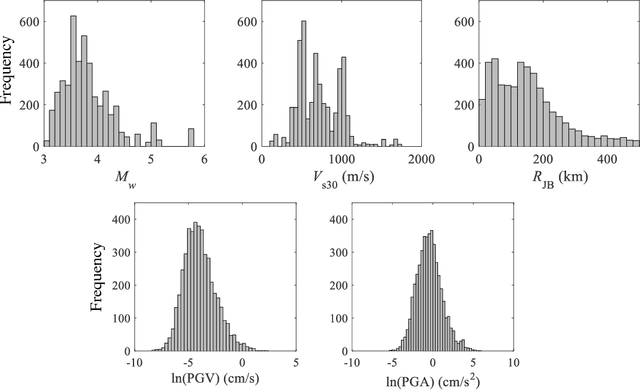
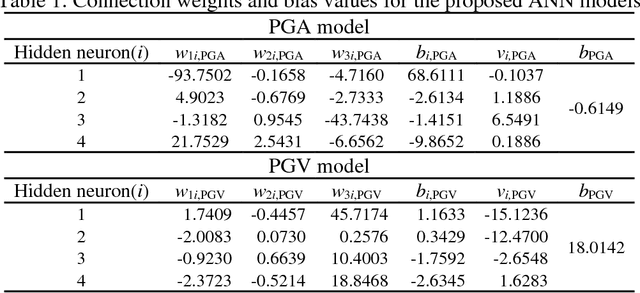
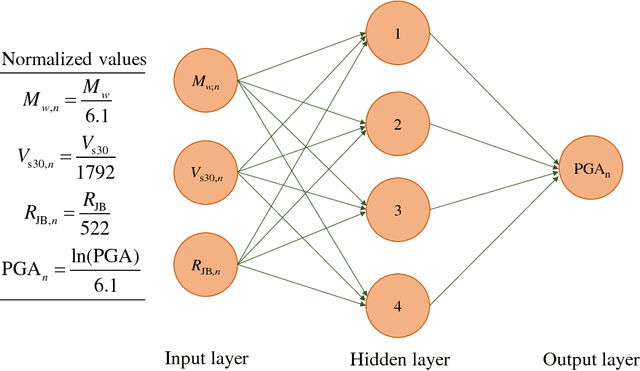
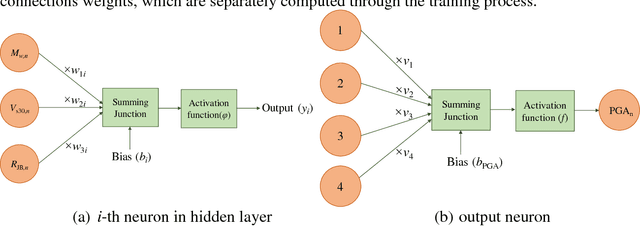
Parts of Texas, Oklahoma, and Kansas have experienced increased rates of seismicity in recent years, providing new datasets of earthquake recordings to develop ground motion prediction models for this particular region of the Central and Eastern North America (CENA). This paper outlines a framework for using Artificial Neural Networks (ANNs) to develop attenuation models from the ground motion recordings in this region. While attenuation models exist for the CENA, concerns over the increased rate of seismicity in this region necessitate investigation of ground motions prediction models particular to these states. To do so, an ANN-based framework is proposed to predict peak ground acceleration (PGA) and peak ground velocity (PGV) given magnitude, earthquake source-to-site distance, and shear wave velocity. In this framework, approximately 4,500 ground motions with magnitude greater than 3.0 recorded in these three states (Texas, Oklahoma, and Kansas) since 2005 are considered. Results from this study suggest that existing ground motion prediction models developed for CENA do not accurately predict the ground motion intensity measures for earthquakes in this region, especially for those with low source-to-site distances or on very soft soil conditions. The proposed ANN models provide much more accurate prediction of the ground motion intensity measures at all distances and magnitudes. The proposed ANN models are also converted to relatively simple mathematical equations so that engineers can easily use them to predict the ground motion intensity measures for future events. Finally, through a sensitivity analysis, the contributions of the predictive parameters to the prediction of the considered intensity measures are investigated.