 Add to Chrome
 Add to Firefox
 Add to Edge
Reconstructing Patched or Partial Holograms to allow for Whole Slide Imaging with a Self-Referencing Holographic Microscope
Jan 22, 2026
The last decade has seen significant advances in computer-aided diagnostics for cytological screening, mainly through the improvement and integration of scanning techniques such as whole slide imaging (WSI) and the combination with deep learning. Simultaneously, new imaging techniques such as quantitative phase imaging (QPI) are being developed to capture richer cell information with less sample preparation. So far, the two worlds of WSI and QPI have not been combined. In this work, we present a reconstruction algorithm which makes whole slide imaging of cervical smears possible by using a self-referencing three-wave digital holographic microscope. Since a WSI is constructed by combining multiple patches, the algorithm is adaptive and can be used on partial holograms and patched holograms. We present the algorithm for a single shot hologram, the adaptations to make it flexible to various inputs and show that the algorithm performs well for the tested epithelial cells. This is a preprint of our paper, which has been accepted for publication in 2026 IEEE International Symposium on Biomedical Imaging (ISBI).

Unsupervised high-throughput segmentation of cells and cell nuclei in quantitative phase images
Nov 24, 2023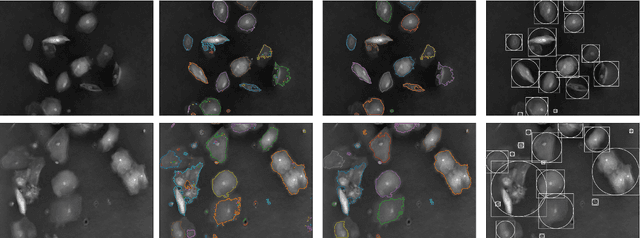
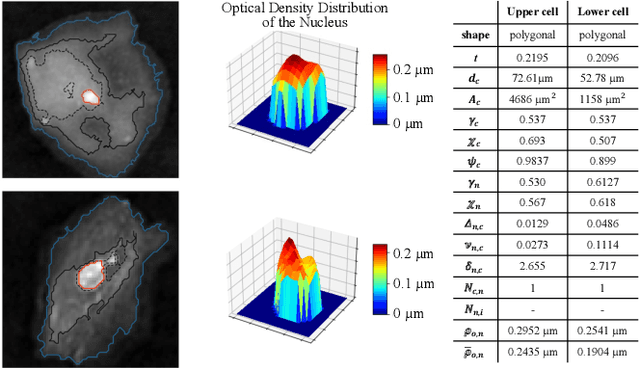
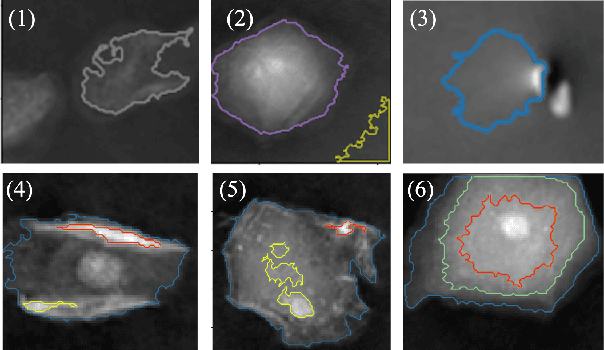
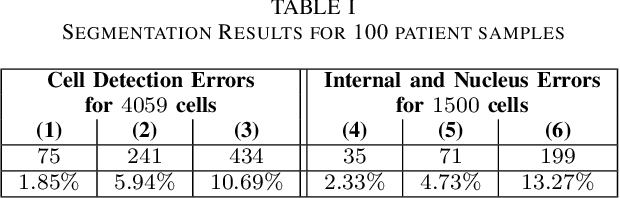
In the effort to aid cytologic diagnostics by establishing automatic single cell screening using high throughput digital holographic microscopy for clinical studies thousands of images and millions of cells are captured. The bottleneck lies in an automatic, fast, and unsupervised segmentation technique that does not limit the types of cells which might occur. We propose an unsupervised multistage method that segments correctly without confusing noise or reflections with cells and without missing cells that also includes the detection of relevant inner structures, especially the cell nucleus in the unstained cell. In an effort to make the information reasonable and interpretable for cytopathologists, we also introduce new cytoplasmic and nuclear features of potential help for cytologic diagnoses which exploit the quantitative phase information inherent to the measurement scheme. We show that the segmentation provides consistently good results over many experiments on patient samples in a reasonable per cell analysis time.