 Add to Chrome
 Add to Firefox
 Add to Edge
Stepwise Variational Inference with Vine Copulas
Mar 24, 2026
We propose stepwise variational inference (VI) with vine copulas: a universal VI procedure that combines vine copulas with a novel stepwise estimation procedure of the variational parameters. Vine copulas consist of a nested sequence of trees built from copulas, where more complex latent dependence can be modeled with increasing number of trees. We propose to estimate the vine copula approximate posterior in a stepwise fashion, tree by tree along the vine structure. Further, we show that the usual backward Kullback-Leibler divergence cannot recover the correct parameters in the vine copula model, thus the evidence lower bound is defined based on the Rényi divergence. Finally, an intuitive stopping criterion for adding further trees to the vine eliminates the need to pre-define a complexity parameter of the variational distribution, as required for most other approaches. Thus, our method interpolates between mean-field VI (MFVI) and full latent dependence. In many applications, in particular sparse Gaussian processes, our method is parsimonious with parameters, while outperforming MFVI.

TVineSynth: A Truncated C-Vine Copula Generator of Synthetic Tabular Data to Balance Privacy and Utility
Mar 20, 2025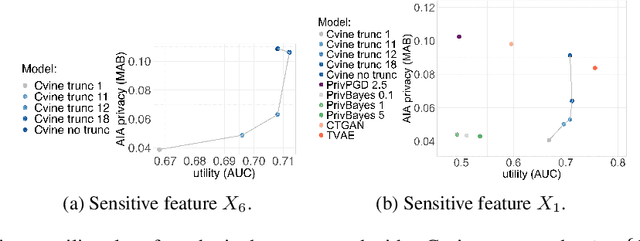
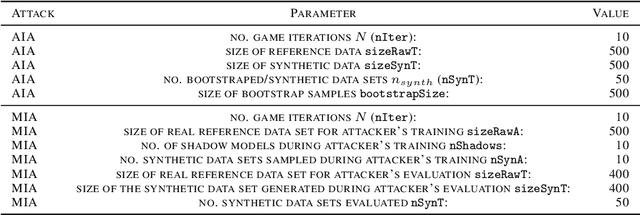
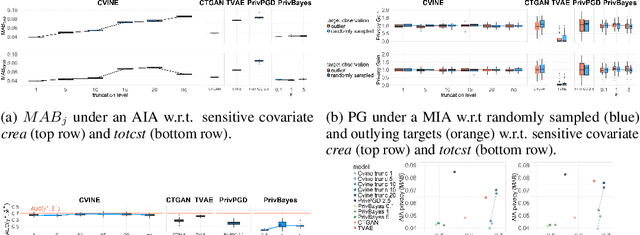
We propose TVineSynth, a vine copula based synthetic tabular data generator, which is designed to balance privacy and utility, using the vine tree structure and its truncation to do the trade-off. Contrary to synthetic data generators that achieve DP by globally adding noise, TVineSynth performs a controlled approximation of the estimated data generating distribution, so that it does not suffer from poor utility of the resulting synthetic data for downstream prediction tasks. TVineSynth introduces a targeted bias into the vine copula model that, combined with the specific tree structure of the vine, causes the model to zero out privacy-leaking dependencies while relying on those that are beneficial for utility. Privacy is here measured with membership (MIA) and attribute inference attacks (AIA). Further, we theoretically justify how the construction of TVineSynth ensures AIA privacy under a natural privacy measure for continuous sensitive attributes. When compared to competitor models, with and without DP, on simulated and on real-world data, TVineSynth achieves a superior privacy-utility balance.