 Add to Chrome
 Add to Firefox
 Add to Edge
EqDeepRx: Learning a Scalable MIMO Receiver
Feb 12, 2026
While machine learning (ML)-based receiver algorithms have received a great deal of attention in the recent literature, they often suffer from poor scaling with increasing spatial multiplexing order and lack of explainability and generalization. This paper presents EqDeepRx, a practical deep-learning-aided multiple-input multiple-output (MIMO) receiver, which is built by augmenting linear receiver processing with carefully engineered ML blocks. At the core of the receiver model is a shared-weight DetectorNN that operates independently on each spatial stream or layer, enabling near-linear complexity scaling with respect to multiplexing order. To ensure better explainability and generalization, EqDeepRx retains conventional channel estimation and augments it with a lightweight DenoiseNN that learns frequency-domain smoothing. To reduce the dimensionality of the DetectorNN inputs, the receiver utilizes two linear equalizers in parallel: a linear minimum mean-square error (LMMSE) equalizer with interference-plus-noise covariance estimation and a regularized zero-forcing (RZF) equalizer. The parallel equalized streams are jointly consumed by the DetectorNN, after which a compact DemapperNN produces bit log-likelihood ratios for channel decoding. 5G/6G-compliant end-to-end simulations across multiple channel scenarios, pilot patterns, and inter-cell interference conditions show improved error rate and spectral efficiency over a conventional baseline, while maintaining low-complexity inference and support for different MIMO configurations without retraining.

Coupled regularized sample covariance matrix estimator for multiple classes
Nov 09, 2020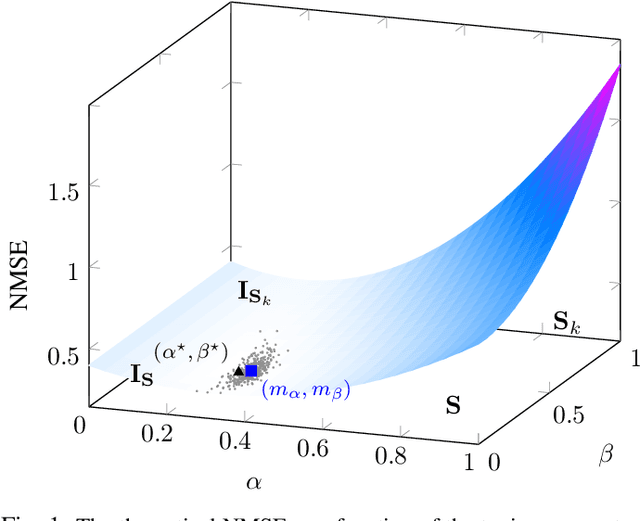
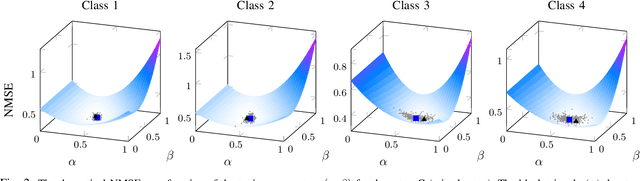
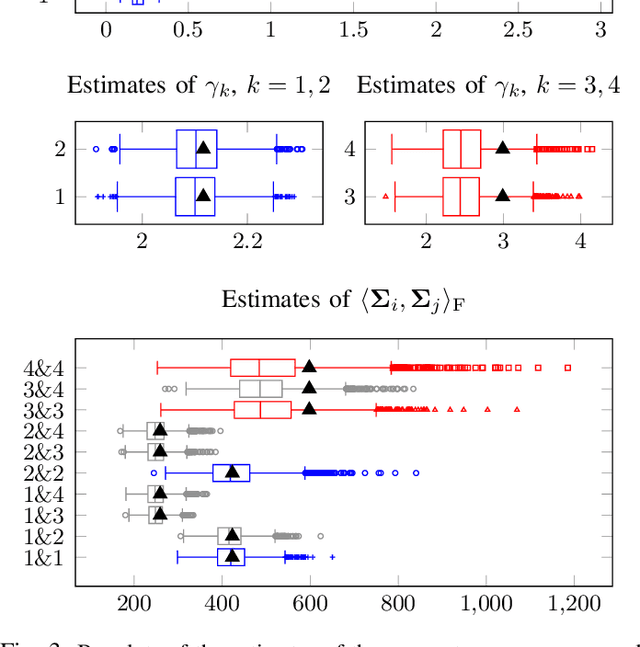
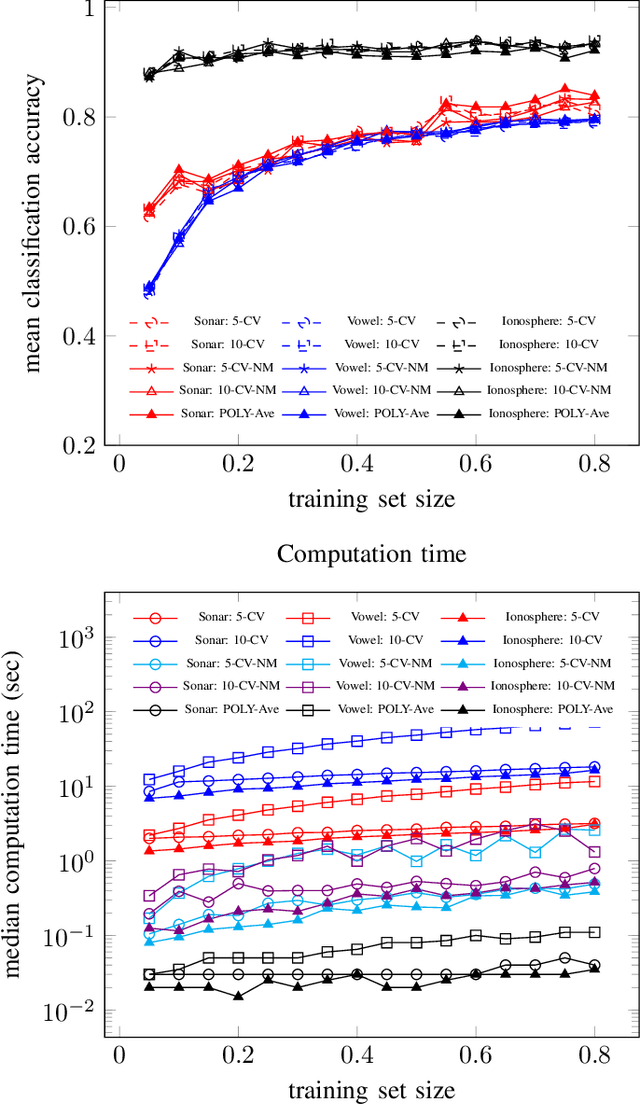
The estimation of covariance matrices of multiple classes with limited training data is a difficult problem. The sample covariance matrix (SCM) is known to perform poorly when the number of variables is large compared to the available number of samples. In order to reduce the mean squared error (MSE) of the SCM, regularized (shrinkage) SCM estimators are often used. In this work, we consider regularized SCM (RSCM) estimators for multiclass problems that couple together two different target matrices for regularization: the pooled (average) SCM of the classes and the scaled identity matrix. Regularization toward the pooled SCM is beneficial when the population covariances are similar, whereas regularization toward the identity matrix guarantees that the estimators are positive definite. We derive the MSE optimal tuning parameters for the estimators as well as propose a method for their estimation under the assumption that the class populations follow (unspecified) elliptical distributions with finite fourth-order moments. The MSE performance of the proposed coupled RSCMs are evaluated with simulations and in a regularized discriminant analysis (RDA) classification set-up on real data. The results based on three different real data sets indicate comparable performance to cross-validation but with a significant speed-up in computation time.