 Add to Chrome
 Add to Firefox
 Add to Edge
On the Relationship Between Activation Outliers and Feature Death in Sparse Autoencoders
May 29, 2026
Sparse autoencoders (SAEs) decompose neural network activations into interpretable features, but many learned features never activate, a problem called feature death that wastes dictionary capacity and can reintroduce superposition. Death rates vary dramatically between models: near-zero on GPT-2, over 70% on AlphaFold3 with identical configurations. We find that dimension-level activation outliers (dimensions whose mean magnitude is large relative to per-token variation) cause this by shifting pre-activations at initialization based on each feature's alignment with the activation mean. Features anti-aligned with the mean receive permanently negative pre-activations and never fire. We formalize outlier severity as $γ= \|μ\|/\|σ\|$; it predicts initial death rates (Spearman $ρ= 0.89$ for dead-by-TopK, $0.82$ for dead-by-ReLU) across 454 model-layer combinations spanning language, vision, protein, and genomic models. Dead features can revive during training, but recovery requires the SAE bias to learn the activation mean, a process that is prohibitively slow at high $γ$. Mean-centering (subtracting the activation mean) sidesteps this and eliminates outlier-induced death across all tested models, confirming the mechanism and providing a principled basis for when and why this preprocessing step is necessary.

ChemBERTa-2: Towards Chemical Foundation Models
Sep 05, 2022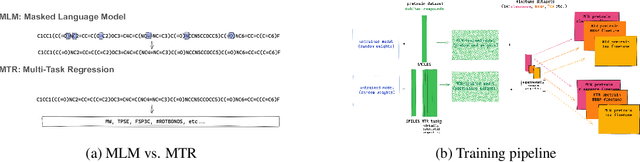
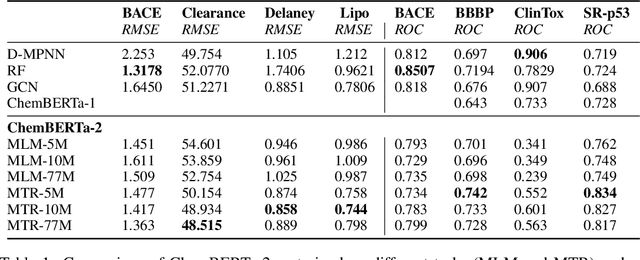
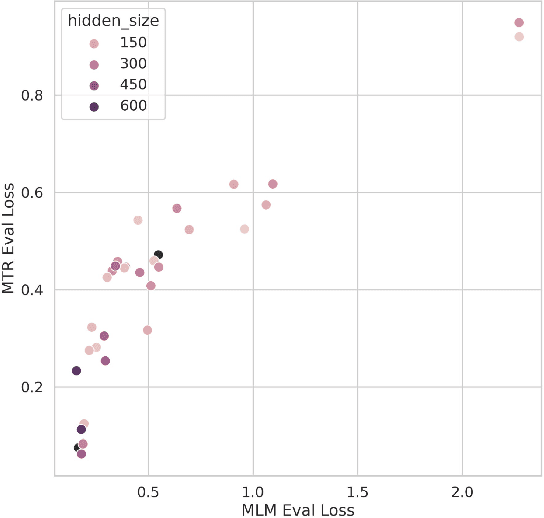
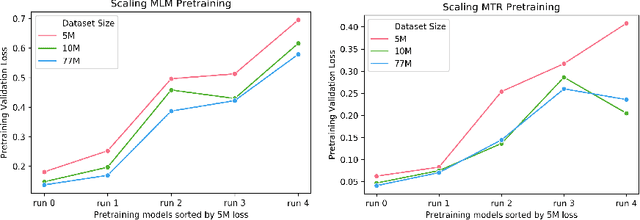
Large pretrained models such as GPT-3 have had tremendous impact on modern natural language processing by leveraging self-supervised learning to learn salient representations that can be used to readily finetune on a wide variety of downstream tasks. We investigate the possibility of transferring such advances to molecular machine learning by building a chemical foundation model, ChemBERTa-2, using the language of SMILES. While labeled data for molecular prediction tasks is typically scarce, libraries of SMILES strings are readily available. In this work, we build upon ChemBERTa by optimizing the pretraining process. We compare multi-task and self-supervised pretraining by varying hyperparameters and pretraining dataset size, up to 77M compounds from PubChem. To our knowledge, the 77M set constitutes one of the largest datasets used for molecular pretraining to date. We find that with these pretraining improvements, we are competitive with existing state-of-the-art architectures on the MoleculeNet benchmark suite. We analyze the degree to which improvements in pretraining translate to improvement on downstream tasks.