 Add to Chrome
 Add to Firefox
 Add to Edge
Beyond Fine-Tuning: In-Context Learning and Chain-of-Thought for Reasoned Distractor Generation
Apr 19, 2026
Distractor generation (DG) remains a labor-intensive task that still significantly depends on domain experts. The task focuses on generating plausible yet incorrect options, known as distractors, for multiple-choice questions. A reliable distractor must be contextually relevant to the question and able to mislead examinees through implicit reasoning when identifying the correct answer. While a recent method integrates fine-tuning pre-trained encoder-decoder models with contrastive learning to generate semantically relevant distractors for a given question-answer, it often fails to capture the underlying reasoning process that experts utilize when selecting distractors in benchmarks. In this paper, we explore large language models (LLMs) reasoning for DG through in-context learning with unsupervised semantic retrieval for selecting few-shot examples. We design a rationale-augmented DG framework that jointly generates distractors and their rationales for a given question-answer. Extensive experiments on six benchmarks, with varying average distractor lengths and domains, demonstrate that prompting LLMs with few-shot examples substantially improves the performance compared to recent DG models. It outperforms recent approaches and achieves state-of-the-art results in generating reasoned distractors that align with human-labeled benchmarks.

Distractor Generation for Multiple-Choice Questions: A Survey of Methods, Datasets, and Evaluation
Feb 02, 2024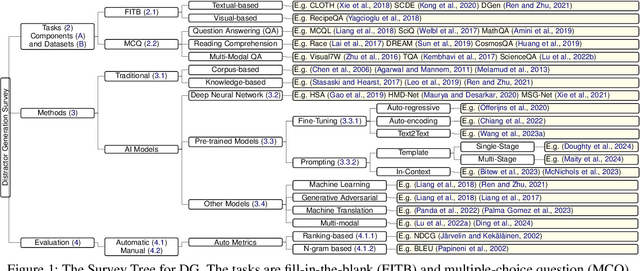
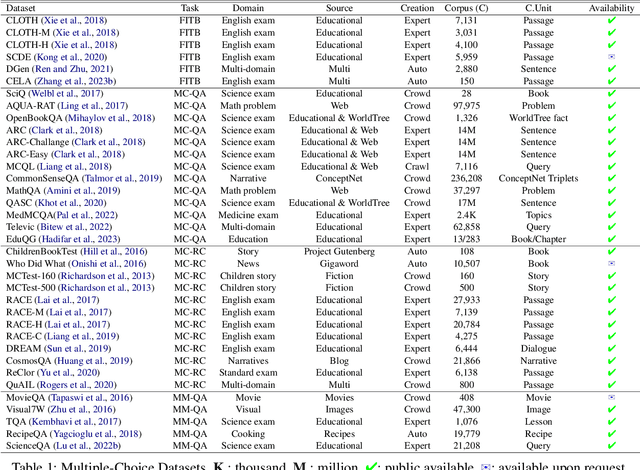
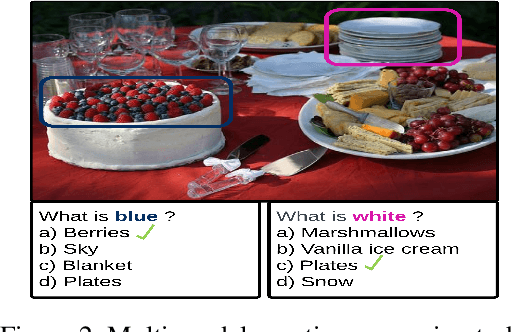

Distractors are important in learning evaluation. This paper surveys distractor generation tasks using English multiple-choice question datasets for textual and multimodal contexts. In particular, this paper presents a thorough literature review of the recent studies on distractor generation tasks, discusses multiple choice components and their characteristics, analyzes the related datasets, and summarizes the evaluation metrics of distractor generation. Our investigation reveals that more than half of datasets are human-generated from educational sources in specific domains such as Science and English, which are largely text-based, with a lack of open domain and multimodal datasets.