 Add to Chrome
 Add to Firefox
 Add to Edge
DyKAF: Dynamical Kronecker Approximation of the Fisher Information Matrix for Gradient Preconditioning
Nov 09, 2025
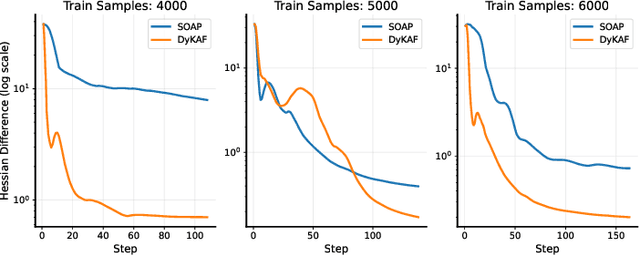
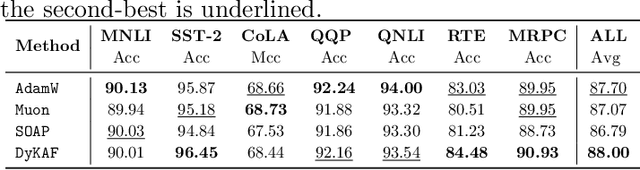
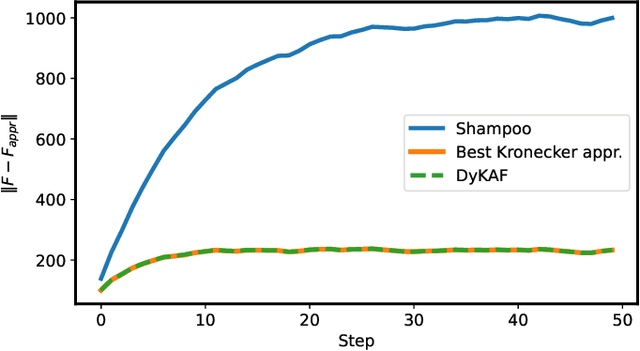
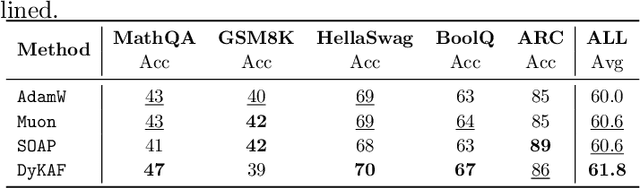
Recently, optimizers that explicitly treat weights as matrices, rather than flattened vectors, have demonstrated their effectiveness. This perspective naturally leads to structured approximations of the Fisher matrix as preconditioners, where the matrix view induces a Kronecker-factorized form that enables memory-efficient representation. However, constructing such approximations both efficiently and accurately remains an open challenge, since obtaining the optimal factorization is resource-intensive and practical methods therefore rely on heuristic design choices. In this work, we introduce a novel approach that leverages projector-splitting integrators to construct effective preconditioners. Our optimizer, DyKAF (Dynamical Kronecker Approximation of the Fisher Matrix), consistently improves the Fisher matrix approximation quality. Experiments on large language model pre-training and fine-tuning demonstrate that DyKAF outperforms existing optimizers across a range of evaluation metrics.

Tight and Efficient Upper Bound on Spectral Norm of Convolutional Layers
Sep 18, 2024Controlling the spectral norm of the Jacobian matrix, which is related to the convolution operation, has been shown to improve generalization, training stability and robustness in CNNs. Existing methods for computing the norm either tend to overestimate it or their performance may deteriorate quickly with increasing the input and kernel sizes. In this paper, we demonstrate that the tensor version of the spectral norm of a four-dimensional convolution kernel, up to a constant factor, serves as an upper bound for the spectral norm of the Jacobian matrix associated with the convolution operation. This new upper bound is independent of the input image resolution, differentiable and can be efficiently calculated during training. Through experiments, we demonstrate how this new bound can be used to improve the performance of convolutional architectures.