 Add to Chrome
 Add to Firefox
 Add to Edge
HapticVLA: Contact-Rich Manipulation via Vision-Language-Action Model without Inference-Time Tactile Sensing
Mar 16, 2026
Tactile sensing is a crucial capability for Vision-Language-Action (VLA) architectures, as it enables dexterous and safe manipulation in contact-rich tasks. However, reliance on dedicated tactile hardware increases cost and reduces reproducibility across robotic platforms. We argue that tactile-aware manipulation can be learned offline and deployed without direct haptic feedback at inference. To this end, we present HapticVLA, which proceeds in two tightly coupled stages: Safety-Aware Reward-Weighted Flow Matching (SA-RWFM) and Tactile Distillation (TD). SA-RWFM trains a flow-matching action expert that incorporates precomputed, safety-aware tactile rewards penalizing excessive grasping force and suboptimal grasping trajectories. TD further transfers this tactile-aware capability into a conventional VLA: we distill a compact tactile token from the SA-RWFM teacher and train a student VLA to predict that token from vision and state modalities, enabling tactile-aware action generation at inference without requiring on-board tactile sensors. This design preserves contact-rich tactile-aware reasoning within VLA while removing the need for on-board tactile sensors during deployment. On real-world experiments, HapticVLA achieves a mean success rate of 86.7%, consistently outperforming baseline VLAs - including versions provided with direct tactile feedback during inference.

Towards properties of adversarial image perturbations
Mar 18, 2025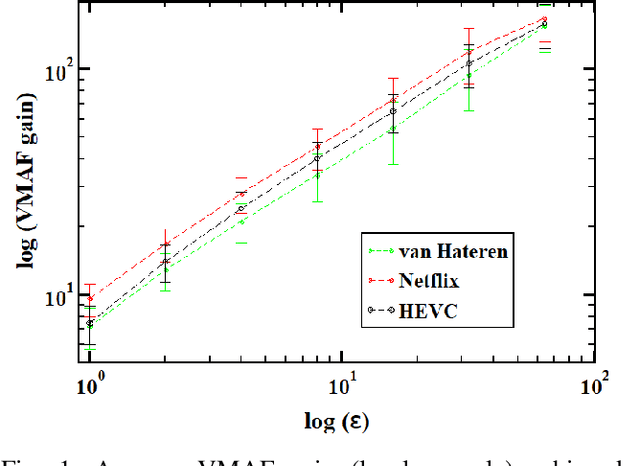
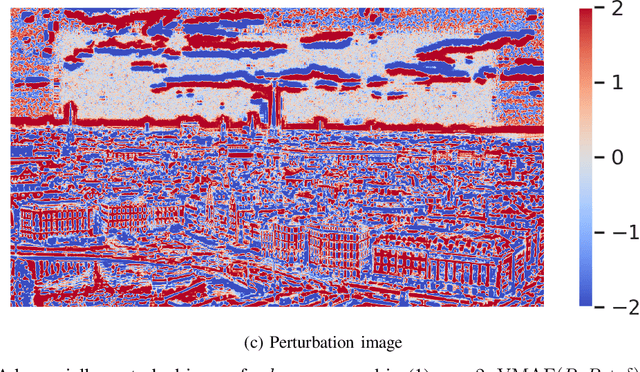
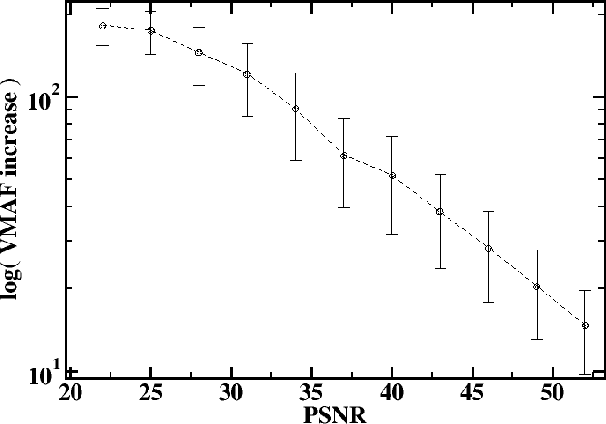
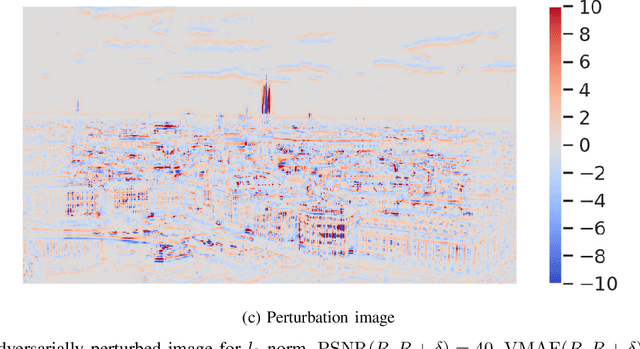
Using stochastic gradient approach we study the properties of adversarial perturbations resulting in noticeable growth of VMAF image quality metric. The structure of the perturbations is investigated depending on the acceptable PSNR values and based on the Fourier power spectrum computations for the perturbations. It is demonstrated that moderate variation of image brightness ($\sim 10$ pixel units in a restricted region of an image can result in VMAF growth by $\sim 60\%$). Unlike some other methods demonstrating similar VMAF growth, the subjective quality of an image remains almost unchanged. It is also shown that the adversarial perturbations may demonstrate approximately linear dependence of perturbation amplitudes on the image brightness. The perturbations are studied based on the direct VMAF optimization in PyTorch. The significant discrepancies between the metric values and subjective judgements are also demonstrated when image restoration from noise is carried out using the same direct VMAF optimization.