 Add to Chrome
 Add to Firefox
 Add to Edge
Efficient Techniques for Data Reconstruction, with Finite-Width Recovery Guarantees
May 07, 2026
Data reconstruction attacks on trained neural networks aim to recover the data on which the network has been trained and pose a significant threat to privacy, especially if the training dataset contains sensitive information. Here, we propose a unified optimization formulation of the data reconstruction problem based on initial and trained parameter values, incorporating state-of-the-art proposals. We show that in the random feature model, this formulation provably leads to training data reconstruction with high probability, provided the network width is sufficiently large; this unprecedented finite-width result uses PAC-style bounds. Furthermore, when the data lies in a low-dimensional subspace, we show that the network width requirement for successful reconstruction can be relaxed, with bounds depending on the subspace dimension rather than the ambient dimension. For general neural network models and unknown data orientations, we propose an efficient reconstruction algorithm that approximates the low-dimensional data subspace through the change in the first-layer weights during training and uses only the last-layer weights for reconstruction, thus reducing the search space dimension and the required network width for high-quality reconstructions. Our numerical experiments on synthetic datasets and CIFAR-10 confirm that our subspace-aware reconstruction approach outperforms standard full-space techniques.

Random Subspace Cubic-Regularization Methods, with Applications to Low-Rank Functions
Jan 16, 2025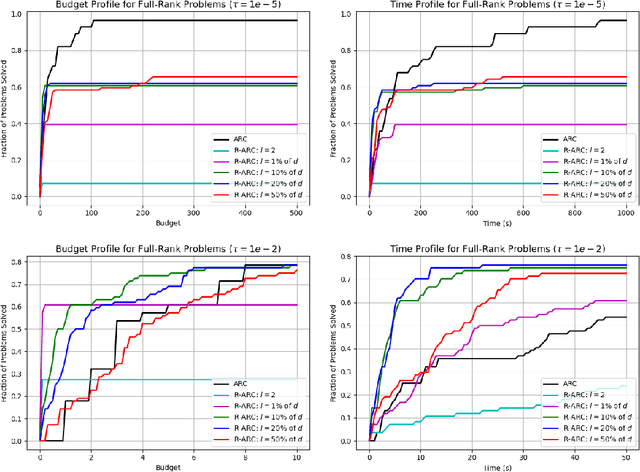
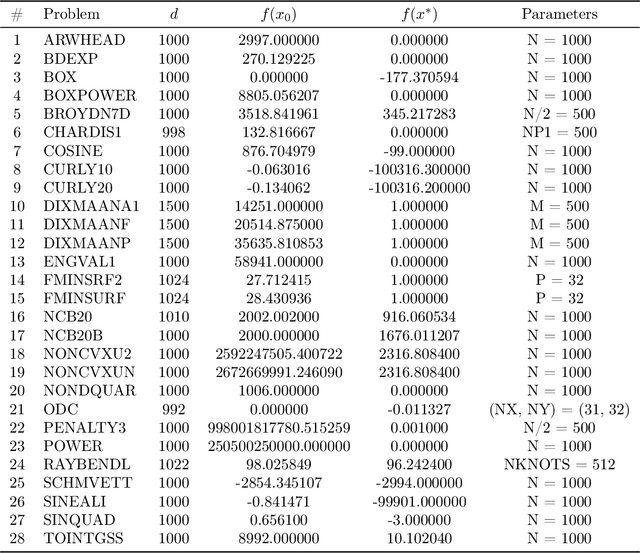
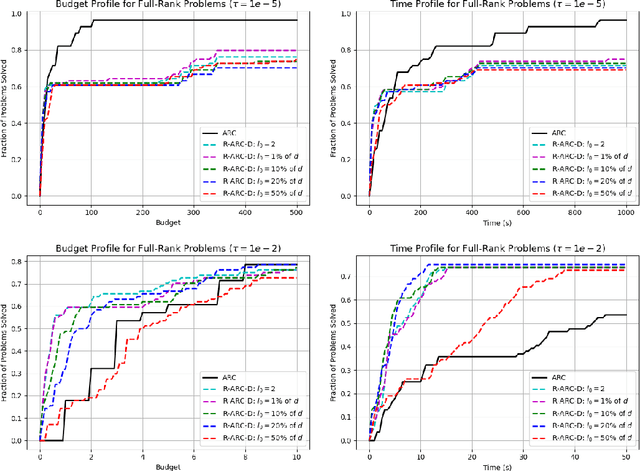
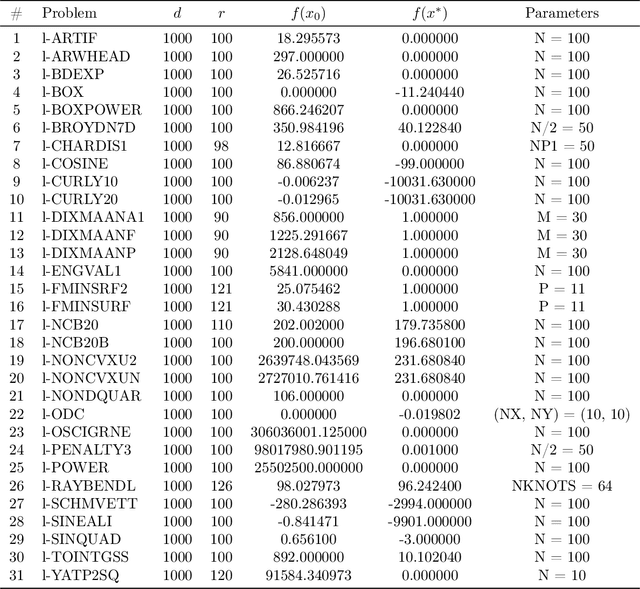
We propose and analyze random subspace variants of the second-order Adaptive Regularization using Cubics (ARC) algorithm. These methods iteratively restrict the search space to some random subspace of the parameters, constructing and minimizing a local model only within this subspace. Thus, our variants only require access to (small-dimensional) projections of first- and second-order problem derivatives and calculate a reduced step inexpensively. Under suitable assumptions, the ensuing methods maintain the optimal first-order, and second-order, global rates of convergence of (full-dimensional) cubic regularization, while showing improved scalability both theoretically and numerically, particularly when applied to low-rank functions. When applied to the latter, our adaptive variant naturally adapts the subspace size to the true rank of the function, without knowing it a priori.