 Add to Chrome
 Add to Firefox
 Add to Edge
Lindbladian Learning with Neural Differential Equations
Mar 08, 2026
Inferring the dynamical generator of a many-body quantum system from measurement data is essential for the verification, calibration, and control of quantum processors. When the system is open, this task becomes considerably harder than in the purely unitary case, because coherent and dissipative mechanisms can produce similar measurement statistics and long-time data can be insensitive to coherent couplings. Here we tackle this so-called Lindbladian learning problem of open-system characterisation with maximum-likelihood on Pauli measurements at multiple experimentally friendly \emph{transient} times, exploiting the richer information content of transient dynamics. To navigate the resulting non-convex likelihood loss-landscape, we augment the physical model neural differential-equation term, which is progressively removed during training to distil an interpretable Lindbladian solution. Our method reliably learns open-system dynamics across neutral-atom (with 2D connectivity) and superconducting Hamiltonians, as well as the Heisenberg XYZ, and PXP models on a spin-1/2 chain. For the dissipative part, we show robustness over phase noise, thermal noise, and their combination. Our algorithm can robustly infer these dissipative systems over noise-to-signal ratios spanning four orders of magnitude, and system sizes up to $N=6$ qubits with fewer than $5 \times 10^5$ shots.

Quantum Machine Learning in Multi-Qubit Phase-Space Part I: Foundations
Jul 16, 2025Quantum machine learning (QML) seeks to exploit the intrinsic properties of quantum mechanical systems, including superposition, coherence, and quantum entanglement for classical data processing. However, due to the exponential growth of the Hilbert space, QML faces practical limits in classical simulations with the state-vector representation of quantum system. On the other hand, phase-space methods offer an alternative by encoding quantum states as quasi-probability functions. Building on prior work in qubit phase-space and the Stratonovich-Weyl (SW) correspondence, we construct a closed, composable dynamical formalism for one- and many-qubit systems in phase-space. This formalism replaces the operator algebra of the Pauli group with function dynamics on symplectic manifolds, and recasts the curse of dimensionality in terms of harmonic support on a domain that scales linearly with the number of qubits. It opens a new route for QML based on variational modelling over phase-space.
Solving The Quantum Many-Body Hamiltonian Learning Problem with Neural Differential Equations
Aug 16, 2024Understanding and characterising quantum many-body dynamics remains a significant challenge due to both the exponential complexity required to represent quantum many-body Hamiltonians, and the need to accurately track states in time under the action of such Hamiltonians. This inherent complexity limits our ability to characterise quantum many-body systems, highlighting the need for innovative approaches to unlock their full potential. To address this challenge, we propose a novel method to solve the Hamiltonian Learning (HL) problem-inferring quantum dynamics from many-body state trajectories-using Neural Differential Equations combined with an Ansatz Hamiltonian. Our method is reliably convergent, experimentally friendly, and interpretable, making it a stable solution for HL on a set of Hamiltonians previously unlearnable in the literature. In addition to this, we propose a new quantitative benchmark based on power laws, which can objectively compare the reliability and generalisation capabilities of any two HL algorithms. Finally, we benchmark our method against state-of-the-art HL algorithms with a 1D spin-1/2 chain proof of concept.
SoK: How Robust is Image Classification Deep Neural Network Watermarking?
Aug 11, 2021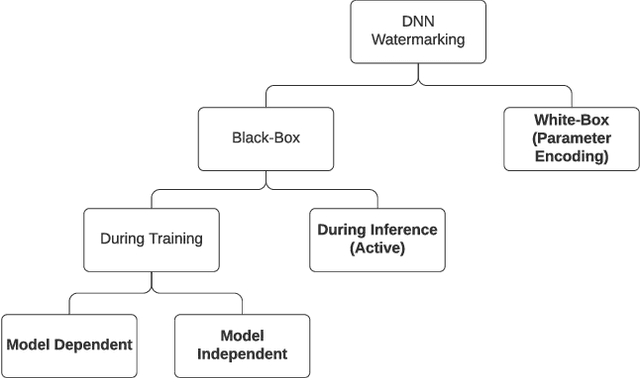
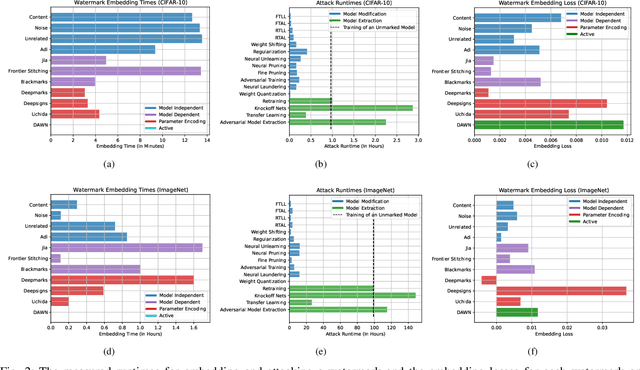
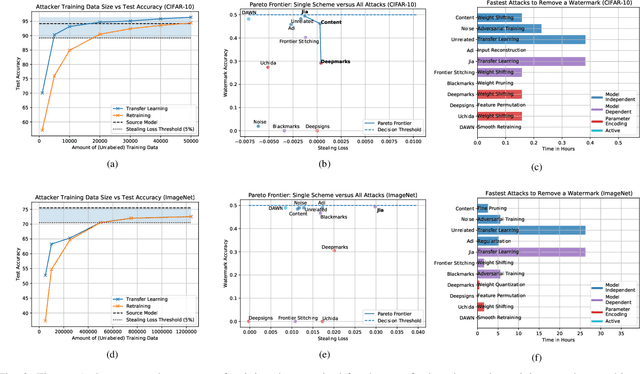
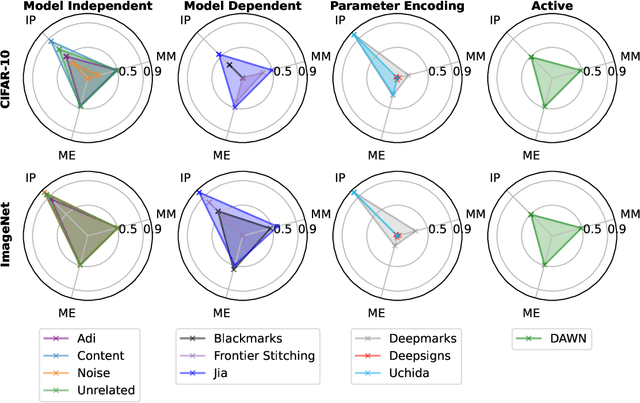
Deep Neural Network (DNN) watermarking is a method for provenance verification of DNN models. Watermarking should be robust against watermark removal attacks that derive a surrogate model that evades provenance verification. Many watermarking schemes that claim robustness have been proposed, but their robustness is only validated in isolation against a relatively small set of attacks. There is no systematic, empirical evaluation of these claims against a common, comprehensive set of removal attacks. This uncertainty about a watermarking scheme's robustness causes difficulty to trust their deployment in practice. In this paper, we evaluate whether recently proposed watermarking schemes that claim robustness are robust against a large set of removal attacks. We survey methods from the literature that (i) are known removal attacks, (ii) derive surrogate models but have not been evaluated as removal attacks, and (iii) novel removal attacks. Weight shifting and smooth retraining are novel removal attacks adapted to the DNN watermarking schemes surveyed in this paper. We propose taxonomies for watermarking schemes and removal attacks. Our empirical evaluation includes an ablation study over sets of parameters for each attack and watermarking scheme on the CIFAR-10 and ImageNet datasets. Surprisingly, none of the surveyed watermarking schemes is robust in practice. We find that schemes fail to withstand adaptive attacks and known methods for deriving surrogate models that have not been evaluated as removal attacks. This points to intrinsic flaws in how robustness is currently evaluated. We show that watermarking schemes need to be evaluated against a more extensive set of removal attacks with a more realistic adversary model. Our source code and a complete dataset of evaluation results are publicly available, which allows to independently verify our conclusions.