 Add to Chrome
 Add to Firefox
 Add to Edge
Unrolled Reconstruction with Integrated Super-Resolution for Accelerated 3D LGE MRI
Mar 18, 2026
Accelerated 3D late gadolinium enhancement (LGE) MRI requires robust reconstruction methods to recover thin atrial structures from undersampled k-space data. While unrolled model-based networks effectively integrate physics-driven data consistency with learned priors, they operate at the acquired resolution and may fail to fully recover high-frequency detail. We propose a hybrid unrolled reconstruction framework in which an Enhanced Deep Super-Resolution (EDSR) network replaces the proximal operator within each iteration of the optimization loop, enabling joint super-resolution enhancement and data consistency enforcement. The model is trained end-to-end on retrospectively undersampled preclinical 3D LGE datasets and compared against compressed sensing, Model-Based Deep Learning (MoDL), and self-guided Deep Image Prior (DIP) baselines. Across acceleration factors, the proposed method consistently improves PSNR and SSIM over standard unrolled reconstruction and better preserves fine cardiac structures, leading to improved LA (left atrium) segmentation performance. These results demonstrate that integrating super-resolution priors directly within model-based reconstruction provides measurable gains in accelerated 3D LGE MRI.

Deformation corrected compressed sensing (DC-CS): a novel framework for accelerated dynamic MRI
Sep 02, 2014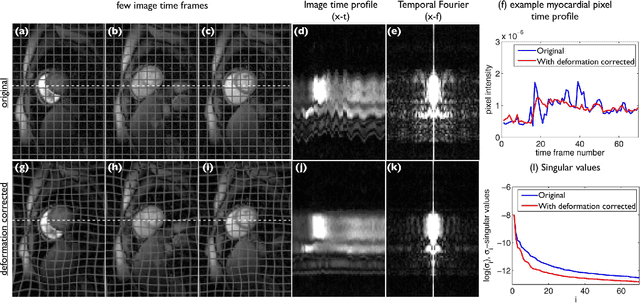
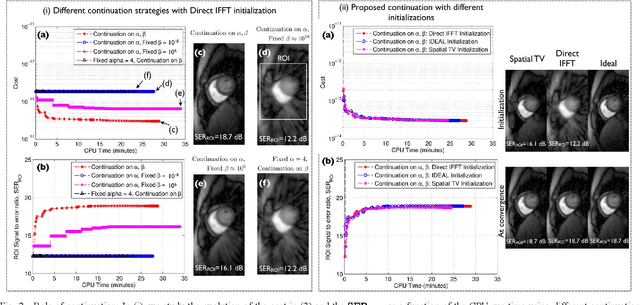
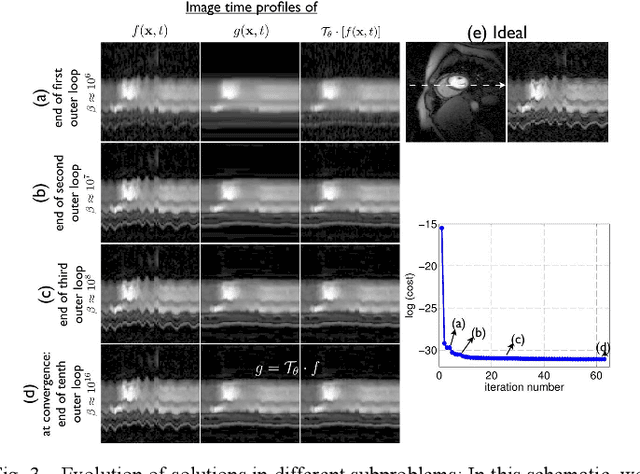
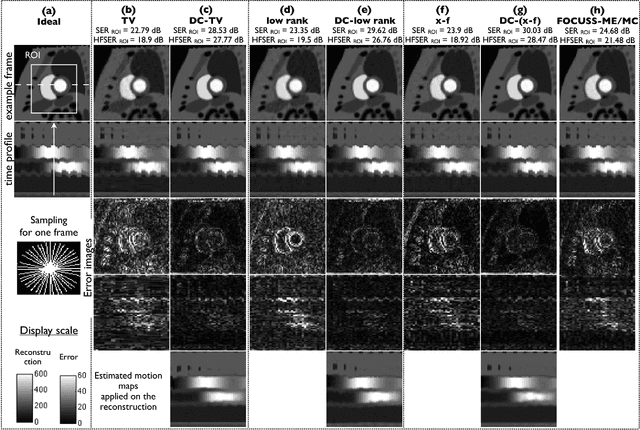
We propose a novel deformation corrected compressed sensing (DC-CS) framework to recover dynamic magnetic resonance images from undersampled measurements. We introduce a generalized formulation that is capable of handling a wide class of sparsity/compactness priors on the deformation corrected dynamic signal. In this work, we consider example compactness priors such as sparsity in temporal Fourier domain, sparsity in temporal finite difference domain, and nuclear norm penalty to exploit low rank structure. Using variable splitting, we decouple the complex optimization problem to simpler and well understood sub problems; the resulting algorithm alternates between simple steps of shrinkage based denoising, deformable registration, and a quadratic optimization step. Additionally, we employ efficient continuation strategies to minimize the risk of convergence to local minima. The proposed formulation contrasts with existing DC-CS schemes that are customized for free breathing cardiac cine applications, and other schemes that rely on fully sampled reference frames or navigator signals to estimate the deformation parameters. The efficient decoupling enabled by the proposed scheme allows its application to a wide range of applications including contrast enhanced dynamic MRI. Through experiments on numerical phantom and in vivo myocardial perfusion MRI datasets, we demonstrate the utility of the proposed DC-CS scheme in providing robust reconstructions with reduced motion artifacts over classical compressed sensing schemes that utilize the compact priors on the original deformation un-corrected signal.