 Add to Chrome
 Add to Firefox
 Add to Edge
Smoothness Errors in Dynamics Models and How to Avoid Them
Feb 05, 2026
Modern neural networks have shown promise for solving partial differential equations over surfaces, often by discretizing the surface as a mesh and learning with a mesh-aware graph neural network. However, graph neural networks suffer from oversmoothing, where a node's features become increasingly similar to those of its neighbors. Unitary graph convolutions, which are mathematically constrained to preserve smoothness, have been proposed to address this issue. Despite this, in many physical systems, such as diffusion processes, smoothness naturally increases and unitarity may be overconstraining. In this paper, we systematically study the smoothing effects of different GNNs for dynamics modeling and prove that unitary convolutions hurt performance for such tasks. We propose relaxed unitary convolutions that balance smoothness preservation with the natural smoothing required for physical systems. We also generalize unitary and relaxed unitary convolutions from graphs to meshes. In experiments on PDEs such as the heat and wave equations over complex meshes and on weather forecasting, we find that our method outperforms several strong baselines, including mesh-aware transformers and equivariant neural networks.

On Uncertainty Calibration for Equivariant Functions
Oct 27, 2025
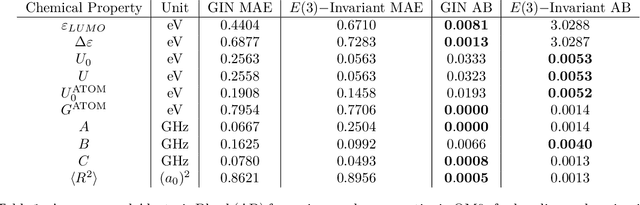
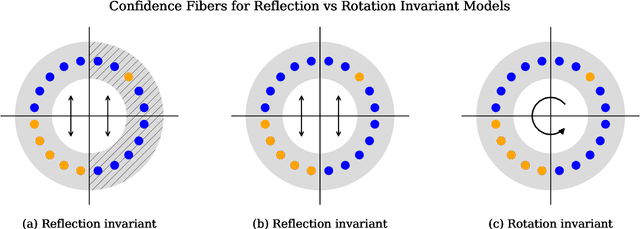
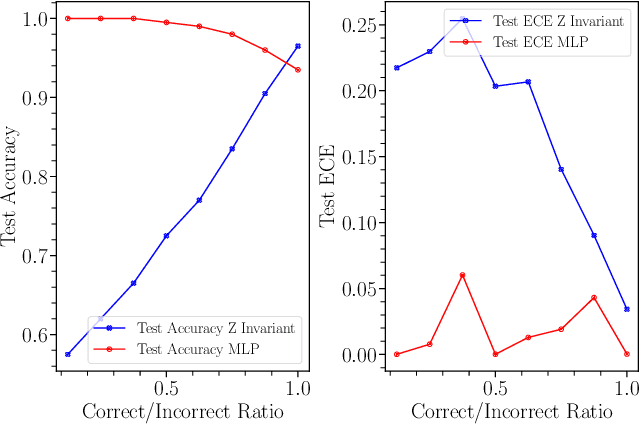
Data-sparse settings such as robotic manipulation, molecular physics, and galaxy morphology classification are some of the hardest domains for deep learning. For these problems, equivariant networks can help improve modeling across undersampled parts of the input space, and uncertainty estimation can guard against overconfidence. However, until now, the relationships between equivariance and model confidence, and more generally equivariance and model calibration, has yet to be studied. Since traditional classification and regression error terms show up in the definitions of calibration error, it is natural to suspect that previous work can be used to help understand the relationship between equivariance and calibration error. In this work, we present a theory relating equivariance to uncertainty estimation. By proving lower and upper bounds on uncertainty calibration errors (ECE and ENCE) under various equivariance conditions, we elucidate the generalization limits of equivariant models and illustrate how symmetry mismatch can result in miscalibration in both classification and regression. We complement our theoretical framework with numerical experiments that clarify the relationship between equivariance and uncertainty using a variety of real and simulated datasets, and we comment on trends with symmetry mismatch, group size, and aleatoric and epistemic uncertainties.
The State of Julia for Scientific Machine Learning
Oct 14, 2024Julia has been heralded as a potential successor to Python for scientific machine learning and numerical computing, boasting ergonomic and performance improvements. Since Julia's inception in 2012 and declaration of language goals in 2017, its ecosystem and language-level features have grown tremendously. In this paper, we take a modern look at Julia's features and ecosystem, assess the current state of the language, and discuss its viability and pitfalls as a replacement for Python as the de-facto scientific machine learning language. We call for the community to address Julia's language-level issues that are preventing further adoption.