 Add to Chrome
 Add to Firefox
 Add to Edge
Bilevel Late Acceptance Hill Climbing for the Electric Capacitated Vehicle Routing Problem
Apr 14, 2026
This paper tackles the Electric Capacitated Vehicle Routing Problem (E-CVRP) through a bilevel optimization framework that handles routing and charging decisions separately or jointly depending on the search stage. By analyzing their interaction, we introduce a surrogate objective at the upper level to guide the search and accelerate convergence. A bilevel Late Acceptance Hill Climbing algorithm (b-LAHC) is introduced that operates through three phases: greedy descent, neighborhood exploration, and final solution refinement. b-LAHC operates with fixed parameters, eliminating the need for complex adaptation while remaining lightweight and effective. Extensive experiments on the IEEE WCCI-2020 benchmark show that b-LAHC achieves superior or competitive performance against eight state-of-the-art algorithms. Under a fixed evaluation budget, it attains near-optimal solutions on small-scale instances and sets 9/10 new best-known results on large-scale benchmarks, improving existing records by an average of 1.07%. Moreover, the strong correlation (though not universal) observed between the surrogate objective and the complete cost justifies the use of the surrogate objective while still necessitating a joint solution of both levels, thereby validating the effectiveness of the proposed bilevel framework and highlighting its potential for efficiently solving large-scale routing problems with a hierarchical structure.

A space-indexed formulation of packing boxes into a larger box
Jan 02, 2021


Current integer programming solvers fail to decide whether 12 unit cubes can be packed into a 1x1x11 box within an hour using the natural relaxation of Chen/Padberg. We present an alternative relaxation of the problem of packing boxes into a larger box, which makes it possible to solve much larger instances.
* arXiv admin note: substantial text overlap with arXiv:1412.2526
Decomposition, Reformulation, and Diving in University Course Timetabling
Mar 20, 2009
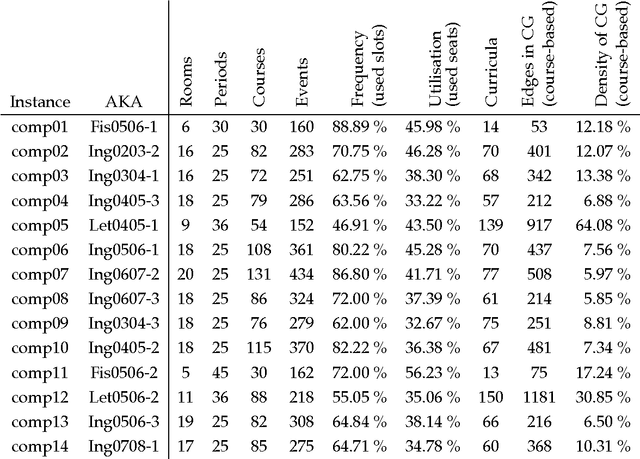
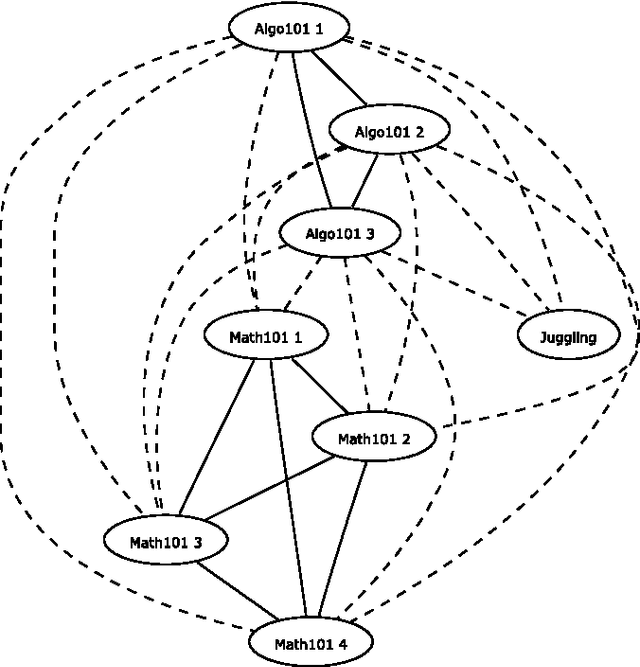
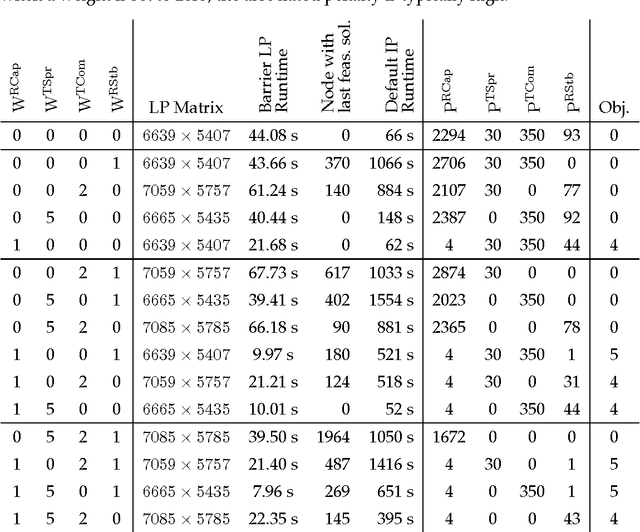
In many real-life optimisation problems, there are multiple interacting components in a solution. For example, different components might specify assignments to different kinds of resource. Often, each component is associated with different sets of soft constraints, and so with different measures of soft constraint violation. The goal is then to minimise a linear combination of such measures. This paper studies an approach to such problems, which can be thought of as multiphase exploitation of multiple objective-/value-restricted submodels. In this approach, only one computationally difficult component of a problem and the associated subset of objectives is considered at first. This produces partial solutions, which define interesting neighbourhoods in the search space of the complete problem. Often, it is possible to pick the initial component so that variable aggregation can be performed at the first stage, and the neighbourhoods to be explored next are guaranteed to contain feasible solutions. Using integer programming, it is then easy to implement heuristics producing solutions with bounds on their quality. Our study is performed on a university course timetabling problem used in the 2007 International Timetabling Competition, also known as the Udine Course Timetabling Problem. In the proposed heuristic, an objective-restricted neighbourhood generator produces assignments of periods to events, with decreasing numbers of violations of two period-related soft constraints. Those are relaxed into assignments of events to days, which define neighbourhoods that are easier to search with respect to all four soft constraints. Integer programming formulations for all subproblems are given and evaluated using ILOG CPLEX 11. The wider applicability of this approach is analysed and discussed.
* 45 pages, 7 figures. Improved typesetting of figures and tables