 Add to Chrome
 Add to Firefox
 Add to Edge
Breadth-First Search vs. Restarting Random Walks for Escaping Uninformed Heuristic Regions
Nov 12, 2025
Greedy search methods like Greedy Best-First Search (GBFS) and Enforced Hill-Climbing (EHC) often struggle when faced with Uninformed Heuristic Regions (UHRs) like heuristic local minima or plateaus. In this work, we theoretically and empirically compare two popular methods for escaping UHRs in breadth-first search (BrFS) and restarting random walks (RRWs). We first derive the expected runtime of escaping a UHR using BrFS and RRWs, based on properties of the UHR and the random walk procedure, and then use these results to identify when RRWs will be faster in expectation than BrFS. We then evaluate these methods for escaping UHRs by comparing standard EHC, which uses BrFS to escape UHRs, to variants of EHC called EHC-RRW, which use RRWs for that purpose. EHC-RRW is shown to have strong expected runtime guarantees in cases where EHC has previously been shown to be effective. We also run experiments with these approaches on PDDL planning benchmarks to better understand their relative effectiveness for escaping UHRs.

Preset-Voice Matching for Privacy Regulated Speech-to-Speech Translation Systems
Jul 18, 2024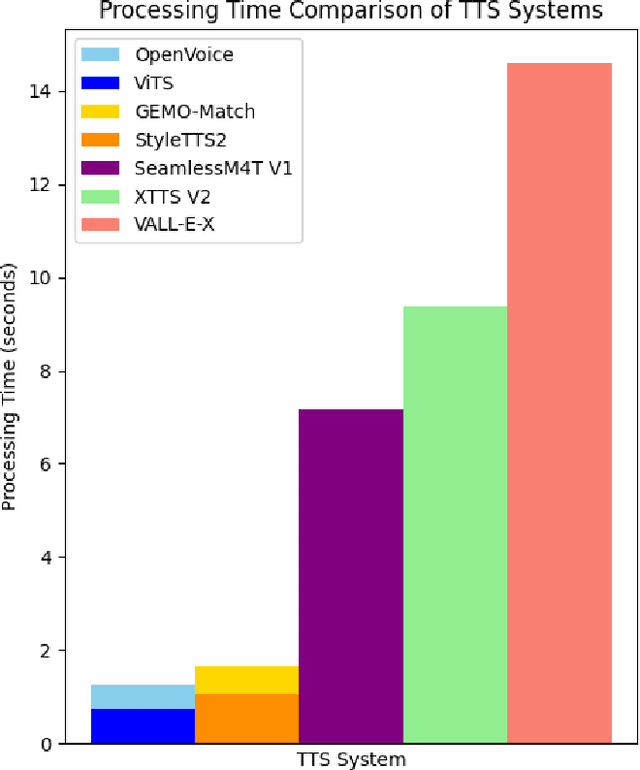
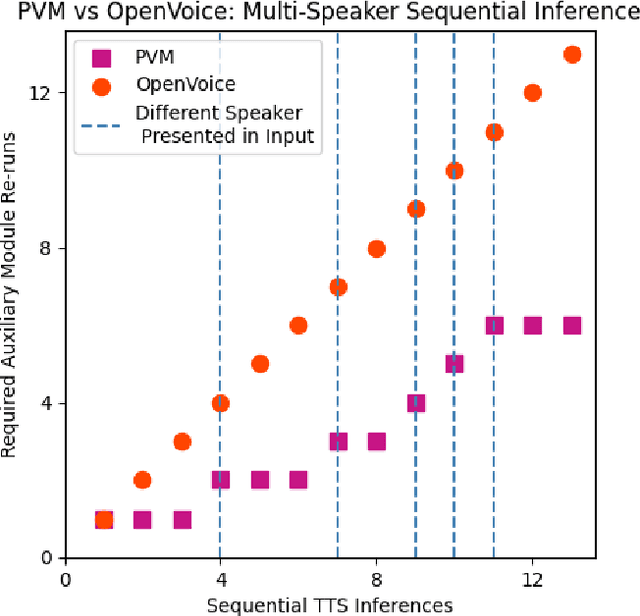
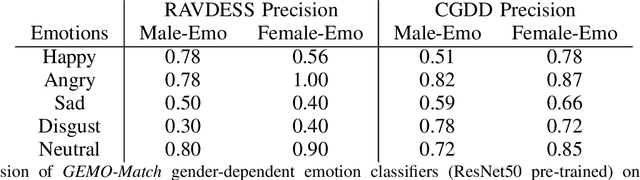
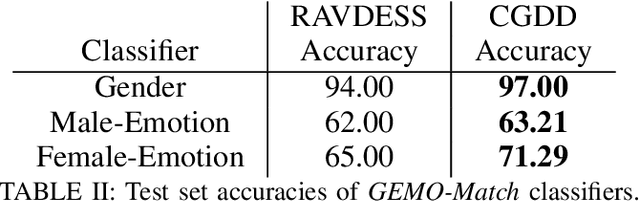
In recent years, there has been increased demand for speech-to-speech translation (S2ST) systems in industry settings. Although successfully commercialized, cloning-based S2ST systems expose their distributors to liabilities when misused by individuals and can infringe on personality rights when exploited by media organizations. This work proposes a regulated S2ST framework called Preset-Voice Matching (PVM). PVM removes cross-lingual voice cloning in S2ST by first matching the input voice to a similar prior consenting speaker voice in the target-language. With this separation, PVM avoids cloning the input speaker, ensuring PVM systems comply with regulations and reduce risk of misuse. Our results demonstrate PVM can significantly improve S2ST system run-time in multi-speaker settings and the naturalness of S2ST synthesized speech. To our knowledge, PVM is the first explicitly regulated S2ST framework leveraging similarly-matched preset-voices for dynamic S2ST tasks.