 Add to Chrome
 Add to Firefox
 Add to Edge
Discrete Versus Continuous Algorithms in Dynamics of Affective Decision Making
Sep 01, 2023
The dynamics of affective decision making is considered for an intelligent network composed of agents with different types of memory: long-term and short-term memory. The consideration is based on probabilistic affective decision theory, which takes into account the rational utility of alternatives as well as the emotional alternative attractiveness. The objective of this paper is the comparison of two multistep operational algorithms of the intelligent network: one based on discrete dynamics and the other on continuous dynamics. By means of numerical analysis, it is shown that, depending on the network parameters, the characteristic probabilities for continuous and discrete operations can exhibit either close or drastically different behavior. Thus, depending on which algorithm is employed, either discrete or continuous, theoretical predictions can be rather different, which does not allow for a uniquely defined description of practical problems. This finding is important for understanding which of the algorithms is more appropriate for the correct analysis of decision-making tasks. A discussion is given, revealing that the discrete operation seems to be more realistic for describing intelligent networks as well as affective artificial intelligence.
* Latex file, 24 pages, 11 figures

Information Processing by Networks of Quantum Decision Makers
Dec 15, 2017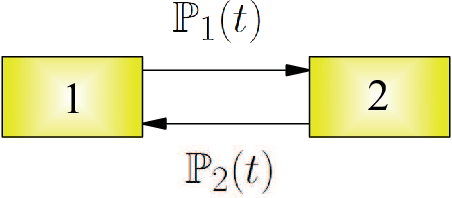

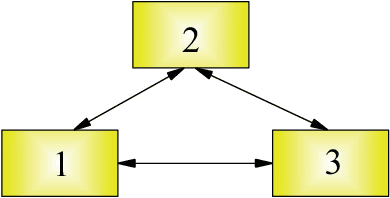
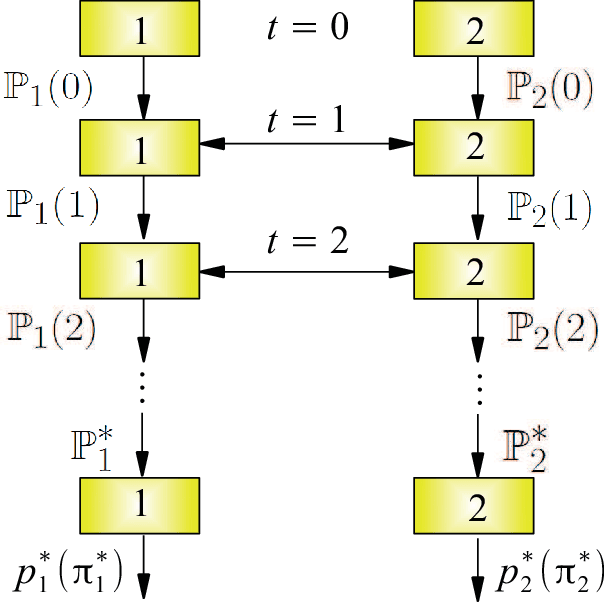
We suggest a model of a multi-agent society of decision makers taking decisions being based on two criteria, one is the utility of the prospects and the other is the attractiveness of the considered prospects. The model is the generalization of quantum decision theory, developed earlier for single decision makers realizing one-step decisions, in two principal aspects. First, several decision makers are considered simultaneously, who interact with each other through information exchange. Second, a multistep procedure is treated, when the agents exchange information many times. Several decision makers exchanging information and forming their judgement, using quantum rules, form a kind of a quantum information network, where collective decisions develop in time as a result of information exchange. In addition to characterizing collective decisions that arise in human societies, such networks can describe dynamical processes occurring in artificial quantum intelligence composed of several parts or in a cluster of quantum computers. The practical usage of the theory is illustrated on the dynamic disjunction effect for which three quantitative predictions are made: (i) the probabilistic behavior of decision makers at the initial stage of the process is described; (ii) the decrease of the difference between the initial prospect probabilities and the related utility factors is proved; (iii) the existence of a common consensus after multiple exchange of information is predicted. The predicted numerical values are in very good agreement with empirical data.