 Add to Chrome
 Add to Firefox
 Add to Edge
Calibration of Quantum Decision Theory: Aversion to Large Losses and Predictability of Probabilistic Choices
Mar 03, 2023
We present the first calibration of quantum decision theory (QDT) to a dataset of binary risky choice. We quantitatively account for the fraction of choice reversals between two repetitions of the experiment, using a probabilistic choice formulation in the simplest form without model assumption or adjustable parameters. The prediction of choice reversal is then refined by introducing heterogeneity between decision makers through their differentiation into two groups: ``majoritarian'' and ``contrarian'' (in proportion 3:1). This supports the first fundamental tenet of QDT, which models choice as an inherent probabilistic process, where the probability of a prospect can be expressed as the sum of its utility and attraction factors. We propose to parameterise the utility factor with a stochastic version of cumulative prospect theory (logit-CPT), and the attraction factor with a constant absolute risk aversion (CARA) function. For this dataset, and penalising the larger number of QDT parameters via the Wilks test of nested hypotheses, the QDT model is found to perform significantly better than logit-CPT at both the aggregate and individual levels, and for all considered fit criteria for the first experiment iteration and for predictions (second ``out-of-sample'' iteration). The distinctive QDT effect captured by the attraction factor is mostly appreciable (i.e., most relevant and strongest in amplitude) for prospects with big losses. Our quantitative analysis of the experimental results supports the existence of an intrinsic limit of predictability, which is associated with the inherent probabilistic nature of choice. The results of the paper can find applications both in the prediction of choice of human decision makers as well as for organizing the operation of artificial intelligence.
* Latex file, 51 pages, 19 figures

Information Processing by Networks of Quantum Decision Makers
Dec 15, 2017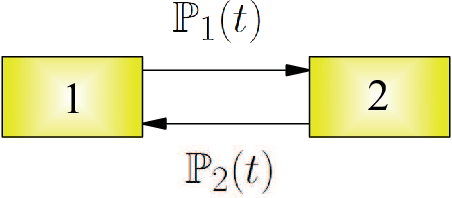

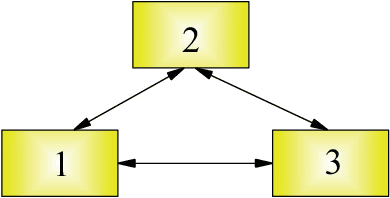
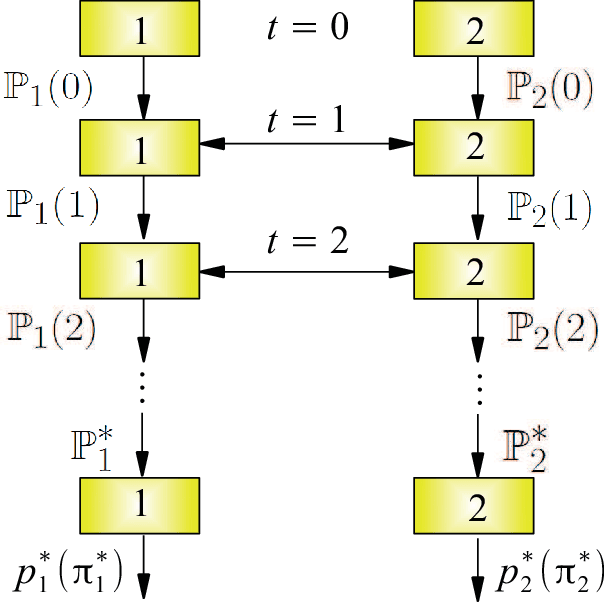
We suggest a model of a multi-agent society of decision makers taking decisions being based on two criteria, one is the utility of the prospects and the other is the attractiveness of the considered prospects. The model is the generalization of quantum decision theory, developed earlier for single decision makers realizing one-step decisions, in two principal aspects. First, several decision makers are considered simultaneously, who interact with each other through information exchange. Second, a multistep procedure is treated, when the agents exchange information many times. Several decision makers exchanging information and forming their judgement, using quantum rules, form a kind of a quantum information network, where collective decisions develop in time as a result of information exchange. In addition to characterizing collective decisions that arise in human societies, such networks can describe dynamical processes occurring in artificial quantum intelligence composed of several parts or in a cluster of quantum computers. The practical usage of the theory is illustrated on the dynamic disjunction effect for which three quantitative predictions are made: (i) the probabilistic behavior of decision makers at the initial stage of the process is described; (ii) the decrease of the difference between the initial prospect probabilities and the related utility factors is proved; (iii) the existence of a common consensus after multiple exchange of information is predicted. The predicted numerical values are in very good agreement with empirical data.
Decision Theory with Prospect Interference and Entanglement
Feb 14, 2011
We present a novel variant of decision making based on the mathematical theory of separable Hilbert spaces. This mathematical structure captures the effect of superposition of composite prospects, including many incorporated intentions, which allows us to describe a variety of interesting fallacies and anomalies that have been reported to particularize the decision making of real human beings. The theory characterizes entangled decision making, non-commutativity of subsequent decisions, and intention interference. We demonstrate how the violation of the Savage's sure-thing principle, known as the disjunction effect, can be explained quantitatively as a result of the interference of intentions, when making decisions under uncertainty. The disjunction effects, observed in experiments, are accurately predicted using a theorem on interference alternation that we derive, which connects aversion-to-uncertainty to the appearance of negative interference terms suppressing the probability of actions. The conjunction fallacy is also explained by the presence of the interference terms. A series of experiments are analysed and shown to be in excellent agreement with a priori evaluation of interference effects. The conjunction fallacy is also shown to be a sufficient condition for the disjunction effect and novel experiments testing the combined interplay between the two effects are suggested.
* Latex file, 42 pages
Mathematical Structure of Quantum Decision Theory
Oct 28, 2010One of the most complex systems is the human brain whose formalized functioning is characterized by decision theory. We present a "Quantum Decision Theory" of decision making, based on the mathematical theory of separable Hilbert spaces. This mathematical structure captures the effect of superposition of composite prospects, including many incorporated intentions, which allows us to explain a variety of interesting fallacies and anomalies that have been reported to particularize the decision making of real human beings. The theory describes entangled decision making, non-commutativity of subsequent decisions, and intention interference of composite prospects. We demonstrate how the violation of the Savage's sure-thing principle (disjunction effect) can be explained as a result of the interference of intentions, when making decisions under uncertainty. The conjunction fallacy is also explained by the presence of the interference terms. We demonstrate that all known anomalies and paradoxes, documented in the context of classical decision theory, are reducible to just a few mathematical archetypes, all of which finding straightforward explanations in the frame of the developed quantum approach.
* 40 pages
Processing Information in Quantum Decision Theory
Mar 17, 2010
A survey is given summarizing the state of the art of describing information processing in Quantum Decision Theory, which has been recently advanced as a novel variant of decision making, based on the mathematical theory of separable Hilbert spaces. This mathematical structure captures the effect of superposition of composite prospects, including many incorporated intended actions. The theory characterizes entangled decision making, non-commutativity of subsequent decisions, and intention interference. The self-consistent procedure of decision making, in the frame of the quantum decision theory, takes into account both the available objective information as well as subjective contextual effects. This quantum approach avoids any paradox typical of classical decision theory. Conditional maximization of entropy, equivalent to the minimization of an information functional, makes it possible to connect the quantum and classical decision theories, showing that the latter is the limit of the former under vanishing interference terms.
* Review article, 49 pages, Latex file
Reverse Engineering Financial Markets with Majority and Minority Games using Genetic Algorithms
Feb 10, 2010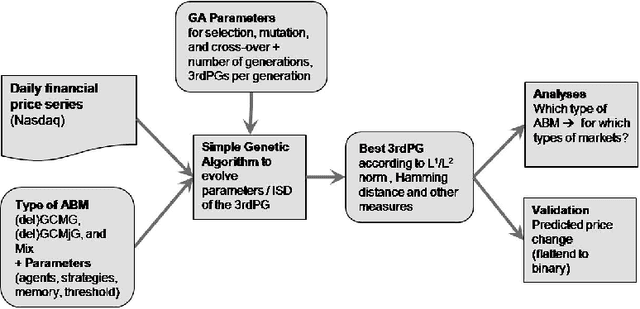


Using virtual stock markets with artificial interacting software investors, aka agent-based models (ABMs), we present a method to reverse engineer real-world financial time series. We model financial markets as made of a large number of interacting boundedly rational agents. By optimizing the similarity between the actual data and that generated by the reconstructed virtual stock market, we obtain parameters and strategies, which reveal some of the inner workings of the target stock market. We validate our approach by out-of-sample predictions of directional moves of the Nasdaq Composite Index.
Physics of risk and uncertainty in quantum decision making
Oct 21, 2009The Quantum Decision Theory, developed recently by the authors, is applied to clarify the role of risk and uncertainty in decision making and in particular in relation to the phenomenon of dynamic inconsistency. By formulating this notion in precise mathematical terms, we distinguish three types of inconsistency: time inconsistency, planning paradox, and inconsistency occurring in some discounting effects. While time inconsistency is well accounted for in classical decision theory, the planning paradox is in contradiction with classical utility theory. It finds a natural explanation in the frame of the Quantum Decision Theory. Different types of discounting effects are analyzed and shown to enjoy a straightforward explanation within the suggested theory. We also introduce a general methodology based on self-similar approximation theory for deriving the evolution equations for the probabilities of future prospects. This provides a novel classification of possible discount factors, which include the previously known cases (exponential or hyperbolic discounting), but also predicts a novel class of discount factors that decay to a strictly positive constant for very large future time horizons. This class may be useful to deal with very long-term discounting situations associated with intergenerational public policy choices, encompassing issues such as global warming and nuclear waste disposal.
* Latex file, 30 pages. Published variant
Scheme of thinking quantum systems
Sep 07, 2009
A general approach describing quantum decision procedures is developed. The approach can be applied to quantum information processing, quantum computing, creation of artificial quantum intelligence, as well as to analyzing decision processes of human decision makers. Our basic point is to consider an active quantum system possessing its own strategic state. Processing information by such a system is analogous to the cognitive processes associated to decision making by humans. The algebra of probability operators, associated with the possible options available to the decision maker, plays the role of the algebra of observables in quantum theory of measurements. A scheme is advanced for a practical realization of decision procedures by thinking quantum systems. Such thinking quantum systems can be realized by using spin lattices, systems of magnetic molecules, cold atoms trapped in optical lattices, ensembles of quantum dots, or multilevel atomic systems interacting with electromagnetic field.
* Latex file, 15 pages, 1 figure
Quantum decision theory as quantum theory of measurement
Mar 30, 2009We present a general theory of quantum information processing devices, that can be applied to human decision makers, to atomic multimode registers, or to molecular high-spin registers. Our quantum decision theory is a generalization of the quantum theory of measurement, endowed with an action ring, a prospect lattice and a probability operator measure. The algebra of probability operators plays the role of the algebra of local observables. Because of the composite nature of prospects and of the entangling properties of the probability operators, quantum interference terms appear, which make actions noncommutative and the prospect probabilities non-additive. The theory provides the basis for explaining a variety of paradoxes typical of the application of classical utility theory to real human decision making. The principal advantage of our approach is that it is formulated as a self-consistent mathematical theory, which allows us to explain not just one effect but actually all known paradoxes in human decision making. Being general, the approach can serve as a tool for characterizing quantum information processing by means of atomic, molecular, and condensed-matter systems.
* Latex file, 11 pages