 Add to Chrome
 Add to Firefox
 Add to Edge
Soft Sensor for Bottom-Hole Pressure Estimation in Petroleum Wells Using Long Short-Term Memory and Transfer Learning
Feb 03, 2026
Monitoring bottom-hole variables in petroleum wells is essential for production optimization, safety, and emissions reduction. Permanent Downhole Gauges (PDGs) provide real-time pressure data but face reliability and cost issues. We propose a machine learning-based soft sensor to estimate flowing Bottom-Hole Pressure (BHP) using wellhead and topside measurements. A Long Short-Term Memory (LSTM) model is introduced and compared with Multi-Layer Perceptron (MLP) and Ridge Regression. We also pioneer Transfer Learning for adapting models across operational environments. Tested on real offshore datasets from Brazil's Pre-salt basin, the methodology achieved Mean Absolute Percentage Error (MAPE) consistently below 2\%, outperforming benchmarks. This work offers a cost-effective, accurate alternative to physical sensors, with broad applicability across diverse reservoir and flow conditions.

Physics-Informed Neural Networks with Adaptive Localized Artificial Viscosity
Mar 15, 2022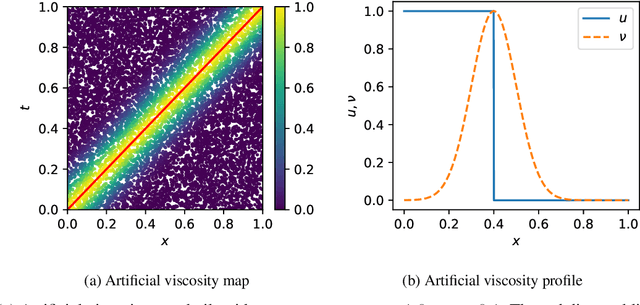
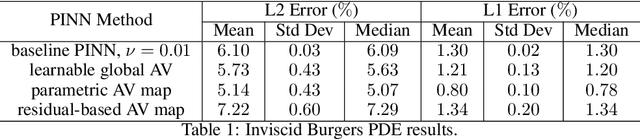
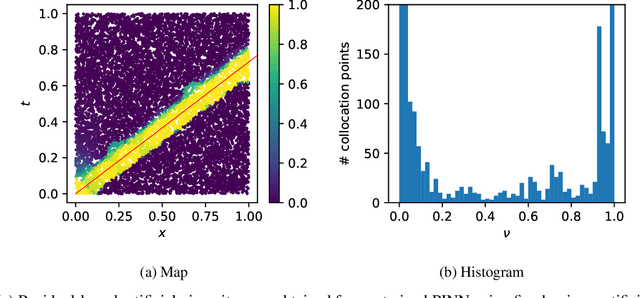
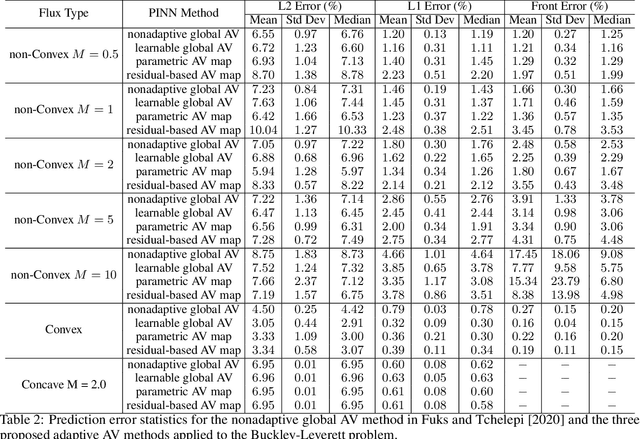
Physics-informed Neural Network (PINN) is a promising tool that has been applied in a variety of physical phenomena described by partial differential equations (PDE). However, it has been observed that PINNs are difficult to train in certain "stiff" problems, which include various nonlinear hyperbolic PDEs that display shocks in their solutions. Recent studies added a diffusion term to the PDE, and an artificial viscosity (AV) value was manually tuned to allow PINNs to solve these problems. In this paper, we propose three approaches to address this problem, none of which rely on an a priori definition of the artificial viscosity value. The first method learns a global AV value, whereas the other two learn localized AV values around the shocks, by means of a parametrized AV map or a residual-based AV map. We applied the proposed methods to the inviscid Burgers equation and the Buckley-Leverett equation, the latter being a classical problem in Petroleum Engineering. The results show that the proposed methods are able to learn both a small AV value and the accurate shock location and improve the approximation error over a nonadaptive global AV alternative method.