 Add to Chrome
 Add to Firefox
 Add to Edge
Computational Paremiology: Charting the temporal, ecological dynamics of proverb use in books, news articles, and tweets
Jul 10, 2021
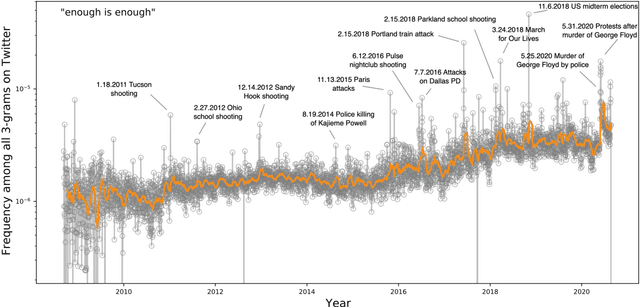
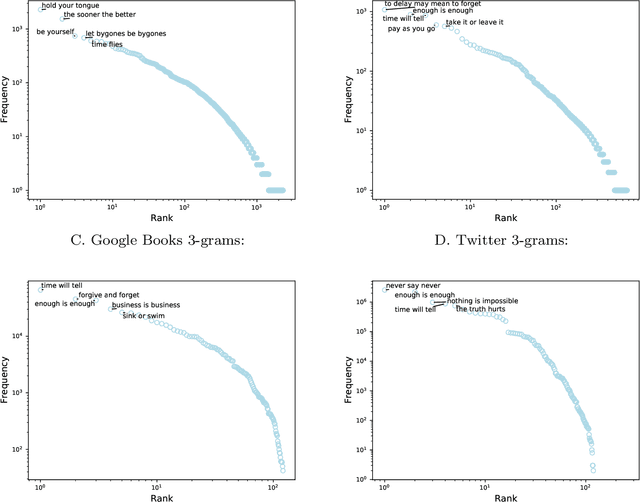
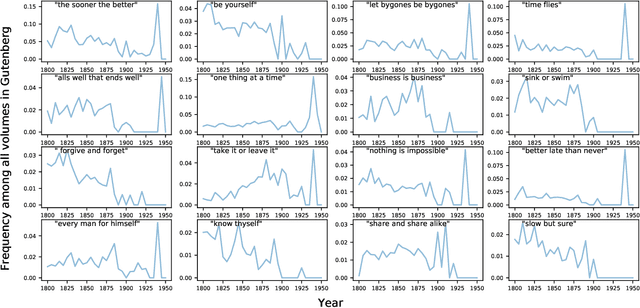
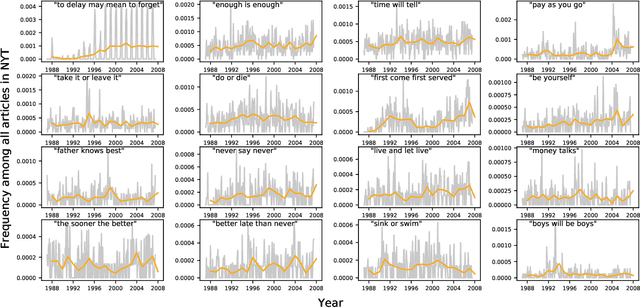
Proverbs are an essential component of language and culture, and though much attention has been paid to their history and currency, there has been comparatively little quantitative work on changes in the frequency with which they are used over time. With wider availability of large corpora reflecting many diverse genres of documents, it is now possible to take a broad and dynamic view of the importance of the proverb. Here, we measure temporal changes in the relevance of proverbs within three corpora, differing in kind, scale, and time frame: Millions of books over centuries; hundreds of millions of news articles over twenty years; and billions of tweets over a decade. We find that proverbs present heavy-tailed frequency-of-usage rank distributions in each venue; exhibit trends reflecting the cultural dynamics of the eras covered; and have evolved into contemporary forms on social media.

Order of Magnitude Comparisons of Distance
May 27, 2011
Order of magnitude reasoning - reasoning by rough comparisons of the sizes of quantities - is often called 'back of the envelope calculation', with the implication that the calculations are quick though approximate. This paper exhibits an interesting class of constraint sets in which order of magnitude reasoning is demonstrably fast. Specifically, we present a polynomial-time algorithm that can solve a set of constraints of the form 'Points a and b are much closer together than points c and d.' We prove that this algorithm can be applied if `much closer together' is interpreted either as referring to an infinite difference in scale or as referring to a finite difference in scale, as long as the difference in scale is greater than the number of variables in the constraint set. We also prove that the first-order theory over such constraints is decidable.