 Add to Chrome
 Add to Firefox
 Add to Edge
BM25-Augmented Many-Shot Translation for Low-Resource North-Eastern Indian Languages
Aug 13, 2026
This paper describes the University of Florida Gators submission to the WMT26 Low-Resource Indic Language Translation shared task. We adapt the retrieval-augmented many-shot translation pipeline from our AmericasNLP 2026 system to translate between English and eleven North-Eastern Indian languages in both directions. At inference time, BM25 retrieves the most similar parallel examples from a language-specific training bank, and Gemini 2.5 Flash translates the input conditioned on these examples. No model fine-tuning is involved. Training banks combine official WMT26 data with publicly available corpora such as Samanantar and prior WMT shared task releases. A grid search over retrieval count r and development exemplar count d across all 22 language-direction pairs selects the best configuration for each submission.

Retrieval-Augmented Long-Context Translation for Cultural Image Captioning: Gators submission for AmericasNLP 2026 shared task
May 20, 2026We present the University of Florida Gators submission to the AmericasNLP 2026 shared task on cultural image captioning for Indigenous languages. Our two-stage pipeline generates a Spanish intermediate caption with Qwen2.5-VL, then produces the target-language caption using retrieval-augmented many-shot prompting with Gemini 2.5 Flash. We achieve 164.1%, 131.7%, and 122.6% improvements over the shared task baseline for Bribri, Guaraní, and Orizaba Nahuatl captioning, respectively, in our dev set evaluation and maintain >150% improvements for the Bribri and Orizaba Nahuatl languages in the test set evaluation. We find retrieval is highly language-dependent, beneficial only for large, in-domain corpora, and that synthetic data augmentation accounts for around 28 chrF++ of the dev set Guaraní performance gain. Our submission is the overall winner of the shared task, placing second out of five finalist submissions in human evaluations of target-language captions.
Transformer-Based Multimodal Knowledge Graph Completion with Link-Aware Contexts
Jan 26, 2025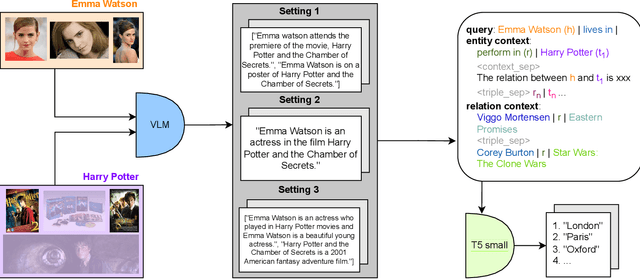
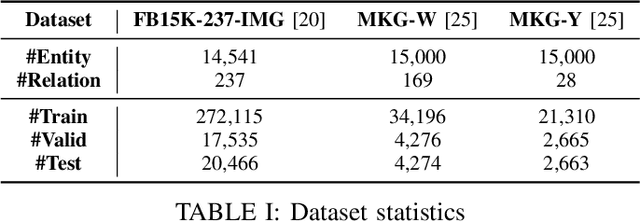
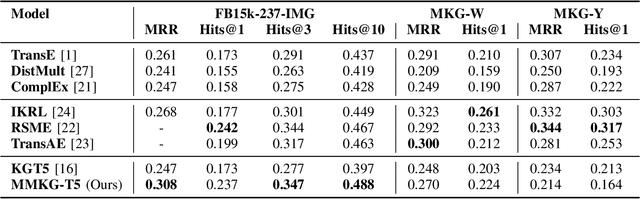

Multimodal knowledge graph completion (MMKGC) aims to predict missing links in multimodal knowledge graphs (MMKGs) by leveraging information from various modalities alongside structural data. Existing MMKGC approaches primarily extend traditional knowledge graph embedding (KGE) models, which often require creating an embedding for every entity. This results in large model sizes and inefficiencies in integrating multimodal information, particularly for real-world graphs. Meanwhile, Transformer-based models have demonstrated competitive performance in knowledge graph completion (KGC). However, their focus on single-modal knowledge limits their capacity to utilize cross-modal information. Recently, Large vision-language models (VLMs) have shown potential in cross-modal tasks but are constrained by the high cost of training. In this work, we propose a novel approach that integrates Transformer-based KGE models with cross-modal context generated by pre-trained VLMs, thereby extending their applicability to MMKGC. Specifically, we employ a pre-trained VLM to transform relevant visual information from entities and their neighbors into textual sequences. We then frame KGC as a sequence-to-sequence task, fine-tuning the model with the generated cross-modal context. This simple yet effective method significantly reduces model size compared to traditional KGE approaches while achieving competitive performance across multiple large-scale datasets with minimal hyperparameter tuning.