 Add to Chrome
 Add to Firefox
 Add to Edge
Seeing Beyond Redundancy: Task Complexity's Role in Vision Token Specialization in VLLMs
Feb 06, 2026
Vision capabilities in vision large language models (VLLMs) have consistently lagged behind their linguistic capabilities. In particular, numerous benchmark studies have demonstrated that VLLMs struggle when fine-grained visual information or spatial reasoning is required. However, we do not yet understand exactly why VLLMs struggle so much with these tasks relative to others. Some works have focused on visual redundancy as an explanation, where high-level visual information is uniformly spread across numerous tokens and specific, fine-grained visual information is discarded. In this work, we investigate this premise in greater detail, seeking to better understand exactly how various types of visual information are processed by the model and what types of visual information are discarded. To do so, we introduce a simple synthetic benchmark dataset that is specifically constructed to probe various visual features, along with a set of metrics for measuring visual redundancy, allowing us to better understand the nuances of their relationship. Then, we explore fine-tuning VLLMs on a number of complex visual tasks to better understand how redundancy and compression change based upon the complexity of the data that a model is trained on. We find that there is a connection between task complexity and visual compression, implying that having a sufficient ratio of high complexity visual data is crucial for altering the way that VLLMs distribute their visual representation and consequently improving their performance on complex visual tasks. We hope that this work will provide valuable insights for training the next generation of VLLMs.

Foundation Models for Remote Sensing: An Analysis of MLLMs for Object Localization
Apr 14, 2025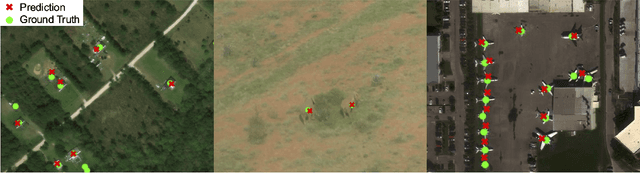
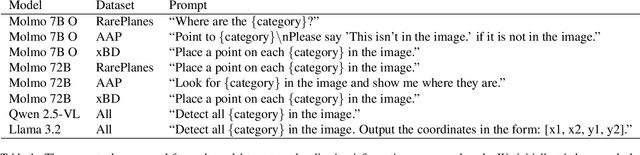
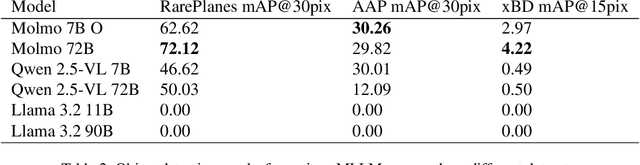
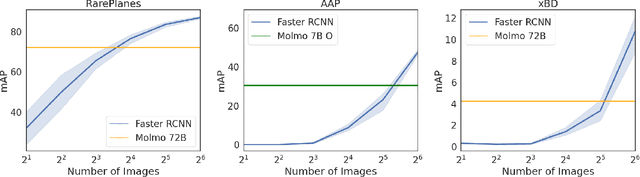
Multimodal large language models (MLLMs) have altered the landscape of computer vision, obtaining impressive results across a wide range of tasks, especially in zero-shot settings. Unfortunately, their strong performance does not always transfer to out-of-distribution domains, such as earth observation (EO) imagery. Prior work has demonstrated that MLLMs excel at some EO tasks, such as image captioning and scene understanding, while failing at tasks that require more fine-grained spatial reasoning, such as object localization. However, MLLMs are advancing rapidly and insights quickly become out-dated. In this work, we analyze more recent MLLMs that have been explicitly trained to include fine-grained spatial reasoning capabilities, benchmarking them on EO object localization tasks. We demonstrate that these models are performant in certain settings, making them well suited for zero-shot scenarios. Additionally, we provide a detailed discussion focused on prompt selection, ground sample distance (GSD) optimization, and analyzing failure cases. We hope that this work will prove valuable as others evaluate whether an MLLM is well suited for a given EO localization task and how to optimize it.