 Add to Chrome
 Add to Firefox
 Add to Edge
Federated Prompt-Tuning with Heterogeneous and Incomplete Multimodal Client Data
Feb 06, 2026
This paper introduces a generalized federated prompt-tuning framework for practical scenarios where local datasets are multi-modal and exhibit different distributional patterns of missing features at the input level. The proposed framework bridges the gap between federated learning and multi-modal prompt-tuning which have traditionally focused on either uni-modal or centralized data. A key challenge in this setting arises from the lack of semantic alignment between prompt instructions that encode similar distributional patterns of missing data across different clients. To address this, our framework introduces specialized client-tuning and server-aggregation designs that simultaneously optimize, align, and aggregate prompt-tuning instructions across clients and data modalities. This allows prompt instructions to complement one another and be combined effectively. Extensive evaluations on diverse multimodal benchmark datasets demonstrate that our work consistently outperforms state-of-the-art (SOTA) baselines.

Learning Reconfigurable Representations for Multimodal Federated Learning with Missing Data
Oct 27, 2025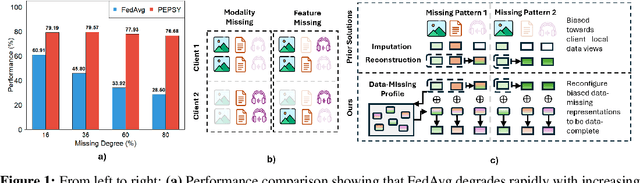
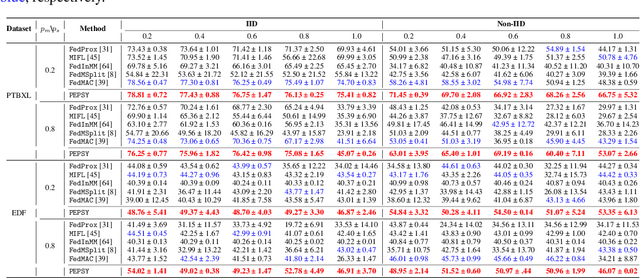
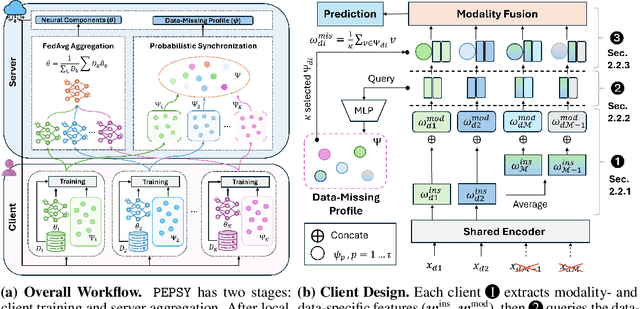
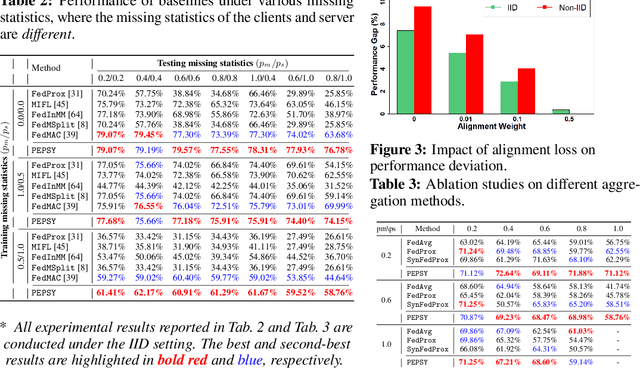
Multimodal federated learning in real-world settings often encounters incomplete and heterogeneous data across clients. This results in misaligned local feature representations that limit the effectiveness of model aggregation. Unlike prior work that assumes either differing modality sets without missing input features or a shared modality set with missing features across clients, we consider a more general and realistic setting where each client observes a different subset of modalities and might also have missing input features within each modality. To address the resulting misalignment in learned representations, we propose a new federated learning framework featuring locally adaptive representations based on learnable client-side embedding controls that encode each client's data-missing patterns. These embeddings serve as reconfiguration signals that align the globally aggregated representation with each client's local context, enabling more effective use of shared information. Furthermore, the embedding controls can be algorithmically aggregated across clients with similar data-missing patterns to enhance the robustness of reconfiguration signals in adapting the global representation. Empirical results on multiple federated multimodal benchmarks with diverse data-missing patterns across clients demonstrate the efficacy of the proposed method, achieving up to 36.45\% performance improvement under severe data incompleteness. The method is also supported by a theoretical analysis with an explicit performance bound that matches our empirical observations. Our source codes are provided at https://github.com/nmduonggg/PEPSY