 Add to Chrome
 Add to Firefox
 Add to Edge
Securing LLMs in the Wild: Privacy and Security Challenges at the Edge
Jul 13, 2026
Large Language Models (LLMs) are rapidly moving from research settings into the wild, deployed on enterprise infrastructure, personal devices, and edge platforms. While cloud deployments offer scalable compute, concerns over data sovereignty, compliance, latency, and third-party dependence are driving organizations toward edge and on-premise LLMs. This shift introduces new security and privacy challenges: limited compute and memory force aggressive optimizations, including quantization, pruning, model partitioning, and parameter-efficient adaptation, each of which can introduce vulnerabilities and reshape the threat landscape. We describe this tension as the Security-Efficiency Paradox, mechanisms that improve efficiency may weaken robustness, expose new attack surfaces, or increase privacy risks. We examine how compression can degrade safety alignment, how partitioned inference enables reconstruction attacks, and how continuous local adaptation may cause privacy leakage and model drift. To analyze these risks, we introduce a deployment-centric taxonomy organized around three architectural constraints: the Memory Wall, the Quadratic Wall, and the Compute Wall. We derive a unified constraint model that quantifies when unsafe optimizations become unavoidable, linking each wall to specific attack surfaces. Building on this model, we propose the Secure Operational Efficiency Score (SOES), a holistic metric balancing task accuracy, jailbreak resistance, and privacy against energy, memory, and latency, enabling practitioners to configure edge LLMs under real-world hardware limits. We further present a practical decision procedure and targeted mitigations for each optimization-induced vulnerability. Together, these contributions provide a co-designed framework for jointly evaluating security, privacy, and efficiency, laying a foundation for securing edge-native intelligent systems.

Building Trust in the Skies: A Knowledge-Grounded LLM-based Framework for Aviation Safety
Apr 10, 2026The integration of Large Language Models (LLMs) into aviation safety decision-making represents a significant technological advancement, yet their standalone application poses critical risks due to inherent limitations such as factual inaccuracies, hallucination, and lack of verifiability. These challenges undermine the reliability required for safety-critical environments where errors can have catastrophic consequences. To address these challenges, this paper proposes a novel, end-to-end framework that synergistically combines LLMs and Knowledge Graphs (KGs) to enhance the trustworthiness of safety analytics. The framework introduces a dual-phase pipeline: it first employs LLMs to automate the construction and dynamic updating of an Aviation Safety Knowledge Graph (ASKG) from multimodal sources. It then leverages this curated KG within a Retrieval-Augmented Generation (RAG) architecture to ground, validate, and explain LLM-generated responses. The implemented system demonstrates improved accuracy and traceability over LLM-only approaches, effectively supporting complex querying and mitigating hallucination. Results confirm the framework's capability to deliver context-aware, verifiable safety insights, addressing the stringent reliability requirements of the aviation industry. Future work will focus on enhancing relationship extraction and integrating hybrid retrieval mechanisms.
Exploiting Meta-Learning-based Poisoning Attacks for Graph Link Prediction
Apr 08, 2025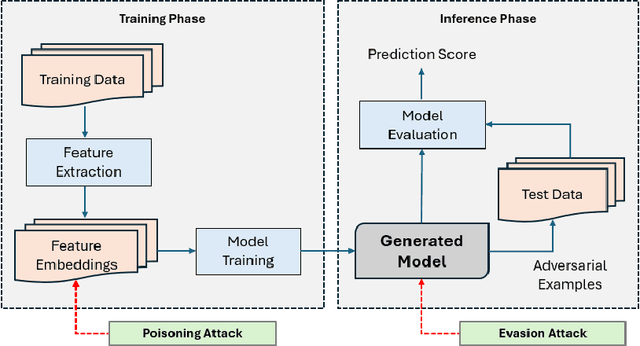

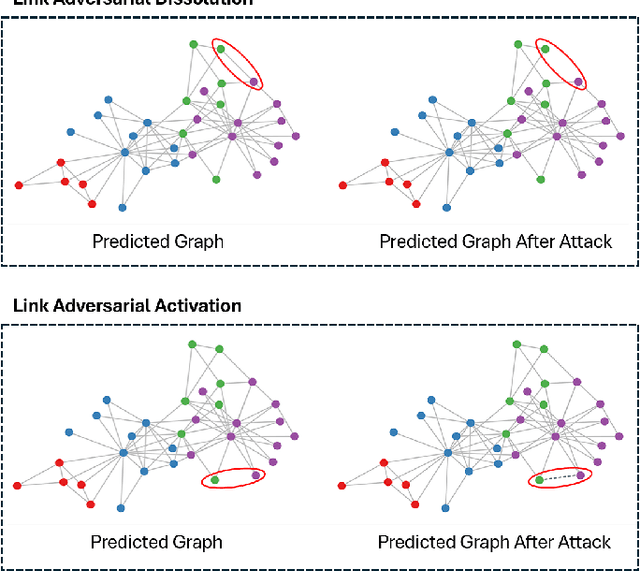
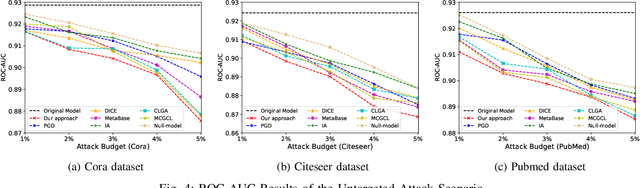
Link prediction in graph data utilizes various algorithms and machine learning/deep learning models to predict potential relationships between graph nodes. This technique has found widespread use in numerous real-world applications, including recommendation systems, community networks, and biological structures. However, recent research has highlighted the vulnerability of link prediction models to adversarial attacks, such as poisoning and evasion attacks. Addressing the vulnerability of these models is crucial to ensure stable and robust performance in link prediction applications. While many works have focused on enhancing the robustness of the Graph Convolution Network (GCN) model, the Variational Graph Auto-Encoder (VGAE), a sophisticated model for link prediction, has not been thoroughly investigated in the context of graph adversarial attacks. To bridge this gap, this article proposes an unweighted graph poisoning attack approach using meta-learning techniques to undermine VGAE's link prediction performance. We conducted comprehensive experiments on diverse datasets to evaluate the proposed method and its parameters, comparing it with existing approaches in similar settings. Our results demonstrate that our approach significantly diminishes link prediction performance and outperforms other state-of-the-art methods.
Cross-Model Transferability of Adversarial Patches in Real-time Segmentation for Autonomous Driving
Feb 22, 2025
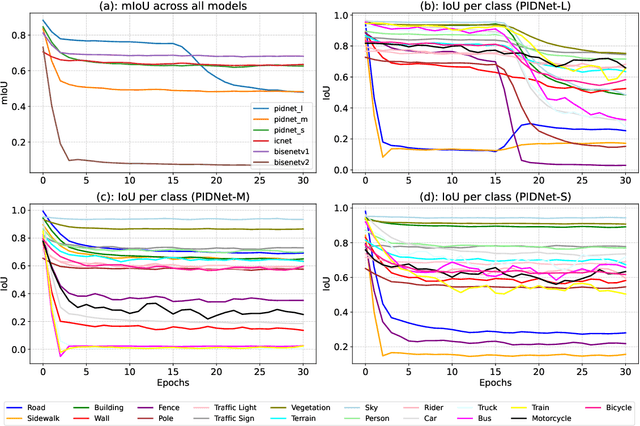

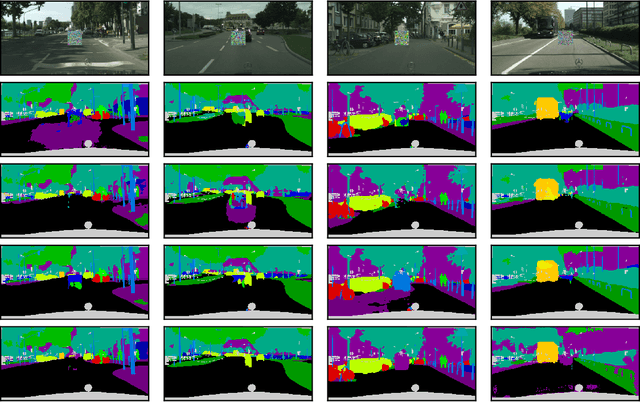
Adversarial attacks pose a significant threat to deep learning models, particularly in safety-critical applications like healthcare and autonomous driving. Recently, patch based attacks have demonstrated effectiveness in real-time inference scenarios owing to their 'drag and drop' nature. Following this idea for Semantic Segmentation (SS), here we propose a novel Expectation Over Transformation (EOT) based adversarial patch attack that is more realistic for autonomous vehicles. To effectively train this attack we also propose a 'simplified' loss function that is easy to analyze and implement. Using this attack as our basis, we investigate whether adversarial patches once optimized on a specific SS model, can fool other models or architectures. We conduct a comprehensive cross-model transferability analysis of adversarial patches trained on SOTA Convolutional Neural Network (CNN) models such PIDNet-S, PIDNet-M and PIDNet-L, among others. Additionally, we also include the Segformer model to study transferability to Vision Transformers (ViTs). All of our analysis is conducted on the widely used Cityscapes dataset. Our study reveals key insights into how model architectures (CNN vs CNN or CNN vs. Transformer-based) influence attack susceptibility. In particular, we conclude that although the transferability (effectiveness) of attacks on unseen images of any dimension is really high, the attacks trained against one particular model are minimally effective on other models. And this was found to be true for both ViT and CNN based models. Additionally our results also indicate that for CNN-based models, the repercussions of patch attacks are local, unlike ViTs. Per-class analysis reveals that simple-classes like 'sky' suffer less misclassification than others. The code for the project is available at: https://github.com/p-shekhar/adversarial-patch-transferability