 Add to Chrome
 Add to Firefox
 Add to Edge
Calibrated Tree-Neural Fusion for Fine-Grained Vegetation Community Classification
Jul 27, 2026
Accurate vegetation-community classification is essential for ecological monitoring, habitat assessment, and evidence-based environmental management in heterogeneous landscapes. Existing studies often rely on standalone tree ensembles or generic neural networks, although fine-grained ecological classes frequently exhibit overlapping spectral, topographic, and structural characteristics. Many frameworks also provide limited protection against stacking leakage, insufficient probability calibration, weak minority-class evaluation, and little evidence of stability across repeated data splits. To address these limitations, this study proposes Calibrated EcoTreeFuseNet-Plus, a tree-neural probability-fusion framework that combines out-of-fold tree probabilities, EcoFuseNet-V2 outputs, validation-selected meta-learning, and post-hoc temperature scaling. Raster values from six LiDAR-derived terrain and canopy variables and two hyperspectral vegetation indices were extracted at coordinate-based reference locations. Quality control removed 26 samples with missing elevation and one sample with non-finite NDWI, producing 1,833 complete records across 29 vegetation and non-vegetation classes. On the held-out test set, the proposed model achieved an accuracy of 0.8000, a macro F1-score of 0.7768, a balanced accuracy of 0.7903, and an MCC of 0.7903. Calibration reduced the expected calibration error from 0.3866 to 0.0651 without changing class predictions. Five-seed evaluation yielded a macro F1-score of 0.7717 +/- 0.0112, indicating stable performance across repeated splits. The results demonstrate a reliable discrimination-calibration trade-off for small-sample, fine-grained ecological classification.

A Sparse-Attention Deep Learning Model Integrating Heterogeneous Multimodal Features for Parkinson's Disease Severity Profiling
Jan 02, 2026Characterising the heterogeneous presentation of Parkinson's disease (PD) requires integrating biological and clinical markers within a unified predictive framework. While multimodal data provide complementary information, many existing computational models struggle with interpretability, class imbalance, or effective fusion of high-dimensional imaging and tabular clinical features. To address these limitations, we propose the Class-Weighted Sparse-Attention Fusion Network (SAFN), an interpretable deep learning framework for robust multimodal profiling. SAFN integrates MRI cortical thickness, MRI volumetric measures, clinical assessments, and demographic variables using modality-specific encoders and a symmetric cross-attention mechanism that captures nonlinear interactions between imaging and clinical representations. A sparsity-constrained attention-gating fusion layer dynamically prioritises informative modalities, while a class-balanced focal loss (beta = 0.999, gamma = 1.5) mitigates dataset imbalance without synthetic oversampling. Evaluated on 703 participants (570 PD, 133 healthy controls) from the Parkinson's Progression Markers Initiative using subject-wise five-fold cross-validation, SAFN achieves an accuracy of 0.98 plus or minus 0.02 and a PR-AUC of 1.00 plus or minus 0.00, outperforming established machine learning and deep learning baselines. Interpretability analysis shows a clinically coherent decision process, with approximately 60 percent of predictive weight assigned to clinical assessments, consistent with Movement Disorder Society diagnostic principles. SAFN provides a reproducible and transparent multimodal modelling paradigm for computational profiling of neurodegenerative disease.
ReflectGAN: Modeling Vegetation Effects for Soil Carbon Estimation from Satellite Imagery
May 24, 2025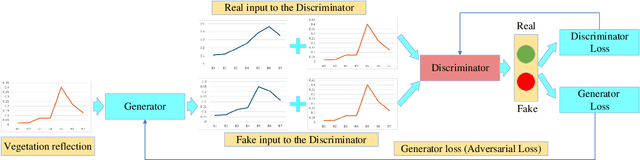


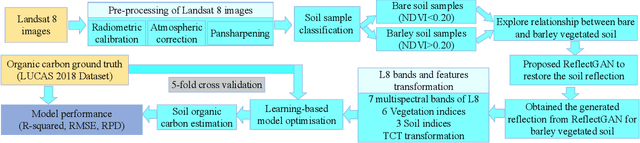
Soil organic carbon (SOC) is a critical indicator of soil health, but its accurate estimation from satellite imagery is hindered in vegetated regions due to spectral contamination from plant cover, which obscures soil reflectance and reduces model reliability. This study proposes the Reflectance Transformation Generative Adversarial Network (ReflectGAN), a novel paired GAN-based framework designed to reconstruct accurate bare soil reflectance from vegetated soil satellite observations. By learning the spectral transformation between vegetated and bare soil reflectance, ReflectGAN facilitates more precise SOC estimation under mixed land cover conditions. Using the LUCAS 2018 dataset and corresponding Landsat 8 imagery, we trained multiple learning-based models on both original and ReflectGAN-reconstructed reflectance inputs. Models trained on ReflectGAN outputs consistently outperformed those using existing vegetation correction methods. For example, the best-performing model (RF) achieved an $R^2$ of 0.54, RMSE of 3.95, and RPD of 2.07 when applied to the ReflectGAN-generated signals, representing a 35\% increase in $R^2$, a 43\% reduction in RMSE, and a 43\% improvement in RPD compared to the best existing method (PMM-SU). The performance of the models with ReflectGAN is also better compared to their counterparts when applied to another dataset, i.e., Sentinel-2 imagery. These findings demonstrate the potential of ReflectGAN to improve SOC estimation accuracy in vegetated landscapes, supporting more reliable soil monitoring.